Ming Dynasty Court Fashion: Evolution and Commissioning Guide
The Zenith of Imperial Silk: Ming Dynasty Court Fashion
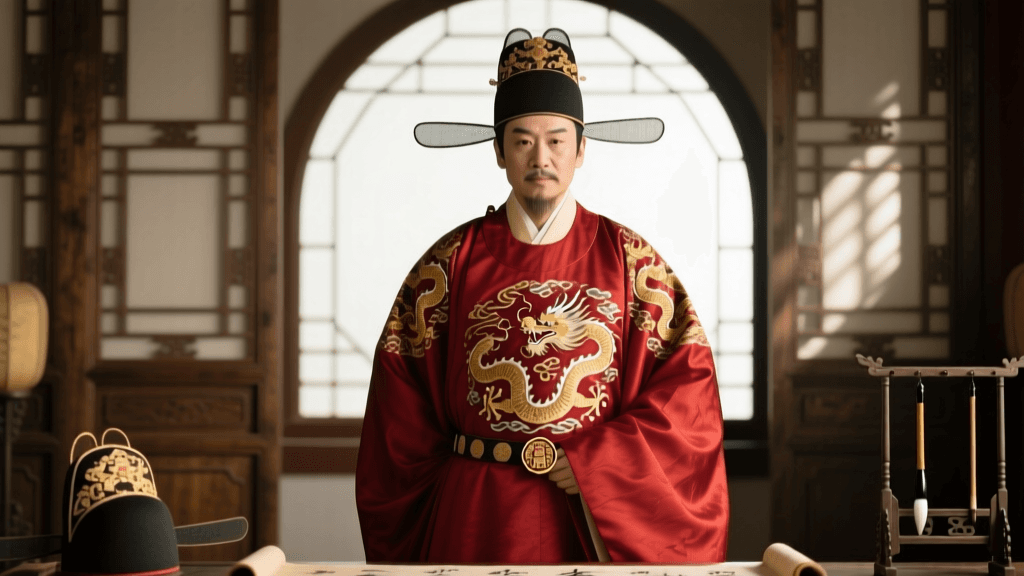
When the Hongwu Emperor (Zhu Yuanzhang) established the Ming Dynasty in 1368, one of his primary cultural mandates was the eradication of Mongol Yuan influences and the restoration of traditional Han Chinese sartorial codes. This decree birthed a golden age of court fashion, characterized by rigid sumptuary laws, unprecedented advancements in silk weaving, and a highly codified system of imperial and official dress. Ming court fashion was not merely about aesthetics; it was a visual language of cosmic order, political hierarchy, and moral authority.
The imperial wardrobe was meticulously regulated. The Emperor alone was permitted to wear the iconic Longpao (Dragon Robe) featuring five-clawed dragons, while the Crown Prince and high-ranking royals were restricted to four-clawed Mang (python) motifs. Beyond the imperial family, the Ming court introduced a sophisticated system of civil and military ranking that relied heavily on specific garment structures, most notably the round-collared robe (Yese) and the Taoist-inspired robe (Daopao), which became staples of the scholar-official class.
Evolution of the Buzi (Rank Badges) and Imperial Motifs
While the concept of rank badges originated in the preceding Yuan Dynasty, it was the Ming court that perfected and strictly codified the Buzi. These intricately embroidered or woven squares were affixed to the front and back of an official's surcoat (Bufu). The Ming sumptuary laws dictated that civil officials wear bird motifs to symbolize literary elegance and administrative grace, while military officials wore beast motifs to represent martial prowess and courage. The evolution of these badges from the early Ming (which often featured two birds facing each other) to the late Ming (featuring a single, prominent bird against a backdrop of clouds and waves) reflects a shift toward more centralized and individualistic iconography in court art.
| Rank | Civil Official (Bird Motif) | Military Official (Beast Motif) |
|---|---|---|
| 1st Rank | Crane (Xianhe) | Lion (Shi) |
| 2nd Rank | Golden Pheasant (Jinji) | Lion (Shi) |
| 3rd Rank | Peacock (Kongque) | Leopard (Bao) |
| 4th Rank | Wild Goose (Yunyan) | Tiger (Hu) |
| 5th Rank | Silver Pheasant (Baiyin) | Bear (Xiong) |
| 6th to 9th Rank | Egret, Oriole, Quail, etc. | Panther, Rhinoceros, Sea Horse |
Textile Mastery: Kesi, Zhuanghua, and Cloud Brocade
The visual splendor of Ming court fashion was made possible by the imperial weaving bureaus located in Jiangnan, particularly in Suzhou, Hangzhou, and Nanjing. According to the Metropolitan Museum of Art's Heilbrunn Timeline of Art History, the Ming period saw the zenith of Kesi (cut silk tapestry) and Zhuanghua (woven gold and silver thread brocade). Kesi was incredibly labor-intensive, requiring weavers to slit the silk threads to create sharp, unblended color boundaries, making it the premier medium for imperial dragon robes. Meanwhile, Nanjing's Yunjin (Cloud Brocade) utilized peacock feather filaments and flattened gold threads to create garments that literally shimmered like celestial clouds. These textiles were so valuable that they were often used as diplomatic gifts and state currency.
Practical Guide: Commissioning a Ming Court Robe Today
For modern Hanfu enthusiasts, historical reenactors, and textile collectors, commissioning a historically accurate Ming Dynasty court robe requires a deep understanding of traditional tailoring geometry, fabric behavior, and historical proportions. Unlike modern Western tailoring, which relies on darts and curved seams to fit the body's contours, traditional Chinese tailoring is flat-patterned, relying on the drape of the fabric and the wearer's posture to create the garment's silhouette.
Essential Measurements and Proportions
When commissioning a Daopao (a pleated scholar's robe) or a Yese (round-collared robe with side slits), you must provide your tailor with specific traditional measurements rather than modern suit measurements:
- Tongxiu (Continuous Sleeve Length): Ming court sleeves were designed to extend past the fingertips. Measure from the center back of the neck, over the shoulder, down to the wrist, and add 15-20 cm (6-8 inches) to allow the sleeves to drape elegantly over the hands when resting.
- Sleeve Width (Xiu Kou): For formal court garments, the cuff width should be exceptionally wide, typically ranging from 60 cm to 80 cm (24-32 inches) to create the iconic "pipa" sleeve shape that tapers at the wrist but billows at the elbow.
- Hem Circumference: A proper Daopao features deep side pleats (Ma Mian). The total hem circumference should be between 220 cm and 260 cm to ensure the pleats remain closed while standing but fan out gracefully when walking or sitting.
- Collar Drop: The round collar of a Yese must sit flush against the base of the neck without gaping. Provide your exact neck circumference plus 2 cm for the inner lining allowance.
Fabric Selection, Costs, and Timing
The cost and timeline of your commission will depend entirely on the textile you select. Here is a practical breakdown for modern buyers:
- Machine-Jacquard Silk (Entry-Level): Costing between $150 and $350 USD, modern jacquard looms can replicate Ming cloud-and-dragon patterns beautifully. This is ideal for everyday Hanfu wearers. Timeline: 3 to 5 weeks.
- Hand-Loomed Yunjin / Zhuanghua (Collector Grade): Authentic Nanjing Cloud Brocade woven on traditional wooden draw-looms with metallic threads costs between $800 and $2,500 USD. This requires sourcing specialized weaving workshops in Nanjing. Timeline: 2 to 4 months.
- Authentic Kesi Tapestry (Museum Grade): A fully hand-woven Kesi robe is a masterwork that can cost upwards of $5,000 to $15,000 USD. Due to the extreme scarcity of master Kesi weavers, Timelines often exceed 6 to 12 months.
Sourcing Reputable Tailors and Authentic Replicas
When sourcing a tailor, look for ateliers that specialize in "Ming-style structural tailoring" (Mingzhi Jiegou). Many commercial Hanfu brands cut corners by using modern set-in sleeves and curved armholes. A true Ming garment utilizes a flat, cross-shaped cutting method where the front, back, and sleeves are cut from continuous lengths of fabric, preserving the integrity of the woven motifs—especially crucial for Buzi rank badges and central dragon medallions. As noted by the curators at the Smithsonian National Museum of Asian Art, the structural integrity of historical Asian garments is inextricably linked to their cultural and spiritual significance; altering the cut alters the meaning.
For buyers outside of China, platforms like Taobao and specialized international Hanfu proxies (such as Newhanfu or Hanfu Global) offer access to premium Ming-reproduction brands like Shisanyu and Zhongzheng Hanfu. When ordering, always request "flat-laid pattern photos" from the seller before they cut the fabric to verify that the sleeve seams fall on the natural shoulder drop rather than featuring a modern, Western-style shoulder seam. Furthermore, ensure that the inner lining is made of breathable, high-grade habotai or mulberry silk, as synthetic linings will ruin the drape and historical authenticity of the heavy brocade exterior.
"The Ming Dynasty's approach to dress was a masterclass in semiotics. Every thread, color, and pleat was calculated to project the stability and divine mandate of the empire. To wear a Ming robe today is to drape oneself in a meticulously engineered architectural marvel of silk."
— Adapted from the Victoria and Albert Museum's archives on Asian textile history and court dress.
Ultimately, investing in a historically accurate Ming court robe is an investment in living history. By understanding the evolution of the Buzi, respecting the flat-pattern tailoring geometry, and choosing the right textile, modern enthusiasts can faithfully resurrect the majestic splendor of China's most iconic imperial wardrobe.