Evolution of the Dragon Robe: Tang to Qing Court Fashion
The Imperial Thread: Decoding Chinese Court Fashion
Court fashion in imperial China was never merely about aesthetics; it was a rigid, highly codified visual language that communicated rank, cosmic harmony, and the imperial mandate. The evolution of the dragon robe, or longpao, serves as the ultimate masterclass in this sartorial diplomacy. For modern collectors, historical reenactors, and textile enthusiasts, understanding the dynastic shifts in Chinese court dress is essential. This guide explores the transformation of imperial garments from the cosmopolitan Tang dynasty to the highly structured Qing era, providing actionable advice on sourcing, commissioning, and preserving these magnificent textiles. According to the Metropolitan Museum of Art, Chinese silk production and court weaving techniques reached unparalleled levels of sophistication, serving as the foundation for these garments and influencing global textile history.
Dynasty Evolution: From Tang Elegance to Qing Structure
Tang and Song: The Genesis of Imperial Motifs
The foundations of Chinese court dress were solidified during the Tang (618–907) and Song (960–1279) dynasties. Tang court fashion was characterized by its cosmopolitan flair, heavily influenced by Silk Road trade and cultural exchange. The round-collar robe, known as the yuanlingpao, became a staple for officials and royalty alike. While the dragon motif was present, it was not yet exclusively restricted to the emperor; high-ranking officials and nobility frequently wore garments adorned with serpentine and draconic creatures. The Song dynasty introduced a more restrained, intellectual aesthetic. Court robes became narrower and less flamboyant, reflecting the neo-Confucian values of the era. However, the weaving techniques, particularly silk brocades and early tapestry weaves (kesi), laid the technical groundwork for the elaborate imperial robes that would follow.
Ming Dynasty: The Classic Yuanlingpao
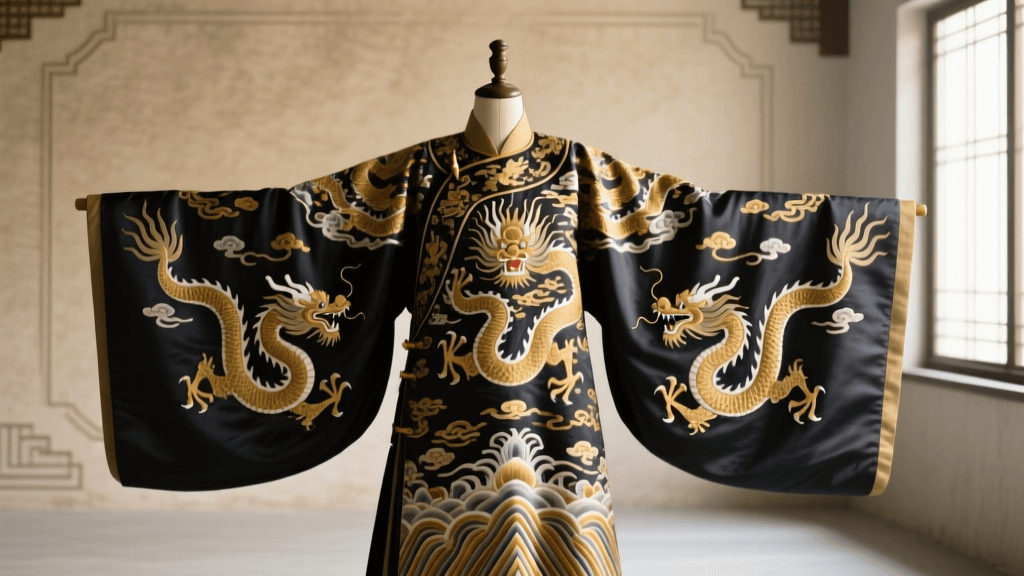
The Ming Dynasty (1368–1644) represents the zenith of traditional Han Chinese court fashion. Following the expulsion of the Mongol Yuan dynasty, the Ming emperors sought to restore ancient Han sartorial codes. The Ming yuanlingpao evolved into a grand, sweeping garment with a flared hem, side slits, and wide, flowing sleeves. It was during this period that the five-clawed dragon (long) was strictly codified as the exclusive emblem of the Emperor, while princes and high officials were relegated to four-clawed dragons or mang (a python-like dragon). The Royal Ontario Museum houses exceptional examples of Ming-era textiles that showcase the vibrant use of gold thread and rich, saturated dyes. Ming dragon robes were typically constructed from continuous lengths of silk jacquard or Zhuanghua brocade, woven on specialized drawlooms to ensure the dragon motifs aligned perfectly at the structural seams.
Qing Dynasty: Manchu Influence and the Jifu
The Qing Dynasty (1636–1912), established by the Manchu people, introduced a dramatic paradigm shift in court fashion. The Manchu rulers mandated the Tifayifu policy, requiring Han Chinese men to adopt the Manchu queue hairstyle and clothing. Consequently, the traditional wide-sleeved Han robes were replaced by the jifu (festive robe) and chaofu (formal court robe). These garments featured a more fitted bodice, a flared skirt with a front and back slit for equestrian mobility, and the distinctive horse-hoof cuffs (matixiu). The Qing emperors also formalized the Twelve Symbols of Sovereignty, ancient motifs that were strategically embroidered onto the emperor's robes to symbolize his universal rule. The Victoria and Albert Museum notes that Qing court textiles required immense labor, with imperial workshops in Jiangnan employing thousands of weavers and embroiderers to meet the court's insatiable demand for silk and gold-wrapped thread.
Comparative Analysis: Ming vs. Qing Dragon Robes
Understanding the structural and symbolic differences between the two most prominent late-imperial dynasties is vital for accurate historical reenactment and textile appraisal.
| Feature | Ming Dynasty (Yuanlingpao) | Qing Dynasty (Jifu / Chaofu) |
|---|---|---|
| Silhouette | Loose, flowing, wide A-line drape | Fitted bodice, flared skirt, riding slits |
| Sleeves & Cuffs | Extremely wide, floor-grazing sleeves | Narrower sleeves with horse-hoof cuffs (matixiu) |
| Collar Style | Round collar (often with white protector) | Mandarin collar with detachable cape/collar |
| Primary Motif | Large frontal and rear dragons, cloud bands | Nine dragons, 12 Symbols of Sovereignty, lishui waves |
The Twelve Symbols of Sovereignty
The Twelve Symbols of Sovereignty are a crucial element of high Qing court fashion. These ancient motifs, originating from the legendary Emperor Shun, were mandated by the Qianlong Emperor in 1759 to be exclusively worn by the sovereign. They include the sun, moon, and stars (representing the heavens), the mountain (representing the earth), the dragon and pheasant (representing the emperor's adaptability and literary refinement), the temple cups (representing filial piety), aquatic grass (purity), flames (brilliance), grain (prosperity), the axe (courage), and the fu symbol (moral discernment). When commissioning a high-end replica, ensuring the accurate placement and proportion of these twelve symbols is a hallmark of master-level craftsmanship and separates a true museum-quality replica from a theatrical costume.
Practical Guide for Collectors and Reenactors
Sourcing and Commissioning: Costs and Timelines
For those looking to acquire a dragon robe, the market is divided into antique sourcing and modern commissioning. Authentic antique Qing jifu robes in good condition typically start at $8,000 and can exceed $50,000 at auction, depending on the presence of the five-clawed dragon and the condition of the gold couching. For reenactors and collectors seeking wearable pieces, commissioning a modern replica from specialized ateliers in Suzhou or Hangzhou is the most viable route.
- Machine-Embroidered Replicas: Cost between $450 and $800. These utilize modern silk-blend jacquards and computerized embroidery. Timeline: 3 to 4 weeks. Ideal for theater and casual reenactment.
- Hand-Embroidered Silk Brocade: Cost between $1,500 and $3,500. Woven on traditional jacquard looms with hand-embroidered accents using Suzhou embroidery techniques. Timeline: 2 to 3 months.
- Museum-Quality Kesi (Tapestry) or Gold Couching: Cost between $5,000 and $15,000+. Fully hand-woven and embroidered using peacock feather thread and real gold leaf strips. Timeline: 6 to 12 months. These are investment-grade pieces.
Fabric Specifications and Measurements
When commissioning a historically accurate Ming yuanlingpao or Qing jifu, understanding traditional fabric widths is critical. Modern silk brocades are typically woven on industrial looms with a width of 140 cm (55 inches). However, traditional drawloom fabrics were woven at approximately 70 cm (27.5 inches) wide. To achieve historical accuracy, a skilled tailor will cut and seam the 140 cm fabric to mimic the structural drape and seam placements of the narrower traditional textiles.
Furthermore, sleeve measurements in Han Chinese court dress are not based on the arm's length, but on the full arm span. A standard Ming court robe requires an arm span measurement of at least 200 cm to 220 cm to create the iconic sweeping, floor-grazing sleeves. For the Qing jifu, the sleeves are shorter and more fitted, ending in the matixiu (horse-hoof cuff), which requires a precise measurement from the shoulder to the knuckles, plus an additional 10 cm for the curved cuff extension. Always provide your tailor with your shoulder-to-shoulder width, full arm span, and neck circumference to ensure the rigid Mandarin collars of the Qing era fit comfortably without chafing.
Preservation and Archival Storage
Whether you own a fragile 19th-century antique or a newly commissioned silk brocade, proper preservation is non-negotiable. Silk is a protein fiber highly susceptible to UV degradation, humidity fluctuations, and acid damage. Never store a dragon robe on a wire or wooden hanger, as the weight of the heavy embroidery will distort the shoulder seams and cause irreversible tearing.
Instead, store the garment flat in an archival-quality, acid-free textile box. Pad the folds with unbuffered, acid-free tissue paper to prevent hard creases, which can eventually snap the silk threads. Maintain a stable environment with a relative humidity of 50% (±5%) and a temperature of around 65°F (18°C). If displaying the robe, use a custom-padded mannequin that supports the full weight of the sleeves and hem, and ensure the display case filters out 99% of UV light to preserve the vibrant indigo, cinnabar, and malachite dyes characteristic of imperial court fashion.