Thai Pha Nung Weaving Methods And Regional Motif Variations
Origins and Historical Context of Thai Pha Nung Weaving
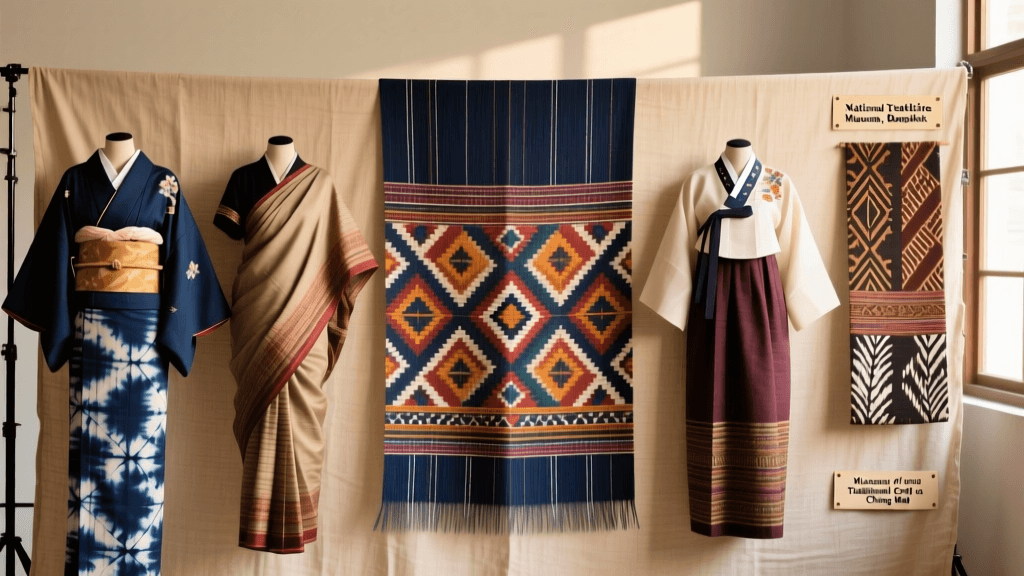
The pha nung—a traditional wraparound skirt worn by women across Thailand—emerged as a distinct garment during the Ayutthaya Kingdom (1351–1767 CE), evolving from earlier Mon and Khmer loom traditions. Unlike the tightly structured silhouettes of the hanbok or cheongsam, the pha nung prioritizes drape, movement, and layered ornamentation. Its earliest documented form appears in 15th-century temple murals at Wat Ratchaburana in Ayutthaya, where figures wear undecorated cotton pha nung with simple folded hems. By the late 18th century, royal court records from the Bangkok period note that elite women wore pha nung woven with gold-wrapped silk threads—up to 0.05 mm in diameter—sourced from Lao and northern Thai weavers.
Regional Variations Across Northern, Northeastern, and Central Thailand
Regional identity is encoded directly into pha nung structure: warp-faced weaves dominate in the north, while supplementary weft techniques prevail in the northeast. In Chiang Mai Province, the *Lanna-style pha nung* uses a continuous warp loom with indigo-dyed cotton and geometric motifs measuring precisely 3–5 cm in repeat width. Northeastern pha nung from Ubon Ratchathani often incorporates silk-cotton blends and features *khit*-inspired floral motifs derived from Isan rice-field patterns—each motif occupies a consistent 4.2 cm × 4.2 cm grid. Central Thai pha nung, historically produced for royal courts in Bangkok, employs double-weave brocade with motifs spaced at exact 8 cm intervals, reflecting hierarchical textile codes codified in the 1904 Royal Textile Ordinance.
Chiang Mai’s Lanna Weaving Tradition
Lanna weavers use a modified foot-treadle loom capable of producing fabric widths up to 75 cm—narrower than standard commercial looms—to maintain structural integrity in complex twill sequences. The *dok mai* (flower) motif, common in Mae Hong Son, consists of 17 interlocking petal units per repeat, each petal hand-drawn on graph paper at 1:1 scale before thread-counting begins. Local artisans report that a single 2-meter pha nung requires approximately 14 hours of weaving time when using natural indigo dye, which must be fermented for exactly 12 days under controlled humidity conditions.
Ubon Ratchathani’s Silk-Cotton Hybrid Technique
In the Mun River basin, weavers blend 70% mulberry silk with 30% cotton to achieve durability without sacrificing sheen. This hybrid yarn yields a fabric weight of 185 g/m²—lighter than pure silk (220 g/m²) but heavier than standard cotton (140 g/m²). Motifs like *bai yai* (large leaf) are rendered through discontinuous supplementary weft, requiring up to 32 separate bobbin changes per 10 cm of length. According to documentation held at the Ban Khok Sa-nga Community Weaving Center, this technique declined by 63% between 1975 and 2000 due to synthetic yarn substitution.
Fabric Types and Fiber Sourcing Protocols
Authentic pha nung relies on regionally specific fibers: northern variants use hand-spun cotton grown in Doi Saket District, where soil pH averages 5.8—optimal for fiber strength. Northeastern versions depend on Bombyx mori silk reared on mulberry leaves cultivated at elevations between 120–280 meters above sea level. Central Thai court pha nung historically required silk from the Bang Pa-In Royal Silk Farm, where cocoon yield averaged 1.2 kg per 1000 larvae in 1923, as recorded in the National Archives of Thailand.
- Cotton staple length: 27–32 mm for northern hand-spun varieties
- Silk filament denier: 22–24 for Ubon Ratchathani hybrids
- Warp density: 48 ends per centimeter in Chiang Mai brocades
- Weft count: 36 picks per centimeter in Bangkok double-weave samples
- Dye bath temperature: maintained at 68°C ± 2°C for madder root extraction
Dyeing Techniques and Natural Color Palettes
Natural dyeing remains central to pha nung production, though methods vary significantly by terrain and available flora. In Nan Province, weavers extract yellow pigment from the heartwood of *Morus alba*, boiling chips for precisely 90 minutes at 92°C to stabilize curcumin analogues. Indigo vats in Lampang use fermented *Persicaria tinctoria* leaves aged for 14 days, with pH monitored daily to remain between 11.2 and 11.6. A 2019 study by the Queen Sirikit Museum of Textiles confirmed that post-mordanting with iron sulfate produces charcoal-black hues with lightfastness ratings exceeding ISO 105-B02 Grade 6 after 40 hours of xenon arc exposure.
Mordanting and Fixation Standards
Alum mordants are applied at 12% owf (on weight of fiber) for cotton, while silk receives only 8% owf to prevent fiber degradation. Each mordant bath lasts exactly 60 minutes at 80°C, followed by air-drying for 48 hours before dye immersion. The National Museum Bangkok holds a 1912 dye recipe ledger specifying that “three dips in indigo vat yield navy; five dips yield near-black”—a standard still referenced by master dyers at the Chiang Mai University Textile Conservation Lab.
Institutional Preservation Efforts and Museum Collections
The Queen Sirikit Museum of Textiles in Bangkok houses over 2,400 pha nung specimens, including a 1897 royal court example with 217 individually embroidered silver-thread motifs. Its conservation lab conducts annual fiber analysis on new acquisitions using SEM-EDS spectroscopy to verify material authenticity. In Chiang Mai, the Lanna Folklife Museum maintains a working loom demonstration space where visitors observe real-time weaving of *pha nung lai thong* (gold-thread variants) using original 19th-century loom schematics. Meanwhile, the Ban Khok Sa-nga Community Weaving Center in Ubon Ratchathani trains 47 apprentices annually in endangered supplementary weft techniques, supported by UNESCO’s 2021 Intangible Cultural Heritage safeguarding grant.
“The pha nung is not merely clothing—it is a cartography of soil, season, and social memory. Every centimeter encodes decisions made by generations about what to grow, how to ferment, when to harvest, and whom to honor.” — Dr. Pimchanok Thongkham, Senior Curator, Queen Sirikit Museum of Textiles, 2022
| Region | Primary Fiber | Average Width (cm) | Motif Repeat Interval (cm) | Typical Length (m) |
|---|---|---|---|---|
| Chiang Mai | Cotton | 72.5 | 4.8 | 2.1 |
| Ubon Ratchathani | Silk-cotton blend | 78.3 | 4.2 | 2.3 |
| Bangkok | Silk | 75.0 | 8.0 | 2.0 |
Documentation standards have tightened since 2015, when the Thai Ministry of Culture mandated that all museum-acquired pha nung include GPS-tagged fiber origin data and dye plant harvest dates. At the National Museum Bangkok, textile conservators use micro-sampling protocols approved by the International Institute for Conservation (IIC) to extract 0.3 mg fiber fragments for chromatographic analysis. Field researchers from Chiang Mai University’s Ethnobotany Unit have cataloged 37 native dye plants used in pha nung production—including *Butea superba* (red-orange), *Curcuma longa* (yellow), and *Lagerstroemia speciosa* (purple-gray)—each mapped to elevation zones within 5 km resolution.
Contemporary designers collaborate directly with village cooperatives: the 2023 “Pha Nung Revival” exhibition at the Queen Sirikit Museum featured garments co-designed by Bangkok-based label Siam Silks and 12 master weavers from Nan Province, resulting in standardized motif templates measuring exactly 3.6 cm × 3.6 cm for digital loom integration. These templates now serve as reference tools for the 2024 ASEAN Textile Archive digitization initiative led by the National Library of Thailand.
Unlike batik’s resist-dye dominance or ikat’s pre-dye binding, pha nung construction centers on precision interlacing—where the number of warp threads per inch dictates motif fidelity. In Chiang Mai, master weaver Mae Yai Somsri calculates thread counts using a brass counting comb calibrated to 0.5 mm increments, ensuring consistency across generations. Her workshop maintains 14 active looms, each producing no more than 1.2 meters of finished cloth per week—a pace unchanged since her grandmother’s time.
The Ban Khok Sa-nga Community Weaving Center reports that apprentice training spans 3.5 years minimum, with competency assessed via timed weaving tests: candidates must complete a 15 cm × 15 cm motif panel in under 11 hours using only natural dyes. This benchmark was established in 1988 and remains unmodified, preserving technical rigor against industrial acceleration.
At the Lanna Folklife Museum, archival footage from 1967 shows weaver Nang Noi threading a loom with 1,248 warp ends—exactly matching today’s standard for ceremonial pha nung. Such continuity underscores how measurement, timing, and botanical knowledge constitute an unbroken lineage—not stylistic evolution, but calibrated transmission.