Miao Silver Ornaments and Pleated Skirts: A Cultural Guide
The Wearable History of the Miao People
The Miao people, widely recognized in the West as the Hmong, represent one of China's most culturally vibrant and historically resilient ethnic minorities. Primarily concentrated in the mountainous provinces of Guizhou, Hunan, and Yunnan, the Miao have cultivated a breathtaking sartorial tradition that serves as far more than mere adornment. Historically lacking a widely used written language, the Miao encoded their myths, migration routes, and ancestral memories into the very fabric of their clothing and the metallurgy of their jewelry. In the study of Asian traditions, Miao garments are frequently referred to by anthropologists as 'wearable history books.' For textile collectors, fashion historians, and cultural enthusiasts, understanding the nuances of Miao attire requires a deep dive into their masterful silver forging, botanical dyeing, and intricate embroidery techniques.
Miao Silver Ornaments (Yinshi): Craftsmanship and Weight
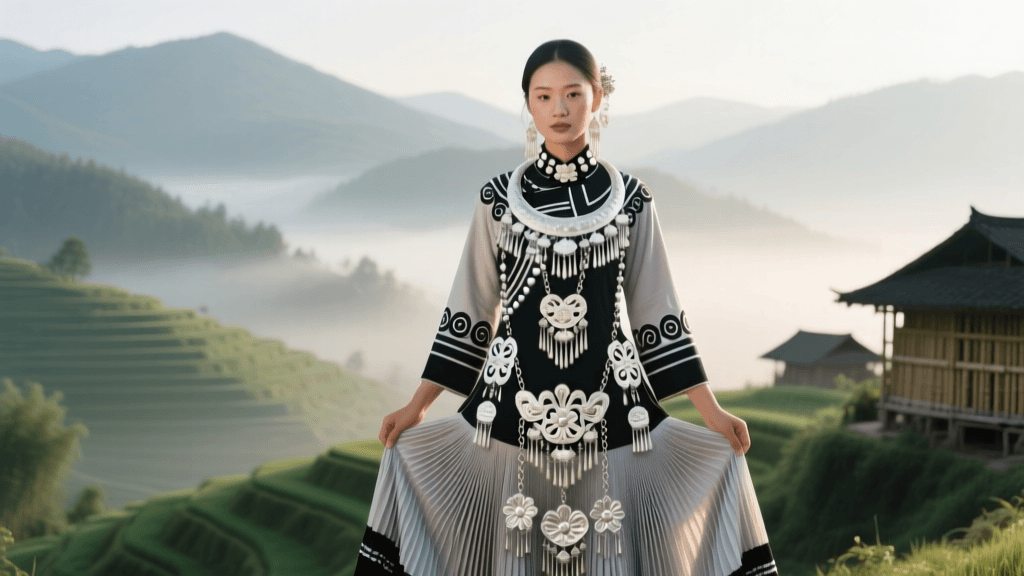
In Miao culture, silver is the ultimate symbol of wealth, health, and spiritual protection. It is believed that the brilliant sheen of silver wards off evil spirits and illuminates the path for the wearer's soul. The creation of Miao silver jewelry, or Yinshi, is a highly specialized craft passed down through generations of master silversmiths, particularly in renowned artisan hubs like the Xijiang Qianhu Miao Village in Guizhou.
The forging process is incredibly labor-intensive. Silversmiths employ over thirty distinct techniques, including hammering, braiding, engraving, and filigree work, to transform raw silver into delicate, nature-inspired motifs such as dragons, phoenixes, butterflies, and water buffalo horns.
Key Silver Pieces and Measurements
- Silver Horns (Yinjiao): The most iconic piece of Miao headwear. These towering, crescent-shaped horns can reach up to 60 centimeters in height and weigh between 1.5 and 3 kilograms. They symbolize the water buffalo, an animal deeply revered in Miao agrarian society for its strength and contribution to survival.
- Layered Necklaces and Torcs (Xiangquan): During major festivals, a Miao woman may wear up to ten layers of silver necklaces, ranging from tight chokers to heavy, chest-covering torcs. The total weight of the necklaces alone can exceed 5 kilograms.
- Silver Combs and Hairpins: Used to secure elaborate updos, these pieces are often shaped like flowers or birds and feature tiny, dangling bells that create a melodic chiming sound with the wearer's every movement.
To wear a full set of Miao silver is to carry the weight of one's ancestors. It is an act of profound reverence, a display of familial devotion, and a physical manifestation of cultural pride.
The Indigo-Dyed Pleated Skirt (Baijianqun)
While the silver catches the eye, the foundation of the traditional Miao festival outfit is the Baijianqun, or hundred-pleat skirt. The creation of this garment is a masterclass in botanical alchemy and textile engineering. The process begins with hand-spun cotton, which is woven on traditional backstrap looms before being subjected to a rigorous dyeing process.
The dye is derived from the Strobilanthes cusia plant, commonly known as Chinese indigo. The leaves are fermented in large wooden vats mixed with rice wine and ash water for 14 to 21 days to extract the deep, rich blue pigment. The cotton is dipped repeatedly—sometimes up to thirty times—drying in the sun between each bath to achieve a dark, almost black-navy hue. To give the skirt its distinctive stiffness and a subtle, lustrous sheen, the dyed fabric is meticulously polished with a smooth river stone and glazed with a mixture of egg whites and ox-hide glue.
The pleating process is equally demanding. Artisans use their fingernails or bamboo tools to fold the damp fabric into hundreds of microscopic, uniform pleats, which are then bound tightly with cotton thread and steamed to set the shape permanently.
Regional Variations of the Pleated Skirt
The Miao are not a monolithic group; they are divided into numerous subgroups, each with distinct sartorial markers. The table below outlines the primary variations of the pleated skirt across different regions.
| Subgroup / Region | Skirt Length | Pleat Count | Key Characteristics |
|---|---|---|---|
| Leishan (Guizhou) | Long (Ankle-length) | 500 - 1,000+ | Deep indigo dye, heavy geometric embroidery concentrated on the lower hem, worn with a heavily embroidered apron. |
| Taijiang (Guizhou) | Mid-Calf | 300 - 500 | Vibrant red, green, and blue silk thread embroidery, often featuring the mythical Butterfly Mother motif. |
| Rongjiang (Guizhou) | Short (15 - 20 cm) | 100 - 200 | Miniature pleated skirts worn over elaborately embroidered, cross-stitched leggings, highly practical for navigating steep mountainous terrain. |
The Language of Miao Embroidery
Miao embroidery is renowned globally for its complexity and the sheer variety of stitches employed. Unlike the flat, painted-like quality of some Han Chinese silk embroidery, Miao embroidery is highly textured, utilizing techniques like the braid stitch, seed stitch, and intricate appliqué. The motifs are deeply symbolic. The 'Butterfly Mother' (Mais Bangx Mais Lief) is a ubiquitous motif, representing the mythical ancestor of the Miao people who hatched from a maple tree. Dragons, depicted not as fearsome imperial beasts but as friendly, water-dwelling protectors with the bodies of fish or buffaloes, are also common.
Actionable Buying and Styling Guide
For collectors, textile enthusiasts, and fashion designers looking to acquire authentic Miao pieces, navigating the markets requires specific knowledge regarding timing, location, and authentication.
Where, When, and How to Buy
- Locations: The best places to source authentic, high-quality garments and silver are the weekly markets in Kaili (the capital of the Qiandongnan Miao and Dong Autonomous Prefecture) and the artisan workshops in Xijiang Qianhu Miao Village. For vintage textiles, the Panjiayuan Antique Market in Beijing occasionally features curated Miao pieces, though provenance can be harder to verify.
- Timing: To witness the garments in their full, intended context and to meet artisans selling their finest work, plan your visit during the Miao New Year (usually falling between November and December on the lunar calendar) or the Sisters' Meal Festival (held in April). During these times, villages become living runways of ancestral fashion.
- Costs: Authentic, hand-forged Miao silver typically ranges from 25 to 45 RMB ($3.50 to $6.25 USD) per gram, depending on the complexity of the filigree. A full festival silver set weighing 3 kilograms can easily cost upwards of $1,500 USD. Vintage, heavily embroidered indigo jackets from the mid-20th century range from $300 to $1,200 USD on the international textile market.
Authenticating Silver and Textiles
When purchasing silver, always carry a strong magnet. Pure silver is non-magnetic; if the piece sticks, it contains iron or steel alloys. Look for the traditional hallmarks or ask the silversmith to perform a 'fire test' on a small, inconspicuous area, as pure silver will not oxidize or turn black when exposed to a butane torch flame. For textiles, rely on your senses. Authentic, naturally dyed indigo retains a faint, earthy, fermented scent that synthetic dyes cannot replicate. Furthermore, examine the reverse side of the embroidery; true master-level Miao work is nearly as neat and legible on the back as it is on the front.
Modern Styling and Wardrobe Integration
Incorporating ethnic minority garments into a modern wardrobe requires a respectful, thoughtful approach to avoid cultural appropriation. Rather than wearing a full, out-of-context festival costume, isolate individual pieces to serve as striking focal points. Pair a single, vintage Miao silver torc with a minimalist, high-necked black turtleneck and tailored trousers. Alternatively, source damaged or incomplete vintage Miao embroidered jacket panels and have a skilled tailor upcycle them into the back panel of a modern bomber jacket or frame them behind UV-protective glass as textile art. This approach honors the craftsmanship while integrating the art form into contemporary aesthetics.
Preserving Intangible Heritage
The rapid modernization of rural China poses a significant threat to traditional crafts, as younger generations often migrate to urban centers for work, leaving the time-intensive practices of indigo dyeing and hand-forging at risk of fading. However, there is a growing movement to preserve these traditions. According to the UNESCO Intangible Cultural Heritage registry, the Miao New Year and its associated traditional crafts are recognized as vital cultural expressions that require active safeguarding and community-led transmission.
Furthermore, global institutions are playing a role in documenting and preserving these masterpieces. The Metropolitan Museum of Art's collection features historical Miao textiles that highlight the incredible weaving and dyeing techniques of the 19th and 20th centuries, providing a benchmark for authentic craftsmanship. By supporting master artisans directly, purchasing ethically sourced pieces, and educating oneself on the profound symbolism woven into every pleat and forged into every silver horn, enthusiasts can help ensure that the Miao's wearable history continues to thrive for generations to come.