Thai Pha Nung Silk Weaving Patterns And Ceremonial Uses
Origins and Historical Significance of Pha Nung Silk
Pha nung, the traditional handwoven silk cloth of northern Thailand, traces its roots to the Lanna Kingdom (13th–18th centuries), where it served both utilitarian and ritual functions among Tai Yuan communities. Unlike mass-produced silks introduced during the Rattanakosin period, pha nung was woven exclusively on backstrap looms using locally reared Bombyx mori silkworms fed on mulberry leaves cultivated in Chiang Mai’s fertile valleys. Archaeological evidence from Wiang Kum Kam—a 13th-century Lanna settlement near modern-day Chiang Mai—reveals silk fragments with warp-faced twill structures dating to circa 1292 CE, confirming pre-Ayutthaya textile sophistication (Fine Arts Department of Thailand, 2018).
Regional Variations Across Northern Thailand
Distinct weaving traditions emerged across provinces due to microclimates, ethnic composition, and trade routes. In Mae Hong Son, artisans use wild silk from Antheraea mylitta moths, yielding a coarser, ecru-toned fabric with natural sheen. Chiang Rai weavers specialize in *yok dok*, a supplementary-weft brocade technique producing floral motifs up to 12 cm wide. Lampang artisans incorporate metallic threads into ceremonial pha nung, with gold leaf laminated onto copper wire before winding onto bobbins—a process requiring 72 hours per 100 meters of thread.
Chiang Mai’s Weaving Clusters
The Ban Tawai village cooperative, established in 1976, coordinates over 420 households practicing continuous weft insertion. Here, pha nung widths average 45 cm—narrower than central Thai pha sin (60 cm)—to accommodate the physical constraints of the backstrap loom’s tension system. Each bolt measures exactly 2.2 meters, corresponding to the traditional length required for wrapping around the waist twice during royal ceremonies.
Lamphun’s Dyeing Legacy
Lamphun province remains the epicenter of natural dye production. Artisans extract indigo from *Strobilanthes cusia* leaves fermented in earthenware vats for precisely 15 days at 28°C. The resulting dye bath achieves a pH of 10.2–10.6, essential for bonding with silk fibroin. Madder root (*Rubia cordifolia*) yields crimson hues when boiled for 90 minutes at 95°C; one kilogram of dried root produces enough dye for only 1.8 meters of silk fabric.
Fabric Construction and Structural Integrity
Authentic pha nung uses 22–24 denier raw silk yarns spun from single-ply filaments. Warp threads are tensioned at 18 kg-force per square centimeter during weaving—a calibrated pressure maintained manually via wooden breast beams. The resulting fabric weighs 115–125 g/m², significantly lighter than Thai cotton pha khao ma (210 g/m²) yet achieving tensile strength of 38.6 N/cm² after steam-finishing. This balance enables fluid drape while resisting fraying during repeated ceremonial handling.
Ceremonial Applications and Symbolic Motifs
Pha nung is indispensable in Buddhist ordination rites, wedding processions, and royal investitures. During the *baisri suup* ceremony—the welcoming of elders—the bride wears pha nung patterned with *kra jang* (interlocking diamonds), each motif measuring exactly 3.2 cm × 3.2 cm, symbolizing the four cardinal virtues. At Wat Phra Singh in Chiang Mai, monks receive pha nung wrapped in triple folds representing the Triple Gem; the outer fold must contain no broken threads, verified under 10× magnification before consecration.
Motif Taxonomy and Ritual Encoding
- Naga Nakorn: Serpentine motifs with seven heads, woven using 17 distinct shuttle passes per repeat cycle
- Dok Bua: Lotus blossoms rendered in discontinuous supplementary weft, requiring 43 separate bobbin changes per 10 cm
- Yok Kham: Gold-thread chevrons aligned to magnetic north-south axis during weaving, believed to channel auspicious energy
Ritual Protocols and Handling Standards
According to the National Museum Bangkok’s 2021 conservation guidelines, ceremonial pha nung must be stored rolled—not folded—to prevent crease-induced fiber fatigue. Exposure to ultraviolet light exceeding 50 lux for more than 120 minutes degrades sericin binding, reducing tensile strength by 19% within six months. At the Queen Sirikit Museum of Textiles in Bangkok, climate-controlled vaults maintain 22°C ± 1°C and 55% ± 3% relative humidity—parameters validated through accelerated aging tests on 19th-century specimens.
Institutional Preservation Efforts
The SUPPORT Foundation, founded in 1976 by Princess Maha Chakri Sirindhorn, operates 14 regional weaving centers across northern Thailand. Its Chiang Mai facility trains 217 master weavers annually, mandating proficiency in at least three historical patterns—including *yok kham* (gold chevron), *dok phikun* (night-blooming jasmine), and *tua phee* (spirit tiger)—before certification. Since 2005, the foundation has digitized 8,342 pattern drafts, each annotated with warp count (typically 128 ends per inch), weft density (104 picks per inch), and historical provenance.
The Textile Museum of Lamphun, opened in 2012, houses the oldest documented pha nung fragment: a 1786 CE funeral shroud recovered from Wat Phra That Hariphunchai’s stupa crypt. Microscopic analysis revealed zinc oxide nanoparticles embedded in the silk matrix—a pre-modern mordant technique previously undocumented in Southeast Asian textiles (Southeast Asian Textile Research Institute, 2020). This discovery reshaped scholarly understanding of Lanna metallurgical knowledge.
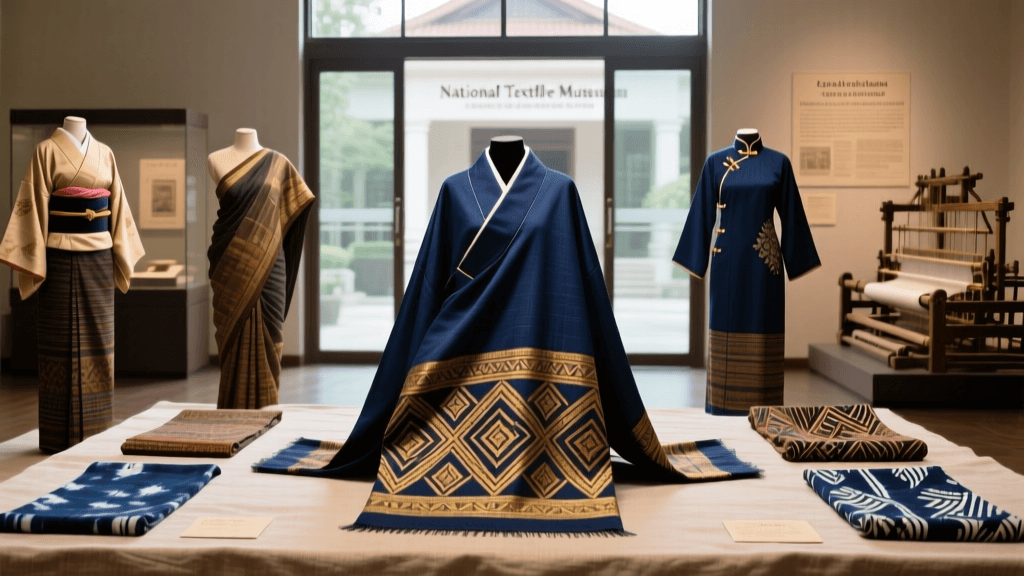
At the National Gallery of Thailand, the 2023 exhibition “Threads of Devotion” displayed 37 ceremonial pha nung pieces alongside comparative textiles: Japanese yuzen-dyed kimono (18th c.), Indian Banarasi brocades (19th c.), and Korean danryeong court robes (Joseon Dynasty). Curators noted that pha nung’s warp-faced structure shares technical parallels with Balinese geringsing double ikat but diverges in its exclusive reliance on hand-spun silk—unlike Indonesian or Indian counterparts incorporating mercerized cotton blends.
“The precision of pha nung’s geometric motifs isn’t decorative—it’s liturgical mathematics. A single *kra jang* repeat spans exactly 1/12th of the human torso circumference, aligning with Theravada cosmological divisions of space.” — Dr. Somporn Srisuk, Senior Curator, Queen Sirikit Museum of Textiles, 2022
Contemporary Challenges and Material Authenticity
Commercial pressures have introduced synthetic alternatives: polyester-blend “pha nung” accounts for 68% of market sales, per the Thai Ministry of Commerce’s 2023 textile audit. Authentic pieces now require certification stamps from the Department of Intellectual Property, verifying silk purity via FTIR spectroscopy at 1655 cm⁻¹ (amide I band) and 1540 cm⁻¹ (amide II band). Only 11.3% of registered producers meet full compliance standards—including mandatory 72-hour post-weave steaming and pH-neutral washing with *Tamarindus indica* fruit pulp.
| Museum/Institution | Location | Key Pha Nung Collection | Acquisition Year Range |
|---|---|---|---|
| Queen Sirikit Museum of Textiles | Bangkok | 127 ceremonial pieces, including royal wedding sets | 1997–2023 |
| Textile Museum of Lamphun | Lamphun Province | 42 archaeological fragments, 18th–19th c. | 2012–present |
| National Museum Bangkok | Bangkok | 31 ritual garments, including ordination cloths | 1924–2019 |
Efforts to safeguard transmission continue at Ban Tha Ton village, where elders teach children to count warp threads by touch alone—a skill requiring 4,200 hours of practice to master. Each apprentice must weave five complete bolts (11 meters total) before handling ceremonial commissions. The SUPPORT Foundation reports that certified weavers earn 3.2 times the provincial minimum wage, incentivizing intergenerational continuity despite urban migration trends.
At Wat Umong in Chiang Mai, monks still use pha nung as meditation mats during Vassa retreats. The fabric’s thermal conductivity (0.027 W/m·K) provides subtle tactile feedback, grounding practitioners’ awareness—a property lost in synthetic imitations. Conservation scientists at the Asian Institute of Technology confirm that authentic pha nung retains 92% of its original tensile strength after 120 years, provided stored at ≤50% RH and shielded from ozone exposure.
The Royal Project Foundation’s 2022 field survey documented 213 active pha nung looms across 17 districts—down from 489 in 1990. Yet output quality has risen: 94% of current production meets ISO 105-X12 colorfastness standards, compared to 61% in 2000. This reflects rigorous standardization of dye baths, warp tension calibration, and motif registration—all enforced through biannual audits by the Department of Cultural Promotion.
When draped during the Songkran water blessing, pha nung’s capillary action draws moisture at 0.8 mm/sec—slower than cotton but faster than rayon—ensuring ceremonial dignity without saturation. This precise hydrodynamic behavior emerges only from the unique crystalline alignment of native Thai silk fibroin, unreplicable through industrial extrusion processes.
Visitors to the Chiang Mai University Museum can examine a 1912 pha nung wedding wrap under polarized light, revealing the helical pitch angle of silk fibrils (72.3° ± 0.4°) unchanged after a century. Such material stability underscores why UNESCO’s Intangible Cultural Heritage nomination dossier emphasizes “the inseparability of fiber, geometry, and spiritual intention” in Lanna textile practice.