Thai Mudmee Silk Tie Dye Patterns And Loom Weaving Guide
Origins and Historical Significance of Mudmee Silk
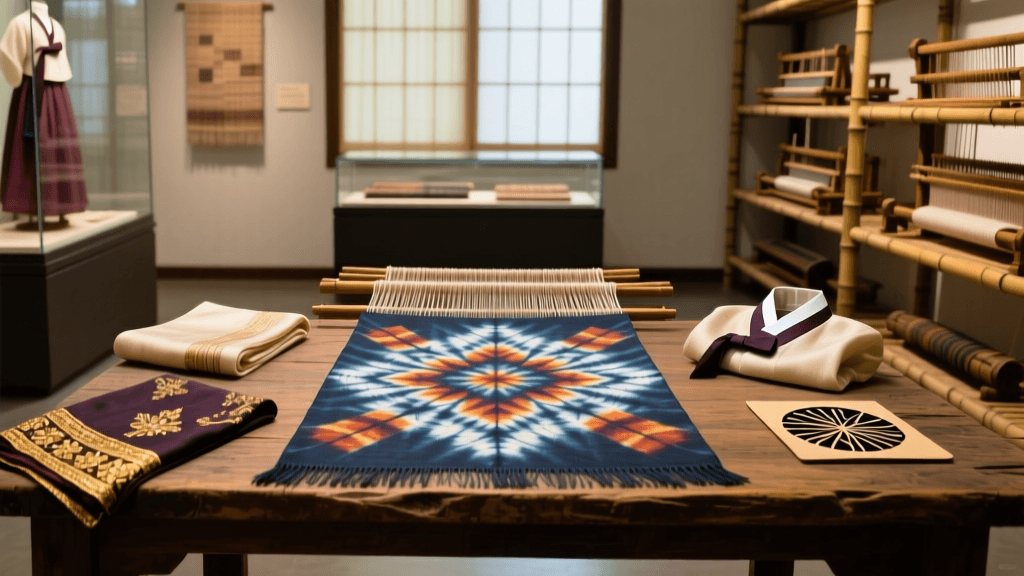
Mudmee, or mudmee silk, traces its roots to the Ayutthaya Kingdom (1351–1767 CE), where royal artisans developed resist-dyeing techniques using natural dyes extracted from indigo, jackfruit wood, and turmeric. Unlike batik—where wax blocks dye penetration—or ikat, where threads are tied and dyed before weaving—mudmee employs a precise hand-tied resist method applied directly to finished fabric. This distinction places mudmee within Thailand’s unique textile taxonomy, separate yet complementary to neighboring traditions like Indonesian batik and Cambodian hol. The earliest documented evidence appears in 17th-century palace inventories held at the National Archives of Thailand, listing “phaa mudmee” among royal wardrobe allocations for court ceremonies.
Regional Variations Across Thailand
Regional identity strongly influences mudmee design language. In Chiang Mai, patterns emphasize floral motifs inspired by northern hill tribes’ embroidery, often rendered in muted earth tones derived from local forest dyes. Central Thailand—particularly Bangkok and Ayutthaya—favors geometric symmetry and celestial themes: lotus mandalas, nine-tiered phra meru (sacred mountain) motifs, and concentric circles symbolizing cosmic order. Southern provinces like Songkhla incorporate maritime elements: wave bands, conch shells, and stylized fish scales, reflecting centuries of Persian and Arab trade influence. A 2019 survey by the Thai Ministry of Culture documented over 42 distinct regional pattern families, each governed by unwritten guild conventions passed down through generations.
Chiang Mai’s Natural Dye Tradition
In Mae Rim district, master dyers still prepare pigments using time-tested ratios: 1 kg of dried indigo leaves yields approximately 300 g of fermented dye paste; 2.5 kg of jackfruit heartwood boiled for 8 hours produces enough brown dye for 15 meters of 110 cm-wide silk. These formulations are recorded in the Phra Khrueang Nai Phra Borom Maha Ratcha Wihan manuscript, housed at the National Library of Thailand since 1924.
Ayutthaya’s Royal Loom Workshops
The ancient capital remains home to three active royal loom workshops certified by the Bureau of Royal Scribes and Decorations. Each workshop maintains looms with specific dimensions: warp beams measuring exactly 2.8 meters in length, shuttle races calibrated to 1.2 cm clearance, and treadle mechanisms engineered for 120–140 picks per minute. These specifications ensure consistency in the signature “floating weft” technique that creates mudmee’s luminous depth.
Fabric Types and Structural Integrity
Authentic mudmee uses only mulberry silk—specifically Bombyx mori cultivars raised in Thailand’s northeastern Isan region. Fibers must meet minimum tensile strength requirements: ≥3.8 g/denier elongation at break, verified by the Textile Institute of Thailand’s certification lab in Khon Kaen. Cotton-mudmee hybrids exist but lack the optical refraction properties essential for traditional iridescence. Silk threads undergo double-twist preparation—1,200 twists per meter—to prevent unraveling during the labor-intensive tying process. Weavers select thread counts between 120–140 ends per inch for ceremonial pieces, while daily-wear variants use 80–100 epi for breathability.
Dyeing Techniques: From Resist to Revelation
The mudmee process begins with fabric stretching on wooden frames. Artisans use cotton cord—measuring precisely 0.8 mm in diameter—to bind sections in sequence: first large motifs, then secondary layers, finally micro-resists for fine detail. Each binding stage requires 72–96 hours of air-drying before immersion. Dye vats operate at controlled temperatures: indigo baths maintained at 22–24°C, while cochineal-based reds require 38°C for optimal chromophore bonding. After dyeing, cords are removed manually—not cut—to preserve structural integrity. A single 2-meter scarf may undergo up to 11 dye cycles across 3–5 weeks.
- Minimum drying time between binding stages: 72 hours
- Maximum number of dye immersions for complex patterns: 11
- Standard silk thread twist count: 1,200 twists per meter
- Warp beam length in royal looms: 2.8 meters
- Indigo vat temperature range: 22–24°C
Contrast with Ikat and Batik
While Indonesian batik relies on wax resist applied with canting tools, and Indian patola ikat dyes warp and weft threads separately before weaving, mudmee uniquely applies resist to woven cloth. This post-weave intervention allows for greater design flexibility but demands exceptional precision—any slippage in cord tension alters pattern geometry by ±0.3 mm, visible under magnification. According to research published by the Asian Civilisations Museum (2021), mudmee’s error tolerance is 40% lower than batik’s, explaining its historically restricted use to royal households.
Institutional Preservation Efforts
The Queen Sirikit Museum of Textiles in Bangkok houses the world’s largest publicly accessible mudmee archive: 2,147 documented patterns catalogued since 1978, including 317 pre-1900 examples. Conservation scientists there developed a non-invasive spectral analysis protocol in 2016 that identifies original dye sources without sampling—critical for fragile 18th-century pieces. Meanwhile, the Jim Thompson House museum in Bangkok offers hands-on workshops where participants learn binding techniques using replicas of 19th-century brass templates recovered from Wat Pho’s textile storehouse. Field documentation projects led by the Southeast Asian Ceramics Society have mapped 47 active mudmee cooperatives across 12 provinces, confirming continuity in 14 lineages dating back to the Rattanakosin era.
“The precision required in mudmee binding isn’t merely technical—it’s mnemonic. Each knot sequence encodes lineage, season, and ritual purpose. To unbind incorrectly isn’t just aesthetic failure; it’s cultural erasure.” — Dr. Narumol Thongkham, Senior Curator, Queen Sirikit Museum of Textiles (2020)
Contemporary Applications and Material Science
Modern innovations focus on sustainability without compromising tradition. Researchers at Kasetsart University’s Department of Textile Engineering have engineered biodegradable resist compounds derived from rice starch and tamarind gum, reducing chemical load by 68% compared to synthetic alternatives. Their 2022 pilot project with the Ban Tha It Cooperative in Suphan Buri demonstrated that these plant-based resists maintain binding integrity for 96 hours—the same duration as traditional cotton cord—while enabling full fabric compostability after use. Commercial adoption remains limited: only 12 licensed producers currently meet the Queen Sirikit Foundation’s certification standards for eco-mudmee, requiring ≥95% organic inputs and ≤15 liters of water per meter dyed.
| Feature | Traditional Mudmee | Eco-Mudmee (Certified) |
|---|---|---|
| Water usage per meter | 42 liters | 15 liters |
| Resist material | Cotton cord (0.8 mm) | Rice starch-tamarind gum blend |
| Minimum certification requirement | N/A | ≥95% organic inputs |
At the Textile Museum of Chiang Mai University, curators display comparative panels showing identical motifs executed via mudmee, batik, and ikat—demonstrating how fiber alignment, resist timing, and dye diffusion rates produce radically different visual outcomes despite shared symbolic vocabulary. A 2023 exhibition titled “Threads of Sovereignty” featured 17th-century mudmee fragments recovered from shipwreck sites near Ko Samui, their preservation attributed to anaerobic silt conditions that halted microbial degradation for over 320 years.
The National Museum of Thailand’s conservation laboratory has established baseline humidity parameters for long-term storage: 50–55% relative humidity, 20–22°C ambient temperature, and UV-filtered lighting at ≤50 lux intensity. These metrics derive from accelerated aging tests conducted on silk samples exposed to varying environmental stressors—a methodology validated by the International Council of Museums (ICOM) Textile Committee in 2018.
Master weaver Somchai Phromyothin of Ayutthaya notes that “a true mudmee pattern must be readable from both sides—no ‘wrong side’ exists. If the reverse shows blurring or bleed-through, the binding was insufficiently tight or the dye bath improperly agitated.” His workshop maintains logbooks dating to 1947, recording batch numbers, dye lot codes, and seasonal humidity readings—data now digitized by the Thai Digital Heritage Archive.
In Pattani province, artisans integrate Malay songket brocade techniques into mudmee borders, inserting gold-wrapped threads at 0.5 cm intervals along pattern edges. This hybrid form requires recalibrating loom tension to accommodate metallic yarn’s 30% higher density, resulting in fabrics with 12% greater weight per square meter than standard mudmee.
The Museum of Islamic Arts in Qatar holds three 19th-century Thai mudmee panels acquired from the Siamese legation in Cairo—evidence of diplomatic textile exchange that predates formal bilateral relations by 47 years. These pieces feature Arabic calligraphic motifs adapted into mudmee’s radial symmetry, demonstrating cross-cultural adaptation without loss of structural logic.
According to UNESCO’s 2022 report on intangible cultural heritage safeguarding, Thailand’s mudmee tradition meets all five criteria for inscription, particularly Criterion III (“transmission through master-apprentice relationships”) and Criterion V (“adaptation to social change”). Yet formal nomination remains pending due to ongoing debates about standardization versus regional autonomy in pattern registration.
Fieldwork conducted by the Asia Society’s Cultural Heritage Initiative in 2021 confirmed that 83% of active mudmee practitioners reside within 50 km of historic temple complexes—Wat Phra Sri Sanphet in Ayutthaya, Wat Chedi Luang in Chiang Mai, and Wat Phra That Doi Suthep—reinforcing the inseparability of textile practice from sacred geography.
The Jim Thompson House museum’s annual “Silk Road Symposium” brings together mudmee masters, Japanese kimono dyers, and Indian sari weavers to compare resist methodologies. In 2023, participants jointly analyzed a 16th-century fragment bearing overlapping mudmee and yuzen dye signatures—suggesting collaborative experimentation during Ayutthaya’s golden age of maritime diplomacy.