2026 Archival Storage Guide for Silk Road Archaeological Textiles
The 2026 Landscape of Silk Road Archaeological Textiles
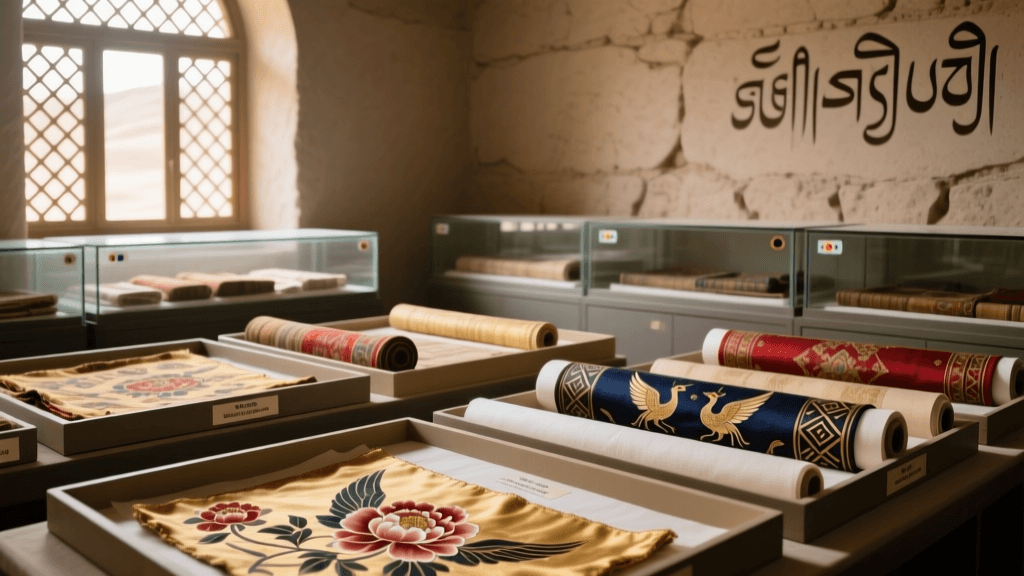
The 2026 archaeological season across the Tarim Basin, the Fergana Valley, and the greater Silk Road corridor has yielded an unprecedented volume of textile artifacts. Recent excavations at the Astana cemetery extensions and newly uncovered Sogdian merchant outposts have brought to light fragile 8th-century samites, intricate Tang dynasty kesi (silk tapestries), and remarkably preserved Han dynasty warp-faced silks. While these discoveries offer profound insights into ancient trans-Eurasian trade, they present an immediate and critical challenge for conservators: how to stabilize and store these highly degraded organic materials using the latest 2026 preservation standards.
According to the UNESCO Silk Roads Programme, the cross-cultural exchange of textile technologies fundamentally shaped the ancient world, making these surviving fragments invaluable global heritage assets. However, excavated silks are notoriously unstable. Having survived for over a millennium in the arid, anaerobic microclimates of Central Asian deserts, their sudden exposure to modern atmospheric conditions can trigger rapid desiccation, dye oxidation, and structural collapse. This comprehensive guide outlines the most current, actionable archival storage protocols for Silk Road textiles, tailored for museum professionals, university researchers, and private antiquities conservators operating in 2026.
Understanding the Structural Vulnerabilities of Excavated Silks
Before implementing any storage protocol, it is vital to understand the specific weave structures and dye chemistries inherent to Silk Road artifacts. The two most commonly excavated textile types require vastly different physical support strategies.
Sogdian Samite (Weft-Faced Compound Twill)
Samite was the luxury fabric of the Silk Road, heavily traded by Sogdian merchants. It is a weft-faced compound twill, meaning the weft threads create the pattern while the warp threads remain hidden. In archaeological contexts, the warp threads—often made of lower-twist silk or even plant fibers—degrade first. By 2026, conservators recognize that excavated samite is essentially a fragile matrix of weft threads held together by mineralized soil or degraded binding agents. It lacks tensile strength and will shatter if folded or subjected to tension.
Tang Dynasty Warp-Faced Silks and Kesi
Conversely, traditional Chinese warp-faced silks rely on the warp threads for both structure and pattern. While they generally survive with better tensile integrity than samite, they are highly susceptible to crease-memory. If stored folded in the ground for centuries, the silk polymers (fibroin and sericin) become permanently set in those creases. Attempting to flatten them without proper humidification and support will result in catastrophic tearing along the ancient fold lines.
2026 Environmental Control Standards for Archival Storage
The baseline for textile conservation has evolved significantly. The Smithsonian Museum Conservation Institute emphasizes that fluctuating relative humidity (RH) is far more destructive to archaeological silk than a stable, slightly sub-optimal humidity level. For 2026, the strict environmental parameters for Silk Road textiles are as follows:
- Temperature: A stable 18°C to 20°C (64°F to 68°F). Lower temperatures slow chemical degradation, but extreme cold makes desiccated silk brittle.
- Relative Humidity (RH):strong> 45% to 50%. This is the critical threshold. Below 40%, the silk fibroin loses its bound water and becomes brittle; above 55%, the risk of mold spores germinating on residual archaeological organics increases exponentially.
- Illumination: Strictly 50 lux or less when the textiles are being examined, utilizing 2026-generation UV-free OLED task lighting. Total annual lux exposure must be logged via smart-sensors to prevent cumulative photochemical fading of sensitive madder and indigo dyes.
Modern facilities now utilize wireless IoT climate dataloggers, such as the latest Hanwell IMS or Eltek Telesis nodes, placed directly inside the archival enclosures to monitor micro-climates in real-time, alerting conservators via cloud-based dashboards if RH fluctuates by more than 2% within a 24-hour period.
Physical Storage Protocols: Rolling, Padding, and Enclosure
The cardinal rule of 2026 textile storage is: never fold an excavated Silk Road textile. Folding induces mechanical stress that will inevitably sever degraded fibers. The standard protocol involves rolling, padding, and enclosing the artifact in chemically inert materials.
Step-by-Step Rolling and Padding
- Preparation: Lay a sheet of 100% unbuffered, acid-free tissue paper (pH 7.0) on a clean, sanitized polyethylene work surface. Buffered tissue (pH 8.5) must be avoided, as the alkaline reserve can degrade protein-based silk fibers over time.
- The Core: Use an acid-free, lignin-free honeycomb paperboard tube, minimum 4 inches (10 cm) in diameter. A larger diameter reduces the curvature stress on the silk fibers.
- Interleaving: Place the textile face-up on the tissue paper. Cover it with another layer of tissue, followed by a layer of washed, unbleached cotton muslin or Tyvek (flash-spun high-density polyethylene). Tyvek is highly recommended in 2026 for its superior tear resistance and breathability.
- Rolling: Gently roll the textile onto the tube, ensuring the warp threads run parallel to the tube's axis to distribute tension evenly. Do not roll tightly; the roll should be firm but yielding.
- Outer Protection: Wrap the rolled bundle in a final layer of Tyvek and secure it with unbleached cotton twill tape. Never use pins, metal clips, or adhesive tapes.
Carving Custom Ethafoam Supports for Fragments
For heavily fragmented samite that cannot be rolled, conservators must carve custom depressions into closed-cell polyethylene foam (Ethafoam). Using 2026 precision hot-wire cutters, carve a depression that perfectly matches the fragment's irregular edges. Line the depression with a thin layer of polyester batting and cover it with washed cotton jersey. The fragment is then placed into the depression, ensuring it is fully supported without any pressure on its edges.
Material Compatibility Chart for Silk Road Textiles
Selecting the wrong storage material can lead to irreversible chemical damage. The following table outlines the approved and prohibited materials for 2026 archival storage of Silk Road artifacts.
| Material Category | Approved for 2026 Archival Use | Strictly Prohibited (Causes Damage) | Primary Risk to Silk Road Textiles |
|---|---|---|---|
| Enclosures & Boxes | Coroplast (polypropylene), Acid-free lignin-free board, Anodized aluminum | PVC plastics, standard cardboard, untreated wood, MDF | Off-gassing of plasticizers and formaldehyde; acidic hydrolysis. |
| Wrapping & Interleaving | Unbuffered acid-free tissue, Tyvek, washed cotton muslin, Mylar (polyester) | Buffered tissue, polyurethane foam, bubble wrap, newsprint | Alkaline degradation of protein fibers; trapping of moisture. |
| Padding & Cushioning | Ethafoam (closed-cell polyethylene), polyester batting, polyethylene beads | Polyurethane foam, natural latex, rubber bands, wool felt | Yellowing, acidic off-gassing, sulfur-induced dye degradation. |
| Fasteners & Ties | Unbleached by twill tape, stainless steel (316 grade) pins (if absolutely necessary) | Rubber bands, standard steel pins, brass, adhesive tape, Velcro | Rust stains, sulfur transfer, adhesive residue, mechanical snagging. |
Modern Pest Eradication: Nitrogen Anoxia Over Freezing
When textiles are first excavated or transferred from older, unmonitored storage facilities, they must be quarantined and treated for potential pest infestations, specifically webbing clothes moths (Tineola bisselliella) and carpet beetles. Historically, deep freezing was the standard treatment. However, current 2026 conservation science strongly advises against freezing highly degraded, desiccated Silk Road silks. The expansion of residual moisture within the fibers during the freezing process can cause micro-fractures, literally shattering the ancient fabric.
Instead, the standard protocol is nitrogen anoxia. The textile is sealed inside a specialized, gas-impermeable laminated film barrier (such as Escal film). The oxygen inside the envelope is purged and replaced with humidified nitrogen gas, reducing the oxygen level to below 0.1%. The textile remains in this anoxic environment for a minimum of 21 days at a stable 20°C. This method safely eradicates pests in all life stages (egg, larva, pupa, adult) without subjecting the fragile silk polymers to the thermal shock and mechanical stress of freezing temperatures.
Documentation and 3D Photogrammetry in 2026
Physical handling of Silk Road textiles should be minimized to preserve their structural integrity. In 2026, the integration of high-resolution 3D photogrammetry and multispectral imaging has revolutionized how these artifacts are studied and stored. Before a textile is placed into long-term archival storage, it is scanned using non-UV, cool-light multispectral cameras. This captures not only the visible surface topography but also reveals faded d the naked eye. Guidelines from the Canadian Conservation Institute highlight that creating a comprehensive digital twin of the artifact allows researchers to study weave structures, dye distributions, and degradation patterns virtually, ensuring the physical artifact can remain undisturbed in its climate-controlled enclosure for decades.
Conclusion
The survival of Silk Road textiles is a testament to the extreme environments of the Tarim Basin and the Fergana Valley, but their continued preservation relies entirely on the rigorous application of modern archival science. By understanding the unique structural vulnerabilities of Sogdian samite and Tang silks, maintaining strict 2026 environmental controls, utilizing chemically inert storage materials, and employing safe anoxic pest management, conservators can ensure these irreplaceable threads of human history endure for future generations. Proper storage is not merely about putting an artifact in a box; it is the active, ongoing mitigation of time itself.