Tanzanian Kanga Print Designs Meanings And Tie Dye Techniques
Origins and Cultural Significance of the Kanga in Tanzania
The kanga is far more than a piece of cloth—it is a spoken textile. Originating in 19th-century Zanzibar under Omani Arab influence, the kanga evolved from imported Indian chintz and local hand-stamped cottons. By the 1870s, Swahili women began adapting these fabrics into standardized rectangular garments measuring exactly 1.5 meters by 1.05 meters, a dimension codified by Dar es Salaam’s Mwenge Market textile vendors by 1932. Each kanga bears a central motif (the *mji*), a border pattern (*pindo*), and a Swahili proverb or slogan (*jina*)—often printed along the lower edge. These inscriptions transform the garment into a vehicle for social commentary, political expression, and intergenerational wisdom. As noted by the National Museum of Tanzania in its 2018 exhibition *“Kanga: Cloth as Conversation,”* over 70% of adult women in coastal regions own at least five kangas, worn daily for cooking, childcare, market trading, and ceremonial rites.
Weaving, Printing, and Tie-Dye Techniques in Contemporary Production
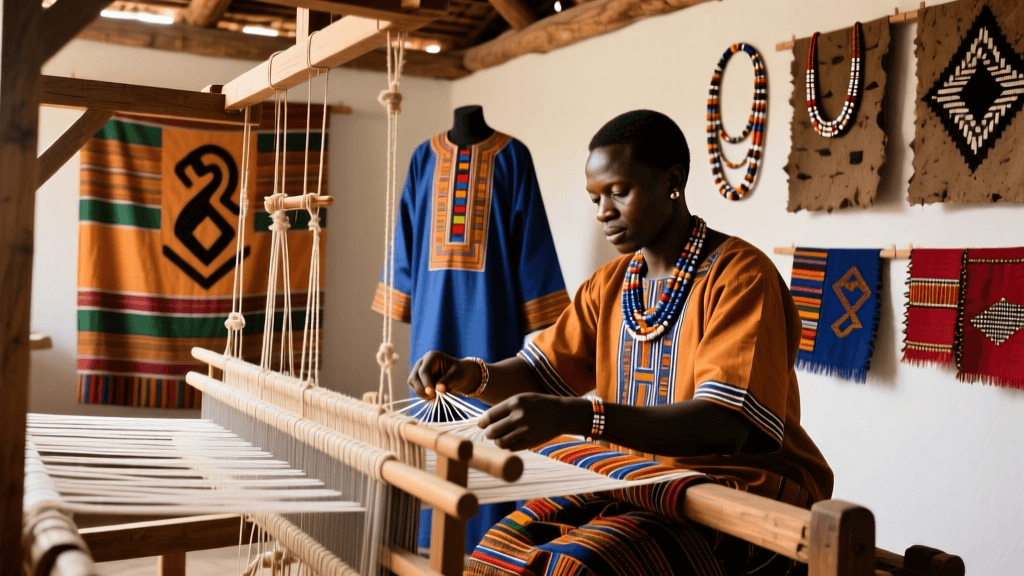
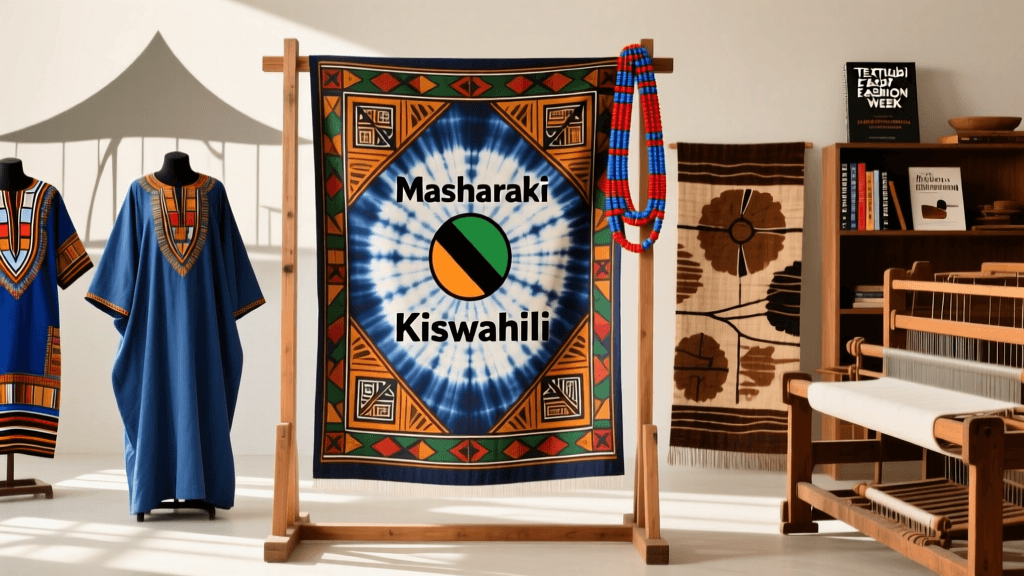
Unlike kente cloth—which relies on complex loom-weaving—the kanga is primarily screen-printed on machine-woven cotton. However, artisanal tie-dye variants persist, especially in Bagamoyo and Tanga. Traditional *kangani* dyeing uses natural indigo extracted from *Indigofera tinctoria*, fermented for 7–10 days before immersion. A single tie-dyed kanga requires 4–6 hours of hand-tying using rubber bands and wooden dowels to create resist patterns such as *mvua ya mchana* (morning rain) or *nyoka ya panya* (snake of the onion). In contrast, commercial producers like Uzuri K&Y in Dar es Salaam employ rotary screen printing at speeds up to 120 meters per minute, yet maintain strict adherence to the 1.5 × 1.05 m standard. Their 2023 production log recorded 24,800 units of hand-tied kangas sold through cooperative networks across 17 districts.
Key Tie-Dye Patterns and Symbolic Readings
Each resist configuration carries layered meaning. The spiral motif (*kukandwa*), formed by twisting fabric from corner to center, signifies unity and cyclical time—echoing the Swahili concept of *muda wa mabadiliko* (time of change). A diamond grid pattern, achieved by folding into 32 equal triangles before binding, references ancestral land divisions mapped in pre-colonial coastal villages. These visual codes are not static; they shift with context. During the 2015–2016 national elections, the phrase *“Haki iwe nguvu”* (“Let justice be strength”) appeared on over 18,000 kangas distributed by the Tanzania Women’s Research Foundation.
- Mwana wa mama (child of mother): A stylized infant cradled in geometric arms—denotes maternal lineage and inheritance rights
- Upepo wa bahari (sea breeze): Wavy lines radiating from corners—symbolizes resilience amid economic turbulence
- Chombo cha kifaru (rhino vessel): Interlocking hexagons resembling rhino hide—invokes protection and communal defense
Symbolism Embedded in Motifs and Proverbs
The *jina*—the Swahili inscription—is the semantic core. Phrases are rarely decorative; they function as public declarations. “Usiache kazi yako kwa sababu ya watoto wako” (“Do not abandon your work because of your children”) appears on kangas worn by female entrepreneurs in Arusha’s Maasai Market, signaling economic agency. Another widely circulated proverb, “Kila mtu anapenda kufanya mambo yake kwa njia yake” (“Everyone prefers to do things their own way”), gained prominence during the 2021 constitutional review debates. Researchers at the University of Dar es Salaam’s Institute of Kiswahili and Foreign Languages documented 1,247 unique jina phrases catalogued between 2010 and 2023—each tied to specific life events, from childbirth to widowhood rites.
Regional Variations Across Tanzania
Coastal Zanzibari kangas favor floral motifs derived from Persian botanical manuscripts, while inland Dodoma versions emphasize abstract geometry inspired by Gogo pottery designs. In Mwanza, near Lake Victoria, fish-scale patterns dominate, often dyed using lake-sourced tannins from *Acacia nilotica* bark. The National Arts Council of Tanzania reports that 68% of registered kanga artisans reside in the Coastal and Dar es Salaam regions, with only 9% operating in the Western Zone. This geographic concentration reflects historical trade routes and port access—not cultural marginalization.
Institutional Support and Contemporary Innovation
The Dar es Salaam School of Art, established in 1964, integrates kanga design into its textile curriculum, requiring students to produce portfolios containing at least three original jina-proverb pairings grounded in ethnographic fieldwork. Similarly, the Bagamoyo Arts and Cultural Institute hosts annual kanga symposia where elders and designers co-develop new motifs—such as solar-panel-inspired grids honoring Tanzania’s 2025 renewable energy targets. In 2022, the African Fashion Foundation partnered with the Tanzania Commission for Science and Technology to digitize 412 historic kanga designs, creating a searchable database accessible to designers across Nairobi, Accra, and Johannesburg.
“The kanga does not whisper. It declares, negotiates, mourns, celebrates—and always in Swahili first.” — Dr. Amina Hassan, Senior Curator, National Museum of Tanzania, 2021
Comparative Context Within African Textile Traditions
While kanga shares communicative intent with Ghanaian adinkra symbols and Malian bogolanfini (mud cloth), its materiality diverges sharply. Adire uses cassava paste resist on handwoven *aso oke*, whereas kanga relies on industrially spun cotton. Kente cloth demands 12–15 hours to weave a single 4-inch strip on a narrow-strip loom—a process requiring mastery of over 300 named patterns, each governed by royal protocol. In contrast, kanga production prioritizes accessibility: a beginner can learn basic tie-dye in under 12 hours. Yet both traditions uphold ethical frameworks—kanga makers observe *haramu ya kujifunza* (the taboo against copying another’s jina without permission), mirroring the Asante prohibition against unauthorized use of *Eban* (safe home) motifs.
| Textile | Origin Group | Primary Technique | Standard Dimension | Institutional Custodian |
|---|---|---|---|---|
| Kanga | Swahili Coast | Rotary screen print / tie-dye | 1.5 m × 1.05 m | National Museum of Tanzania |
| Kente | Ashanti & Ewe | Handloom weaving | Variable (typically 3–4 m) | Manhyia Palace Museum, Kumasi |
| Bogolanfini | Bambara | Mud dyeing on handspun cotton | 1.2 m × 2.0 m | Centre National de l’Artisanat, Bamako |
Contemporary designers such as Nia Muhumuza of Uzuri K&Y reinterpret tradition without erasure—her 2023 collection featured kangas printed with QR codes linking to oral histories recorded in Pangani village. Meanwhile, the Mwalimu Nyerere Memorial Academy’s Department of Heritage Studies mandates kanga analysis in all undergraduate anthropology courses, citing UNESCO’s 2019 recognition of Swahili intangible heritage as foundational to curriculum design. At the grassroots level, the Tanga Women’s Cooperative has trained 217 members in eco-dyeing since 2017, reducing synthetic dye use by 43% per kilogram of fabric.
The enduring power of the kanga lies precisely in its refusal to be frozen in time. When draped over shoulders during a wedding in Stone Town, folded into a baby sling in Singida, or pinned to protest banners in Dodoma, it performs identity—not as relic, but as living syntax. Its colors shift with seasons, its proverbs evolve with politics, and its folds hold generations of unspoken dialogue—all within a rectangle no larger than a doorway.
Efforts to preserve this language extend beyond aesthetics. The African Union’s Pan-African Textile Initiative, launched in 2020, allocated $2.4 million USD specifically for kanga documentation across Zanzibar, Pemba, and Mafia Islands. Field teams collected over 1,800 oral interviews with elder makers, verifying provenance for 312 motifs now listed in the Tanzania Intellectual Property Office’s Traditional Knowledge Registry.
In Mbeya, high school students participate in annual kanga design competitions judged by faculty from the College of Art, Design and Media at the University of Dar es Salaam. Winning entries must include historically accurate jina, culturally appropriate motifs, and demonstrate technical proficiency in at least two dye techniques—including immersion dyeing lasting 45 minutes minimum to achieve archival colorfastness.
The kanga remains unyielding in its insistence: cloth is never silent. Its grammar is stitched in cotton, its verbs printed in ink, its syntax tied in knots that loosen only when the wearer chooses to speak.