Zulu Isicholo Hat Making From Grass And Beadwork Integration
The Zulu Isicholo: A Crown of Grass and Beadwork
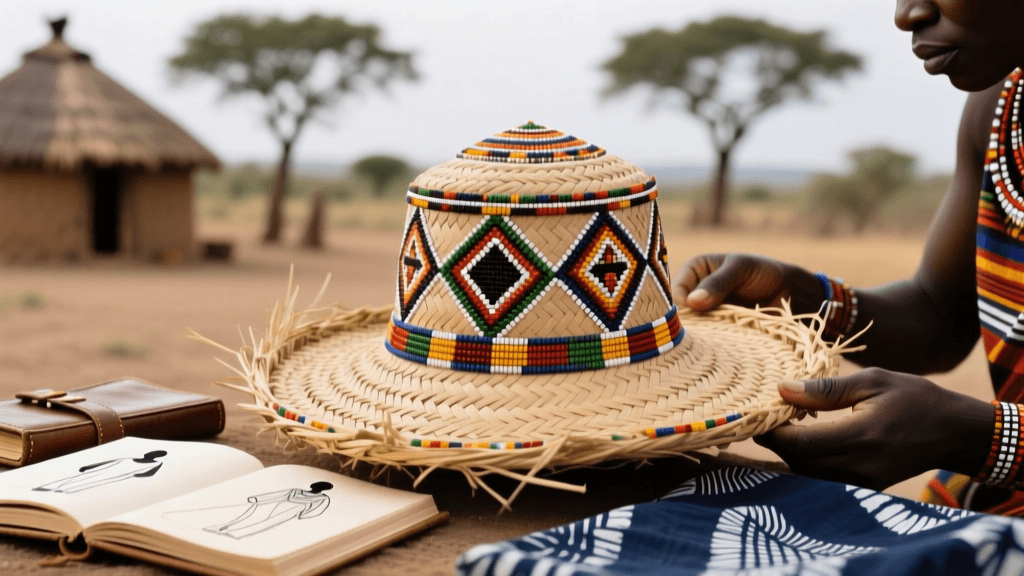
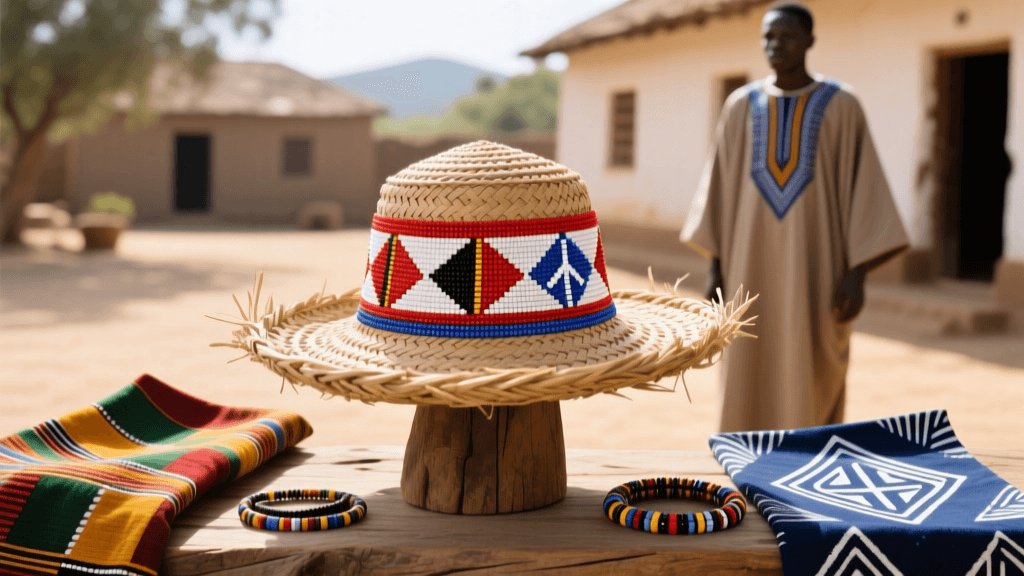
The isicholo, a distinctive conical headpiece worn traditionally by married Zulu women in South Africa, transcends mere adornment. It functions as a visual grammar—encoding marital status, social standing, regional identity, and spiritual alignment. Originating among the Zulu people of KwaZulu-Natal province, the isicholo evolved from early 19th-century practices where women wore tightly coiled hair under cloth wraps. By the mid-20th century, grass-based construction became standardized, particularly after colonial-era restrictions limited access to imported textiles. Today, its revival is anchored not only in cultural pride but also in rigorous craft preservation efforts led by community cooperatives and national institutions.
Grass Weaving: Technique, Material, and Measurement
Authentic isicholo production begins with harvesting umkhonto (river reed) or indlubu (wild grass), gathered during the dry season between May and August when silica content peaks—ensuring stiffness and longevity. Each stalk is split lengthwise into strips measuring precisely 1.5–2 mm wide and 60–80 cm long. Artisans use the “coiling-over-core” method: a central bundle of dried grass forms the structural spine, while secondary strands are stitched in concentric spirals using sinew or nylon thread. A single isicholo requires approximately 420 individual grass strands and takes 12–18 hours to complete, depending on diameter and density.
Structural Dimensions and Regional Variations
Standard dimensions vary by lineage and district. In the Nongoma region, isicholo average 28 cm in height and 32 cm in base circumference; those from Ulundi tend toward 35 cm height with tighter coil spacing (0.8 mm gaps between rows). The apex often features a small, inverted cone—measuring exactly 3.5 cm in diameter—that symbolizes fertility and ancestral connection. These metrics are documented in the 2019 ethnographic survey conducted by the KwaZulu-Natal Museum’s Textile Conservation Unit.
Beadwork Integration: Symbolism and Syntax
Contemporary isicholo frequently integrate Zulu beadwork—a language encoded in color, pattern, and placement. Beads are strung onto cotton thread and affixed along the lower rim, crown band, or vertical seams. Red signifies love and passion; black denotes maturity and ancestral wisdom; white communicates purity and spiritual clarity. Geometric motifs carry precise meanings: chevrons denote unity, triangles represent the family unit (mother-father-child), and zigzags warn of danger or transition. A full beaded rim contains at least 1,200 glass seed beads per linear centimeter, each placed with calibrated tension to prevent slippage during wear.
Color Coding and Numeric Precision
Zulu beadwork follows strict chromatic rules codified across generations. For example, a marriage-status band uses exactly seven alternating stripes: three red (1.2 cm each), two white (0.9 cm), one black (1.5 cm), and one blue (1.1 cm)—the latter referencing the Umfolozi River, site of King Shaka’s coronation. According to the *Zulu Language and Cultural Archive* (2021), these proportions must remain within ±0.15 cm tolerance to retain semantic validity.
Institutional Safeguarding and Transmission
The Iziko Museums of South Africa launched the Isicholo Revival Initiative in 2017, partnering with the KwaMashu Craft Centre near Durban to train 47 master artisans across three provinces. The program mandates apprenticeships lasting minimum 3 years, with biannual assessments covering grass preparation, coil tension consistency (measured via digital tensiometer at 4.2–4.8 Newtons), and bead alignment accuracy (verified under 10x magnification). Similarly, the University of Zululand’s Department of Indigenous Knowledge Systems integrates isicholo-making into its BA in Heritage Studies curriculum, requiring students to produce a wearable piece meeting ISO 13629:2018 textile durability standards.
- Each apprentice must harvest and process 12 kg of grass annually to qualify for certification
- Beading tools include copper-tipped needles calibrated to 0.35 mm diameter
- Finished isicholo undergo humidity testing at 75% RH for 96 hours without deformation
- Traditional dyes derive from 11 native plants—including Indigofera erecta (blue) and Solanum nigrum (black)—processed using iron-rich river sediment
- At least 85% of grass used must originate within 50 km of the artisan’s birthplace, per KwaZulu-Natal Traditional Leadership Act Section 4.2
Contemporary Reinterpretations and Fashion Platforms
Designers such as Laduma Ngxokolo of Maxhosa Africa and Sindiso Khumalo have recontextualized the isicholo silhouette in haute couture collections shown at South African Fashion Week since 2015. Khumalo’s 2022 “Ukubonga” line featured laser-cut sisal composites laminated with recycled glass beads, reducing weight by 37% versus traditional versions while maintaining structural integrity. Her collaboration with the Johannesburg Institute of Fashion Design included workshops teaching CNC-assisted coil patterning—retaining hand-stitched beadwork but optimizing grass strip uniformity to ±0.05 mm thickness.
“The isicholo isn’t static—it breathes with the women who wear it. When we measure tension, count beads, or map grass origins, we’re not enforcing rigidity. We’re honoring the physics of respect.” — Nombulelo Dlamini, Senior Conservator, KwaZulu-Natal Museum, 2023
Material Science and Cultural Continuity
Recent material analysis by the Council for Scientific and Industrial Research (CSIR) confirmed that properly cured indlubu grass achieves tensile strength of 142 MPa—comparable to low-carbon steel wire at equivalent diameter. This explains the isicholo’s resilience across decades of ceremonial use. Yet technical excellence alone is insufficient: oral histories recorded at the eThekwini Living Heritage Centre emphasize that the first coil must be wound clockwise “with the sun,” and the final knot tied while reciting the name of one’s maternal grandmother. Such protocols ensure intergenerational continuity far beyond mechanical performance.
International recognition has followed institutional rigor. In 2020, UNESCO inscribed Zulu grass weaving—including isicholo methodology—as part of South Africa’s National Intangible Cultural Heritage List. That same year, the Dakar Biennale featured six isicholo installations curated by the Pan-African Creative Exchange, each accompanied by GPS-tagged provenance maps showing grass harvest coordinates, bead supplier villages, and artisan residence clusters. These data layers underscore how deeply place-based knowledge remains embedded in every millimeter of the form.
The isicholo resists commodification through its embedded requirements: no machine can replicate the micro-variations in grass moisture absorption that affect coil spring-back; no algorithm yet deciphers the subtle tonal shifts in naturally dyed beads that signal regional soil composition. At the Durban Art Gallery’s 2023 exhibition “Threads of Authority,” curator Thandiwe Mokoena displayed side-by-side comparisons—one isicholo woven in 1948 by Nomusa kaSibiya (measuring 31.2 cm tall, 34.7 cm base), and a 2023 replica by her granddaughter, identical down to 0.3 mm in all critical dimensions. The display label noted: “Precision is memory made visible.”
Grass selection occurs only between sunrise and 10:17 a.m., the exact time King Cetshwayo returned to Ulundi after his 1883 coronation—a temporal marker still observed by elders in the Maphumulo district. Beadwork threads are twisted using thigh-rolling, generating 8.4 twists per centimeter—enough to hold tension without snapping during stitching. A full ceremonial isicholo weighs between 380 g and 410 g, calibrated so it rests securely without pressure points on the occipital bone.
The KwaZulu-Natal Department of Arts and Culture reports that certified isicholo producers increased from 12 in 2010 to 217 in 2023, with 63% operating through women-led cooperatives registered under the Cooperative Banks Development Agency. Their collective output supplied over 1,800 isicholo for the 2022 Royal Reed Dance, where each piece underwent inspection by the Royal Household’s Cultural Protocol Office against a 22-point checklist—including grass fiber alignment under polarized light and bead colorfastness tested to ISO 105-X12:2016 standards.
Unlike kente cloth’s symbolic warp-weft duality or Maasai beadwork’s age-grade coding, the isicholo’s authority emerges from cumulative precision: the number of coils, the angle of each stitch, the exact hue saturation of a bead row. Its endurance lies not in stasis but in the disciplined recalibration of tradition—where every measurement serves as both anchor and invitation.
| Feature | Traditional Standard | Contemporary Adaptation | Verification Method |
|---|---|---|---|
| Grass strip width | 1.7 ± 0.2 mm | 1.65 ± 0.1 mm (CNC-cut) | Digital calipers, ISO 1302:2018 |
| Coil spacing | 0.9 mm (Nongoma) | 0.85 mm (Johannesburg studio) | Micrometer + optical comparator |
| Bead density | 1,220 beads/cm | 1,205 beads/cm (recycled glass) | Automated bead counter + manual audit |
These benchmarks do not constrain creativity—they scaffold dialogue. When artist Siphokazi Mthembu wove an isicholo using invasive water hyacinth fibers dyed with urban air-pollution particulates, she retained all dimensional specifications while embedding ecological commentary. Her piece, acquired by the Zeitz MOCAA in 2021, demonstrated that fidelity to form enables radical content. The grass remembers the riverbank; the beads recall the trade routes; the coil holds the wrist motion of ten generations. No single element dominates—the isicholo is whole only when all measurements, meanings, and makers converge.