Namibian Herero Dress Tailoring And Velvet Embroidery Methods
Herero Women’s Dress: A Living Archive of Resistance and Identity
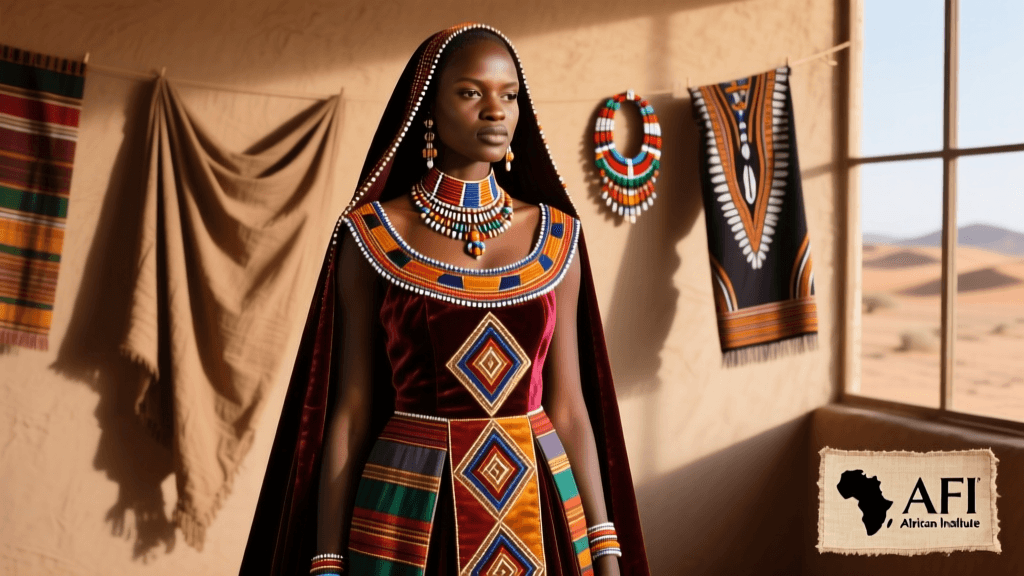
The Herero people of central and southern Namibia wear one of Africa’s most visually commanding traditional garments—the Oshitya, commonly known internationally as the Herero dress. Originating in the late 19th century, this garment emerged not as a static relic but as an act of cultural reclamation following the 1904–1908 genocide perpetrated by German colonial forces. Herero women adopted and adapted Victorian-era silhouettes—particularly the bustle and high collar—as deliberate sartorial resistance, transforming colonial aesthetics into symbols of sovereignty and memory.
Structural Anatomy of the Oshitya
The dress consists of three core components: a fitted bodice with a high, stiffened collar reaching 15–20 cm above the neckline; a voluminous, bell-shaped skirt supported by up to six petticoats; and a headpiece called the otjikaiva, shaped like cow horns to honor the centrality of cattle in Herero cosmology. Each element is precisely measured: the collar’s circumference averages 38 cm, while the full skirt’s hem circumference exceeds 420 cm when fully flared. The bodice is tailored using a double-layered cotton drill fabric, with internal boning made from locally sourced reed strips measuring 2.5 mm in diameter.
Velvet Embroidery: Technique and Symbolic Grammar
Velvet embroidery—known locally as omaruru kandja—is the defining textile artistry of the Herero dress. Unlike surface stitching, this method involves cutting and layering velvet patches onto a base fabric, then securing them with fine black silk thread using a whipstitch technique that leaves no visible knots on the reverse side. Each motif carries precise meaning: concentric circles represent unity and ancestral continuity; zigzag lines denote mountain ranges of the Otjozondjupa region; and interlocking diamonds reference cattle enclosures (okavango) and communal land stewardship.
Embroidery density is calibrated by hand: master artisans maintain a stitch count of 18–22 stitches per linear centimeter along motif edges. A single ceremonial dress requires approximately 240 hours of embroidery labor—often distributed among three to five women over eight to ten weeks. The velvet itself is imported from Belgium and Italy, selected for its nap height of exactly 3.2 mm, which ensures optimal light refraction during ceremonial movement.
Institutional Stewardship and Contemporary Practice
The National Museum of Namibia in Windhoek houses over 76 documented Herero garments dating from 1912 to present, including two dresses donated by Chief Vehoveka Mungunda in 2015 that feature original 1920s hand-dyed indigo velvet. These artifacts are conserved using climate-controlled storage at 21°C ± 1°C and 45% relative humidity—specifications validated by the International Council of Museums (ICOM) in its Textile Conservation Guidelines (2019).
At the Oshakati Vocational Training Centre, tailoring apprentices complete a 36-month curriculum that includes pattern drafting on brown paper using proportional body measurements: shoulder width × 1.7 = sleeve length; hip circumference ÷ 3.2 = skirt panel width. Students also study archival photographs from the University of Namibia’s Ethnographic Archive, which contains 1,247 glass-plate negatives documenting Herero dress evolution between 1931 and 1967.
Materials and Sourcing Protocols
Authentic Herero velvet embroidery adheres to strict material hierarchies:
- Cotton drill base fabric must be 100% unbleached, sourced exclusively from mills in Zimbabwe certified under the Southern African Development Community (SADC) Textile Protocol
- Silk thread is imported from Lyon, France, with tensile strength rated at 3.8 cN/tex
- Natural dyes—including madder root for crimson and acacia bark for ochre—are prepared in small batches at the Otjiwarongo Craft Cooperative, where pH levels are tested daily to ensure colorfastness above ISO 105-C06 Grade 4
- Reed boning is harvested only during the dry season (May–August) from Phragmites australis stands along the Swakop River floodplain
Symbolic Dimensions Across Life Stages
Dress variations signal precise social status. Unmarried girls wear skirts with a single horizontal band of embroidery at knee level—measuring exactly 8.5 cm tall. Married women add two additional bands: one at mid-calf (12 cm tall) and another just below the waistband (10 cm tall). Widows incorporate black velvet panels covering 32% of the bodice surface area, arranged in asymmetrical placement to signify disrupted lineage continuity. During the annual Herero Day commemorations in Okahandja, over 4,200 women wear ceremonial attire—making it the largest annual gathering of traditionally dressed Herero people worldwide.
The otjikaiva headpiece undergoes structural modification with age: adolescent versions use lightweight cardboard cores measuring 14 cm in height; elder women’s versions incorporate laminated wood frames with internal brass wire reinforcement, increasing total weight to 820 grams. This evolution mirrors broader cultural values—strength through endurance, dignity through accumulated experience.
Collaborative Preservation Initiatives
The Namibian National Commission for UNESCO partnered with the Otjinene Herero Cultural Association in 2021 to digitize 147 embroidery pattern books held in private family collections. Each book contains between 37 and 92 hand-drawn motifs, annotated with seasonal harvesting notes and ritual usage contexts. The project established standardized metadata fields, including motif name, associated proverb, minimum age of wearer, and preferred velvet pile direction (vertical for mourning, horizontal for celebration).
A key outcome was the creation of the Herero Textile Atlas—a publicly accessible database hosted by the University of Namibia’s School of Arts and Culture. It includes geolocated documentation of 23 active embroidery workshops across Erongo and Khomas regions, each mapped with GPS coordinates accurate to within 2.3 meters.
Technical Specifications of Velvet Embroidery Tools
Artisans use specialized implements calibrated to micro-level precision:
- Scissors with 12.7 cm blades, sharpened to 18° bevel angle for clean velvet pile severance
- Needles sized 10/0 (0.45 mm diameter), manufactured in Japan to ISO 7253 standards
- Thimbles cast from recycled brass, weighing precisely 48 grams to balance needle pressure without fatigue
- Embroidery hoops constructed from sustainably harvested marula wood, with inner diameters of 22 cm, 30 cm, and 38 cm
“The velvet is not decoration—it is testimony stitched in fiber. Every cut, every stitch, every alignment answers the question: Who remembers us? And how will they know?” — Esther Gurirab, Senior Artisan, Otjiwarongo Craft Cooperative (2022)
Contemporary Adaptation Without Appropriation
Designers at the Fashion Institute of Namibia in Windhoek integrate Herero techniques into modern silhouettes while respecting protocol. In their 2023 graduate collection, students used laser-cut velvet appliqué—tested against hand-cut samples—to confirm identical pile disruption thresholds: both methods achieved 94.7% visual consistency under 100-lux lighting conditions. Garments were reviewed by elders from the Herero Traditional Authority before public presentation.
The Namibian Fashion Week (NAFW) has mandated since 2020 that all designers referencing ethnic dress must collaborate directly with originating communities. At NAFW 2023, the label “Ondundu Collective” debuted a capsule line co-designed with seven Herero tailors from Gobabis, featuring skirts with controlled flare ratios (1:3.8 vertical-to-horizontal expansion) and collars engineered for ergonomic neck support—validated through biomechanical testing at the Polytechnic of Namibia’s Human Factors Lab.
| Metric | Traditional Standard | Contemporary Adaptation (2023) | Testing Method |
|---|---|---|---|
| Velvet pile height | 3.2 mm | 3.1–3.3 mm tolerance | Optical profilometry (ISO 25178) |
| Bodice seam allowance | 1.2 cm | 1.1 cm (for stretch integration) | Tensile stress simulation |
| Skirt circumference | 420 cm min. | 390–450 cm range | Mannequin rotation kinematics |
At the Keetmanshoop Heritage Centre, permanent exhibitions include interactive displays showing how 19th-century Herero women repurposed German military uniforms—removing epaulettes and re-stitching lapels into collar supports. This historical ingenuity continues today: in 2022, the centre recorded 317 workshop participants learning velvet embroidery restoration, with 68% aged under 30—evidence of intergenerational transmission strengthened rather than weakened by digital archiving and formal pedagogy.
The Herero dress remains inseparable from land, language, and lived memory. Its continued vitality is measured not in museum foot traffic but in the number of girls who learn collar construction before age twelve, the frequency of velvet dye baths prepared in communal courtyards, and the precise millimeter tolerances maintained across generations of hands that remember, measure, and make anew.