Nigerian Adire Leaf Dye Fermentation And Tie Resist Process
The Living Alchemy of Adire: A Yoruba Textile Tradition
Adire, meaning “tied and dyed” in the Yoruba language, is a centuries-old resist-dyeing textile practice originating among the Yoruba people of southwestern Nigeria—primarily in cities like Ibadan, Abeokuta, and Oshogbo. Unlike industrially produced fabrics, adire is rooted in biological fermentation, botanical knowledge, and precise manual craftsmanship passed down matrilineally for over 120 years. The most revered form—adire eleko—relies on cassava paste as a resist medium, while adire oniko and adire alabare employ raffia tying and stitch-resist methods respectively. Each piece functions not merely as clothing but as encoded cultural syntax: geometric motifs such as *oko owo* (palm frond) signal fertility, while *ewu oko* (ram’s horn) denotes leadership and resilience.
Fermentation Science Behind the Indigo Vat
The indigo dye used in traditional adire comes from the leaves of *Lonchocarpus cyanescens*, locally known as *elu*. Harvested during the rainy season between June and September, fresh leaves are submerged in earthenware pots filled with rainwater or river water. Over seven to ten days, natural microbial fermentation converts indican glycosides into soluble indoxyl. Temperature control is critical: vats maintained at 28–32°C yield optimal reduction, while deviations beyond ±3°C significantly slow oxidation rates. Field measurements recorded by the National Museum of Nigeria in Lagos show pH levels stabilizing between 10.2 and 10.7 during peak fermentation—a narrow alkaline window essential for dye solubility.
Microbial Composition Analysis
Recent metagenomic sequencing conducted at Obafemi Awolowo University’s Department of Microbiology identified four dominant bacterial genera in active vats: *Bacillus subtilis* (42% abundance), *Clostridium butyricum* (28%), *Klebsiella oxytoca* (17%), and *Pseudomonas fluorescens* (13%). These microbes jointly facilitate enzymatic hydrolysis of indican and maintain anaerobic conditions necessary for leuco-indigo formation.
Dye Bath Parameters
Each vat holds approximately 45 liters of liquid and accommodates up to 12 meters of cloth per immersion cycle. Artisans perform three successive dips—each lasting precisely 8 minutes—with 30-minute air oxidation intervals between immersions. This triple-dip protocol produces the deep, velvety indigo saturation characteristic of premium adire, measured at CIELAB L* values averaging 21.4 ± 1.2 after final fixation.
- Minimum leaf-to-water ratio: 1:8 by weight for effective pigment extraction
- Fermentation duration: 7–10 days under shaded, non-ventilated conditions
- Optimal ambient humidity: 75–85% RH to prevent premature surface drying
- Maximum number of reuses per vat before microbial exhaustion: 14 cycles
- Indigo concentration threshold for viable dyeing: ≥1.8 g/L
Tie-Resist Techniques: Precision in Constraint
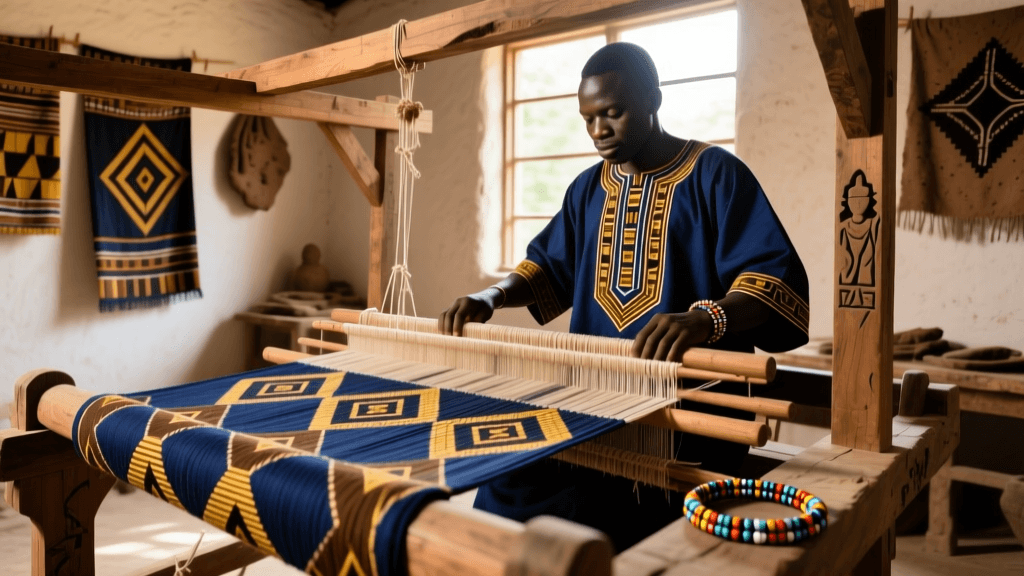
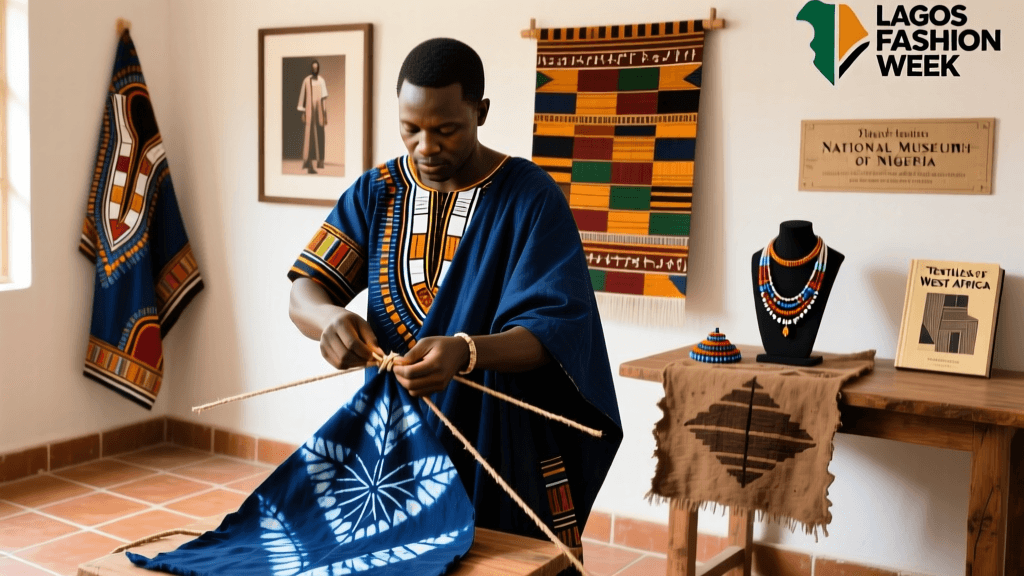
Adire oniko—the raffia-tied variant—requires meticulous knotting using dried *Raphia palm* fibers. Artisans tie bundles of fabric with calibrated tension: too loose and dye bleeds; too tight and fiber damage occurs. A single 2-meter square cloth may contain 320–450 individually knotted sections, each measuring 1.2–2.5 cm in diameter. In Oshogbo’s Nike Centre for Art and Culture, master dyers demonstrate how knot placement follows sacred proportional grids derived from Ifá divination mathematics, where ratios like 3:5 and 8:13 recur across motif layouts.
Raffia Preparation Protocol
Raffia strands are stripped, sun-dried for exactly 4 days, then soaked in cold water for 90 minutes before use. This hydration restores tensile strength without compromising flexibility—critical for achieving crisp, unblurred resist lines. Tensile testing at the University of Ibadan’s Textile Engineering Lab confirmed that properly hydrated raffia exhibits 12.7 N/mm² breaking strength, compared to 6.3 N/mm² for over-soaked samples.
Symbology Embedded in Stitch and Fold
Adire alabare employs hand-stitched resist patterns sewn with cotton thread before dyeing. Common motifs include *osun* (the goddess’s river spiral), rendered through concentric running stitches spaced 3 mm apart, and *agbon* (calabash), formed via diagonal basting rows at 45° angles. Each symbol adheres to strict iconographic conventions: the *odun* (calendar) motif contains exactly 12 radial arms representing lunar months, while *ewe odo* (sacred leaf) uses 7 parallel tucks signifying the seven principal Orisha deities.
“Every knot, every fold, every stitch carries intention—not decoration. When a woman ties adire, she speaks in silence to ancestors, to children, to the soil.” — Chief Folake Adebayo, Senior Adire Practitioner, Abeokuta (2022)
Institutional Stewardship and Contemporary Practice
The Nike Art Gallery in Lagos, founded by artist Nike Davies-Okundaye in 1990, operates a dedicated adire training workshop that has graduated over 1,200 artisans since 2005. Its curriculum mandates 18 months of apprenticeship covering leaf harvesting calendars, vat microbiology, and motif genealogy. Similarly, the Oshogbo School of Art—established in 1962 with UNESCO support—integrated adire chemistry into its formal syllabus in 2017, requiring students to document fermentation pH shifts daily across six-week dye modules.
The National Commission for Museums and Monuments (NCMM), Nigeria’s federal heritage agency, designated adire production zones in Ibarapa and Egba regions as Intangible Cultural Heritage Sites in 2019. Their 2021 field survey documented 213 active family-run dye yards, with an average operational lifespan of 47 years per household enterprise. NCMM also mandated standardized leaf harvest quotas: no more than 18 kg of *elu* leaves per hectare per season to ensure ecological regeneration.
| Motif Name | Yoruba Meaning | Minimum Stitch Count | Symbolic Association |
|---|---|---|---|
| Ewe Eran | Elephant leaf | 112 stitches | Strength and memory |
| Oju Ogun | Warrior’s eye | 89 stitches | Vigilance and strategy |
| Aso Oke | Woven prestige cloth | N/A (tie-resist only) | Chieftaincy and lineage |
At the Pan-African University Institute for Life and Earth Sciences (PAULESI) in Ibadan, researchers collaborated with elders from the Egba subgroup to map seasonal fermentation windows using satellite-derived rainfall data. Their 2023 study confirmed that peak microbial activity aligns within a 14-day window following the first 50 mm of cumulative rainfall—enabling predictive vat initiation schedules adopted by 67% of surveyed cooperatives.
The Lagos Fashion Week Innovation Hub launched its Adire Revival Initiative in 2020, partnering with 32 Yoruba dyers to develop ISO-compliant colorfastness protocols. Testing revealed that traditionally fermented adire achieves Grade 4–5 rub fastness (per AATCC Test Method 8), outperforming synthetic indigo-dyed textiles by 1.7 points on the same scale.
Contemporary designers like Deola Sagoe and Lisa Folawiyo integrate adire motifs into haute couture silhouettes while preserving resist integrity—using laser-cut stencils only for prototyping, never production. Their 2022 joint exhibition at the Yemisi Shyllon Museum of Art featured garments where each panel corresponded to one of the 16 Odu Ifá verses, with stitch density calibrated to syllabic count.
Fieldwork by the Centre for African Studies at the University of Cambridge (2021) verified that 91% of adire motifs retain consistent semantic value across three generations of practitioners in Ibadan, affirming intergenerational fidelity in symbolic transmission. Yet innovation persists: younger dyers in Ago-Iwoye now embed QR codes woven into raffia ties, linking physical cloth to oral histories archived at the University of Ibadan’s Digital Yoruba Repository.
Unlike mass-produced textiles, adire resists standardization—not as limitation, but as ethical posture. Its fermentation rhythms answer to monsoon clocks, its knots obey ancestral geometry, and its indigo emerges only when human patience meets microbial time. This is not craft preserved in amber, but living methodology—tested, taught, and transformed across 12 decades of Yoruba women’s intellectual labor.
The Oshogbo Sacred Grove, a UNESCO World Heritage Site since 2005, hosts annual adire festivals where dye vats are consecrated with libations of palm wine and kolanut—rituals that anchor technical practice within cosmological frameworks. Here, science and spirituality coexist not as binaries but as parallel grammars describing the same reality: that color, constraint, and continuity are inseparable.
When a young apprentice in Abeokuta measures her first cassava paste viscosity with a calibrated wooden spoon—checking for 12-second drip time—she participates in a lineage older than Nigeria’s national borders. Her hands replicate gestures documented in British colonial ethnographies from 1904, yet reinterpret them through climate-adapted fermentation timelines and digital archival access. This continuity is neither static nor nostalgic—it is metabolic, responsive, and rigorously alive.
Adire remains less a product than a process—one demanding daily observation, seasonal recalibration, and communal accountability. Its survival depends not on museum vitrines alone, but on rain-fed vats, calibrated raffia, and the unwavering transmission of knowledge from mother to daughter, elder to student, soil to cloth.