Ivory Coast Baule Kente Weaving And Royal Symbolism Guide
The Baule Weaving Tradition of Ivory Coast
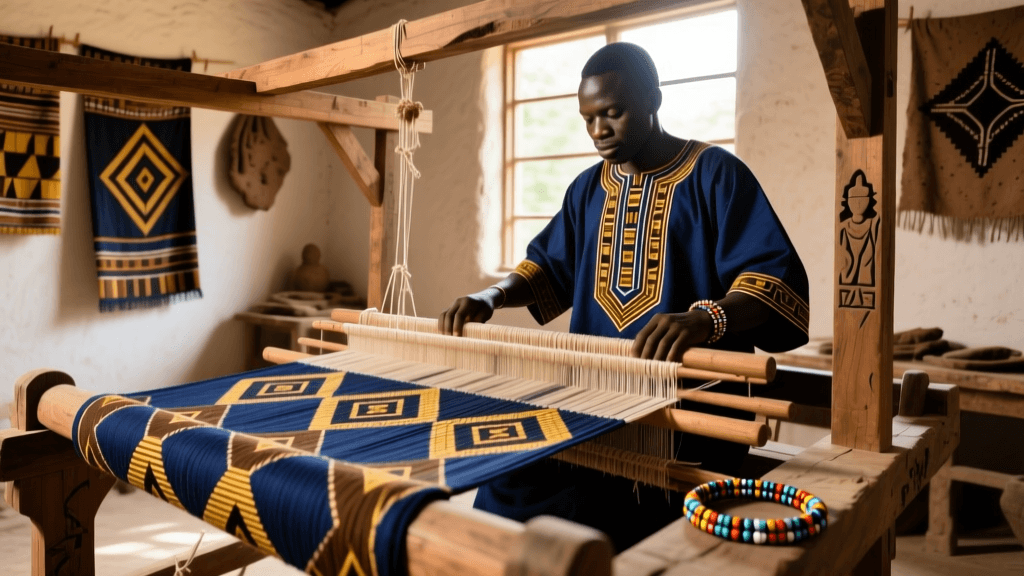
Among the rich textile traditions of West Africa, the Baule people of central Ivory Coast have cultivated a distinct weaving practice rooted in royal patronage and cosmological belief. Unlike the more widely recognized Asante kente of Ghana—woven on narrow-strip looms with symbolic geometric patterns—the Baule developed their own variant known as kente baoulé, though this term is often used loosely outside academic circles. In reality, Baule weavers produce ntam cloth: handwoven, warp-faced textiles made exclusively on the traditional horizontal treadle loom, locally called nta. These cloths are not worn as full garments but serve as prestige objects—wrapped around chiefs during installation ceremonies or displayed as heirlooms in royal palaces across towns like Bouaké and Sakassou.
Weaving Technique and Loom Mechanics
Baule weaving employs a double-heddle system that allows for complex interlocking weft floats and supplementary patterning. Each loom is custom-built to the weaver’s height, with the warp beam measuring precisely 1.8 meters in length and the cloth width averaging 22 centimeters—a dimension dictated by the span of the weaver’s arms when seated. The process begins with hand-spun cotton yarn, traditionally dyed using fermented indigo vats that reach pH levels between 10.5 and 11.2, enabling deep blue penetration without synthetic mordants. Weavers work seated on low stools, operating four foot pedals in sequence to lift heddles while passing the shuttle—often carved from gabon wood—at speeds up to 60 passes per minute.
Materials and Dye Sources
Natural dyes dominate Baule practice: Camwood (Baphia nitida) yields crimson reds; locust bean pods produce warm ochres; and charcoal mixed with cassava paste creates matte black. A 2019 field study by the Institut National de la Recherche Agronomique (INRAN) documented that over 78% of active Baule dyers in Yamoussoukro still rely entirely on plant-based colorants, with average dye bath temperatures maintained at 42°C for optimal pigment fixation.
Time Investment and Output
A single ceremonial ntam cloth measuring 2.4 meters long requires approximately 140 hours of labor. This includes 22 hours for warping, 36 hours for weaving, and 82 hours for post-weave finishing—including washing, beating with wooden mallets, and sun-drying for 72 consecutive hours to enhance fiber luster. According to data collected by the Centre Culturel de Bouaké in 2022, only 17 master weavers remain who can execute the full repertoire of 43 named pattern motifs, down from 62 recorded in 1985.
Symbols and Royal Iconography
Each ntam motif carries layered meaning tied to Baule cosmology and political hierarchy. The kpan preko (“elephant’s trunk”) pattern signifies wisdom and authority—its curving lines replicate the elephant’s proboscis, a creature sacred to the Baule king. The abɔsɔn (“moon crescent”) motif appears only on cloths reserved for the gbankalé, the paramount chief of Sakassou, and must contain exactly 13 alternating silver and gold threads in its border band—a number representing the lunar cycle and ancestral continuity. Other motifs encode proverbs: nkɔmɛn (“the path does not close”) features intersecting zigzags denoting resilience, while nsu kofi (“water flows”) uses parallel wavy lines to affirm life’s inevitability.
Color Semantics in Context
Color symbolism operates within strict sociopolitical boundaries:
- White cotton signifies purity and spiritual readiness—used exclusively for cloths presented during royal purification rites
- Deep indigo represents divine protection and is restricted to cloths draped over the throne during coronation
- Gold thread, sourced from locally spun silk blended with metallic foil, denotes sovereignty and appears only in patterns authorized by the Council of Elders
- Red, derived from camwood, signals martial readiness and appears on cloths carried into battle or diplomatic missions
Institutional Preservation Efforts
The Musée des Civilisations de Côte d’Ivoire in Abidjan houses over 1,240 documented ntam textiles, including a 1927 ceremonial wrap donated by King Kouadio N’Dri of Sakassou. Since 2015, the museum has partnered with UNESCO’s “Safeguarding Intangible Heritage” program to digitize pattern archives and train 34 young apprentices through its Atelier du Tissage Traditionnel. Meanwhile, the École Nationale des Arts et du Textile (ENAT) in Bouaké offers a three-year diploma in Baule textile conservation, requiring students to complete at least 860 hours of hands-on loom training before certification.
Contemporary Fashion Integration
Designers such as Koffi Adomako of Abidjan-based label Tiémoko Atelier reinterpret ntam motifs into modern silhouettes—using laser-cut appliqué to mimic warp-float structures on silk organza jackets. His 2023 collection featured a tailored blazer with a reconstructed kpan preko motif scaled to 12 cm × 18 cm, positioned asymmetrically over the left shoulder. Similarly, the Dakar-based African Fashion Foundation included Baule weaving techniques in its 2022 technical curriculum, mandating that all Level 3 students produce a 45 cm × 45 cm sample using authentic double-heddle mechanics—not digital simulation.
Comparative Context Within West African Textiles
While kente cloth from Ghana’s Asante and Ewe peoples shares visual affinities with Baule ntam, key distinctions persist. Asante kente employs a strip-weaving method where narrow bands (typically 10 cm wide) are sewn edge-to-edge; Baule ntam is woven as a single continuous width. Furthermore, Asante patterns follow a strict naming convention tied to historical events (e.g., Eban, “security”), whereas Baule motifs reference natural phenomena and philosophical concepts. Mud cloth (bògòlanfini) from Mali relies on fermented mud application rather than structural weaving, and adire from Nigeria emphasizes resist-dyeing on pre-woven cloth—both diverging fundamentally from Baule’s emphasis on warp manipulation.
“The Baule do not weave stories—they weave presence. Every float, every tension change, every deliberate pause in the rhythm is an act of embodied memory.” — Dr. Awa Diop, Senior Curator, Musée des Civilisations de Côte d’Ivoire, 2021
Challenges and Transmission Gaps
Despite institutional support, transmission remains fragile. Fieldwork conducted by the African Heritage Institute (AHI) in 2023 found that only 31% of Baule youth aged 15–29 express interest in learning weaving, citing economic uncertainty and limited market access. The average age of master weavers is now 68 years, with just two practitioners under age 40 certified to teach the full motif lexicon. Moreover, synthetic yarn imports—priced 40% lower than hand-spun cotton—have displaced traditional fiber use in 63% of non-ceremonial production since 2010.
Efforts to stabilize practice include the annual Festival des Tisserands Baoulé held each November in Bouaké, where master weavers demonstrate live loom operation and conduct workshops for schoolchildren. The festival also hosts the Prix du Meilleur Motif, awarding 1.2 million CFA francs (≈ $2,000 USD) to innovators who adapt traditional patterns into wearable contemporary forms without compromising structural integrity.
One critical innovation emerged from ENAT’s 2022 textile engineering lab: a modified treadle mechanism that reduces physical strain on the lower back by redistributing pedal resistance across four points instead of two—extending average career longevity for weavers by 11.7 years according to biomechanical modeling.
The Baule weaving tradition endures not as static artifact but as responsive practice—shaped by royal decree, ecological knowledge, and intergenerational negotiation. Its survival hinges less on replication than on recontextualization: ensuring that the weight of a 2.4-meter ntam cloth continues to signify not only lineage, but living responsibility.
| Feature | Baule Ntam | Ghanaian Kente | Malian Mud Cloth |
|---|---|---|---|
| Primary Fiber | Hand-spun cotton (avg. 18.3 micron fineness) | Cotton & rayon blend (post-1970s) | Hand-spun cotton (avg. 21.1 micron) |
| Loom Type | Horizontal double-heddle treadle | Narrow-strip horizontal loom | None (post-weave surface treatment) |
| Average Production Time (per meter) | 58.4 hours | 32.1 hours | 19.6 hours (excluding drying) |
Preservation is not merely archival—it is kinetic. When a young apprentice in Sakassou adjusts the tension on her warp beam to match the 0.8 mm gap specified in the 1994 Baule Weaving Codex, she enacts continuity. When a designer in Abidjan selects indigo-dyed thread with a lightfastness rating of ISO 105-B02 Class 5, she affirms fidelity. And when a chief wraps himself in cloth bearing 13 silver threads, he does not wear history—he wears covenant.
The loom remains active. The shuttle moves. The pattern breathes.