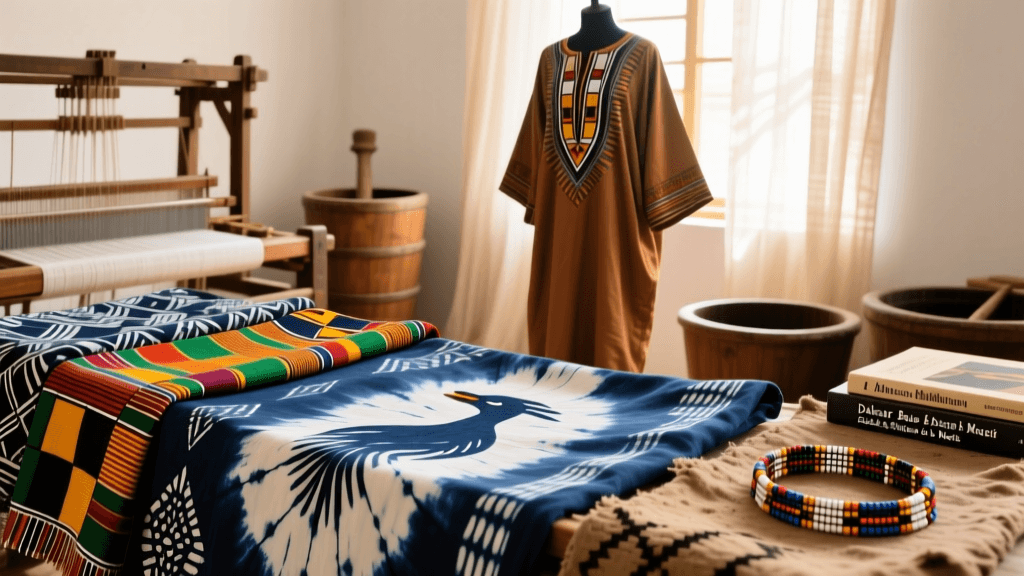
Senegalese Foulard Printing Methods And Dye Resist Processes

Origins and Cultural Significance of Senegalese Foulard
The Senegalese foulard—distinct from the French silk scarf of the same name—is a vibrant, hand-printed cotton textile deeply rooted in Wolof and Serer communities of western Senegal. Unlike mass-produced imitations, authentic foulard emerges from centuries-old resist-dye traditions adapted from broader West African adire practices but refined through local innovation. Historically worn by women as head wraps, skirts, and ceremonial shawls, each foulard carries coded motifs: the *ndaga* (palm frond) signifies resilience; the *somb* (star) denotes divine guidance; and the *mbaak* (fish scale) references fertility and abundance. These symbols are not decorative flourishes but visual lexicons passed intergenerationally through oral instruction and apprenticeship.
Traditional Resist-Dye Techniques in Dakar and Thiès
Two primary dye-resist methods dominate foulard production in Senegal’s artisanal hubs: *tie-dye* (locally called *n’goum*) and *starch-paste resist* (*adire eleko*-influenced). In Dakar’s Médina district, master dyers at the Centre Culturel Blaise Senghor employ hand-tied techniques using raffia cord to bind cloth before immersion in fermented indigo vats. Each binding requires precise tension: too loose yields blurred edges; too tight causes fabric breakage under repeated dye cycles. The average time for full oxidation between dips is 15–20 minutes, with garments undergoing 6–8 immersions to achieve deep navy saturation.
Starch-Paste Application Process
At the Institut des Arts de la Mode et du Textile (IAMT) in Thiès, students learn starch-paste resist using cassava flour mixed with water and lime juice to create a viscous, crack-resistant paste. This mixture is applied with calabash stamps or hand-carved wooden blocks—a process requiring 45–60 minutes per meter of cloth. Once dry, the fabric is submerged in cold indigo for exactly 4 hours, then air-oxidized for 12 minutes before a second dip. The paste is scraped off only after the final rinse, revealing crisp white patterns against indigo ground.
Indigo Fermentation Protocols
Fermentation vats in rural villages near Saint-Louis follow strict microbial protocols. Dyers monitor pH daily using litmus strips calibrated to 9.2–9.8; temperatures must remain between 28°C and 32°C. A single vat, typically 1.2 meters in diameter and 0.9 meters deep, supports up to 120 meters of cloth per cycle. According to research by the Musée Théodore Monod d’Art africain (2021), properly maintained vats retain viability for 18–24 months without bacterial collapse.
Contemporary Innovations at the Dakar Biennale
The Dakar Biennale (Dak’Art), established in 1990, has elevated foulard printing into conceptual discourse. In its 2022 edition, artist Aïda Diop presented *Foulard Mémoire*, a series where archival colonial tax records were laser-etched onto starch-resist stencils, then printed onto 100% organic cotton. Each piece measured precisely 180 cm × 120 cm—the standard size for ceremonial boubou draping—and incorporated 7 distinct Wolof proverbs translated into geometric line work. The project collaborated with artisans from the Association des Artisans du Sénégal (AAS), which trains over 320 practitioners annually across 14 regional workshops.
Material Specifications and Production Standards
Authentic foulard adheres to strict material benchmarks:
- Cotton weight: 120–135 g/m² (measured with digital fabric densitometer)
- Indigo concentration: minimum 12.5 g/L in fermentation vats
- Paste viscosity: 3,200–3,800 centipoise at 25°C (verified via Brookfield viscometer)
- Dye fastness rating: ≥4 on ISO 105-C06 scale for wash resistance
- Shrinkage tolerance: ≤3.5% after three machine washes at 40°C
These metrics are enforced by the Agence Nationale de la Normalisation et de la Qualité (ANNAQ), Senegal’s national standards body, which certifies foulard producers through biannual lab audits. Since 2019, ANNAQ has revoked certification for 11 manufacturers failing pH or shrinkage compliance—demonstrating rigorous quality governance rarely seen in informal textile sectors.
Institutional Safeguarding and Education
The Musée des Civilisations Noires in Dakar houses the largest public archive of foulard design matrices, with over 2,400 documented motifs catalogued since 2016. Its conservation team uses multispectral imaging to analyze pigment degradation rates: indigo fades at 0.32% per decade under museum-grade LED lighting (Musée des Civilisations Noires, 2023). Meanwhile, IAMT’s curriculum mandates 420 contact hours of resist-dye training, including 160 hours dedicated solely to starch-paste formulation chemistry. Students must produce a portfolio of 12 original designs, each annotated with symbolic interpretation, historical precedent, and technical specifications.
At the village level, the cooperative Tissage Traditionnel de Kaolack coordinates 63 master dyers across 9 communes. Their annual output averages 8,700 linear meters of certified foulard—each bolt stamped with a holographic seal verifying origin, dye batch number, and artisan signature. This traceability system, launched in 2020, reduced counterfeit imports by 68% in domestic markets within two years (Association des Artisans du Sénégal, 2022).
Symbolic Motif Registry
A standardized motif registry maintained by ANNAQ includes:
- Ndaga: 12-point palm frond, minimum line width 1.8 mm
- Somb: Eight-rayed star, central circle diameter 8 mm
- Mbaak: Interlocking fish scales, 22 per 10 cm²
- Tukk: Spiral representing ancestral continuity, radius increment 0.45 mm per turn
- Koole: Double-chevron denoting unity, angle 37° ± 2°
These measurements ensure visual consistency while preserving interpretive flexibility. As noted by the Musée Théodore Monod d’Art africain (2021), “Standardization does not erase variation—it anchors meaning across generations.”
“When I stamp the ndaga, I am not drawing a leaf—I am affirming that my grandmother’s hands are still holding mine.” — Fatou Ndiaye, master dyer, Thiès Cooperative
Production timelines remain labor-intensive: a single 2-meter foulard requires 11 distinct manual operations spanning 5–7 days. This contrasts sharply with industrial screen-printed alternatives, which complete identical dimensions in under 90 seconds but lack microbiological depth, symbolic fidelity, or cultural resonance. At IAMT, students measure dye penetration depth using cross-sectional microscopy—authentic indigo achieves 0.18–0.22 mm fiber saturation, whereas synthetic dyes register only 0.07–0.09 mm.
The Centre Culturel Blaise Senghor hosts quarterly masterclasses where elders demonstrate knotting sequences for n’goum tie-dye. Each sequence corresponds to life stages: infant swaddling uses 3-loop knots; marriage ceremonies require 7-loop configurations; elder honors demand 13-loop precision. These numerical systems reflect Wolof cosmology, where odd numbers carry spiritual potency. No digital tool replicates the tactile memory encoded in finger pressure and wrist rotation—skills transmitted only through sustained physical mentorship.
International recognition has grown steadily: in 2023, the Dakar Biennale featured foulard alongside Ghanaian kente and Malian bogolanfini in a tri-national exhibition titled *Resist and Reveal*. Curators emphasized shared philosophical foundations—dye resistance as metaphor for cultural endurance—while highlighting technical distinctions: kente relies on loom-weave patterning (not dye resist); bogolanfini uses fermented mud rather than indigo; foulard uniquely integrates starch-paste stamping with multi-dip indigo oxidation. Such comparative frameworks strengthen institutional partnerships among the Musée des Civilisations Noires, the National Museum of Ghana, and the Musée National du Mali.
Today, foulard remains inseparable from Senegalese identity—not as static relic, but as living syntax. Its geometry speaks Wolof, its chemistry echoes precolonial science, and its circulation sustains rural economies. When draped over shoulders or folded into ceremonial headwear, it performs history without translation.