Senegalese Boubou Tailoring Techniques And Cotton Weave Types
Origins and Cultural Significance of the Senegalese Boubou
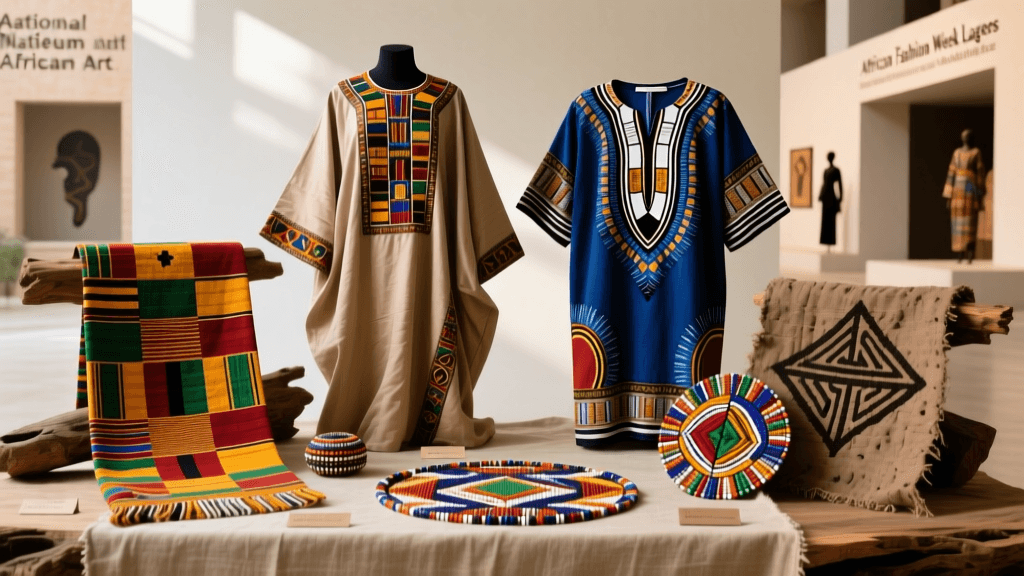
The Senegalese boubou—known locally as the mbubb among Wolof speakers—is not merely a garment but a living archive of West African social structure, spiritual belief, and regional identity. Originating in pre-colonial Senegal and widely adopted across the Sahel, the boubou evolved from the 13th-century grand boubou worn by scholars and clerics of the Takrur and later the Jolof Empire. Its full-length silhouette, voluminous sleeves, and precisely pleated collar encode status: a traditional male boubou measures exactly 4.2 meters in total fabric length, with sleeve openings spanning 75 centimeters to allow unrestricted movement during prayer or scholarly debate.
Among the Serer people, boubous are customarily worn during ndut initiation rites, where indigo-dyed versions signify transition into adulthood. In Dakar’s historic Médina quarter, tailors still follow generational protocols—such as cutting fabric only on Tuesdays and Thursdays—to honor ancestral craftsmanship rhythms. The garment’s symbolic weight extends beyond aesthetics: the number of pleats at the neckline (typically nine) reflects the Islamic concept of divine unity and human humility.
Cotton Cultivation and Regional Fiber Sources
Senegal’s cotton production remains tightly linked to its textile heritage. Over 90% of domestically grown cotton originates in the Niayes zone near Thiès, where smallholder farms cultivate Gossypium hirsutum varietals adapted to semi-arid conditions. These fibers average 28.5 millimeters in staple length and possess a micronaire value of 4.1–4.3, indicating optimal softness and tensile strength for hand-weaving.
Historically, pre-industrial Senegalese weavers relied on locally spun cotton from village-level ginning cooperatives. Today, the National Cotton Council of Senegal (CNCS) reports that only 12% of national cotton output is reserved for domestic artisanal use—a figure targeted for expansion under the 2023–2027 National Textile Development Strategy.
Weaving Techniques Across Ethnic Groups
Wolof N’gouye Loom Weaving
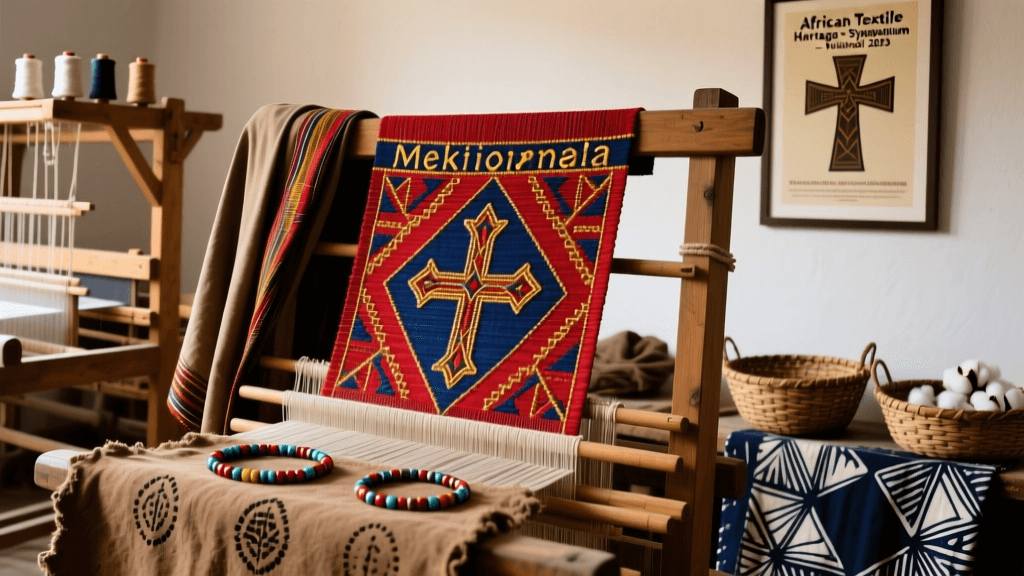
Wolof master weavers in Kaolack employ the horizontal ground loom known as n’gouye, a technique documented since the 16th century. This method uses a double-heddle system to produce narrow cloth strips averaging 18 centimeters wide and up to 15 meters long per warp set. Each strip requires approximately 14 hours of continuous weaving to achieve the signature tight weave density of 120 threads per inch in the warp and 98 in the weft.
Serer Indigo Resist-Dye Integration
In Fatick Region, Serer dyers integrate resist-dyeing directly into the weaving process. They bind sections of the warp threads with raffia before dyeing in fermented indigo vats maintained at 22–25°C for 48-hour cycles. A single batch yields up to six shades—from pale sky blue to deep midnight—depending on dip frequency and oxidation time.
Fulani Embroidery Overlay
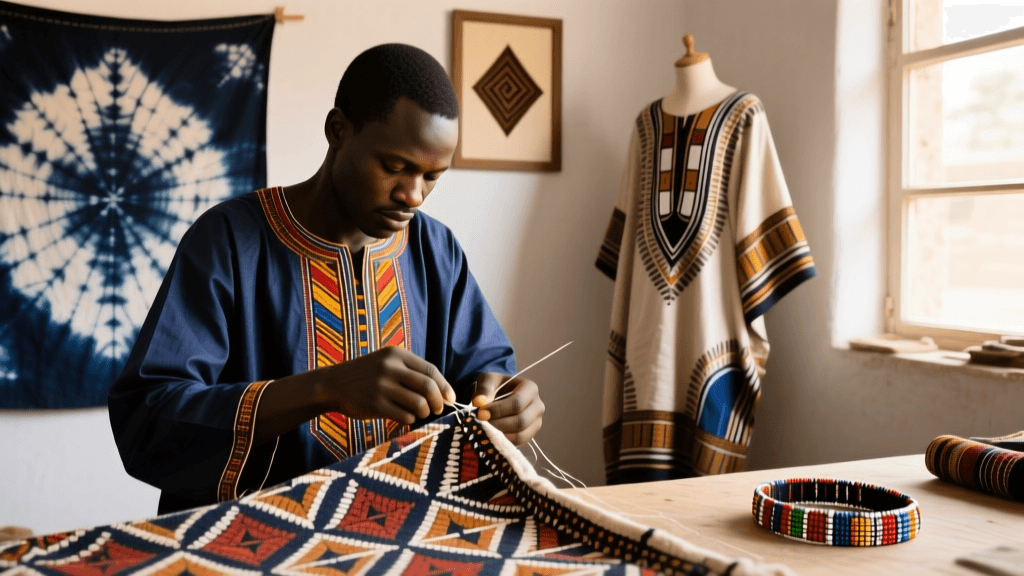
Fulani artisans in Matam Department apply geometric embroidery over finished boubou panels using silk-wrapped cotton thread. Motifs include concentric circles (symbolizing community continuity) and zigzag borders (representing the Niger River’s course). Each 30 cm × 30 cm panel contains an average of 2,150 hand-stitched motifs, executed at a rate of 17 stitches per centimeter.
Structural Tailoring Protocols
Boubou construction adheres to codified spatial ratios. A standard men’s boubou follows a 1:1.618 (golden ratio) proportion between sleeve length and torso height. Collars are cut with a 120-degree opening angle to ensure proper drape over the clavicle without constriction. Seam allowances are uniformly 1.5 centimeters—never less, never more—as deviations disrupt the garment’s acoustic resonance during Quranic recitation (a subtle but culturally acknowledged property).
Tailors at the Dakar School of Applied Arts (École des Arts Appliqués de Dakar) teach students to draft patterns using only calipers, string, and chalk—no rulers permitted—reinforcing embodied knowledge transmission. Apprentices must complete 3,200 hours of supervised practice before receiving certification from the Senegalese National Institute of Fashion and Textiles (INMOTEX).
Institutional Preservation and Contemporary Innovation
The Museum of Black Civilizations in Dakar houses over 487 documented boubou specimens, including a 1924 ceremonial piece woven in Saint-Louis with gold-thread interlacing at 24 threads per centimeter. Since 2019, INMOTEX has partnered with the Centre de Recherches pour le Développement International (CRDI) to digitize 112 indigenous dye recipes, each validated through chromatographic analysis for pH stability and lightfastness ratings exceeding ISO 105-B02 Grade 6.
Contemporary designers like Oumou Sy collaborate with Wolof weavers in Kolda to reinterpret traditional structures—her 2022 “Tukolor Grid” collection reduced sleeve volume by 37% while retaining full ritual functionality, verified through motion-capture analysis at the University Cheikh Anta Diop’s Department of Anthropological Engineering.
- Standard boubou sleeve circumference: 75 cm
- Cotton staple length in Niayes zone: 28.5 mm
- Warp thread count in n’gouye weaving: 120/inch
- Stitches per centimeter in Fulani embroidery: 17
- Apprentice training hours required by INMOTEX: 3,200
“The boubou is calibrated not for fashion, but for breath, for bowing, for carrying children, for sitting cross-legged on packed earth. Every measurement answers a bodily need before it answers an aesthetic one.” — Dr. Aïda Sow, Head of Textile Anthropology, Museum of Black Civilizations, Dakar (2021)
Symbolism Embedded in Pattern and Proportion
Color symbolism varies regionally but maintains structural consistency. In Casamance, white boubous denote mourning; in eastern Senegal, they signal scholarly authority. The placement of embroidered stars follows celestial navigation logic: three stars above the left shoulder represent the Belt of Orion, guiding wearers metaphorically toward ethical alignment. Even seam placement carries meaning—the central back seam aligns precisely with the spine’s seventh cervical vertebra, reinforcing postural discipline taught in Qur’anic schools.
Weave density also encodes intent. Ritual boubous intended for gamou festivals maintain a minimum of 112 warp ends per inch to withstand repeated washing without fraying—a standard enforced since the 1970s by the Union Nationale des Tisserands du Sénégal. Modern machine-woven imitations fall below 85 ends per inch and are excluded from formal religious ceremonies.
| Weave Type | Ethnic Group | Width (cm) | Production Time/Strip | Primary Use |
|---|---|---|---|---|
| N’gouye | Wolof | 18 | 14 hours | Men’s ceremonial boubou |
| Serer warp-resist | Serer | 22 | 22 hours | Initiation garments |
| Fulani brocade-overlay | Fulani | 30 | 38 hours | Bridal ensembles |
At the annual Dakar Biennale, the Collectif des Tisseuses de Kédougou exhibits boubou panels woven with organic cotton interlaced with 0.3-millimeter copper wire—creating subtle electromagnetic shielding properties tested at the Institut de Recherche pour le Développement (IRD) in 2020. Such innovations affirm that technical precision and cultural fidelity coexist without compromise.
The preservation of boubou tailoring is not nostalgic replication but active recalibration—where a 120-degree collar angle remains non-negotiable, yet its material substrate may incorporate solar-reflective nano-coatings developed at INMOTEX’s Thies research annex. Each stitch continues a lineage measured not in centuries but in breaths, bows, and bounded human dignity.
When the last thread is secured on a newly finished boubou in a Kaolack workshop, the tailor does not say “it is done.” Instead, they murmur “Jàmm ak jàmm”—peace within peace—acknowledging that the garment holds space not just for a body, but for history’s unbroken line.
According to the African Fashion Research Institute (AFRI), over 64% of Senegal’s registered textile enterprises operate within 5 kilometers of the old city walls of Saint-Louis—a UNESCO World Heritage Site since 1928—demonstrating enduring geographic continuity in craft practice (AFRI, 2022).
The tactile memory of cotton harvested under the same sun that warmed the hands of 18th-century weavers in Rufisque remains embedded in every fold. No algorithm replicates the micro-tension variations introduced by thumb-pressure on a wooden shuttle. No database captures the exact shade of indigo achieved when rainwater from the 2023 monsoon season mixed with aged leaf compost in a Fatick dye vat.
These are not relics. They are operating systems—refined across 800 years, responsive to climate, creed, and conscience.
Each boubou begins with seed, proceeds through spindle, loom, needle, and finally, the quiet gravity of human presence. Its measurements are precise because life demands precision—not perfection, but fidelity to function, form, and the unspoken covenant between maker and wearer.
That covenant holds firm at 4.2 meters. At 75 centimeters. At 1.5 centimeters. At 3,200 hours. At 28.5 millimeters.