Mastering Tanmono: Zero-Waste Kimono Construction in 2026
The Philosophy of the Tanmono Bolt
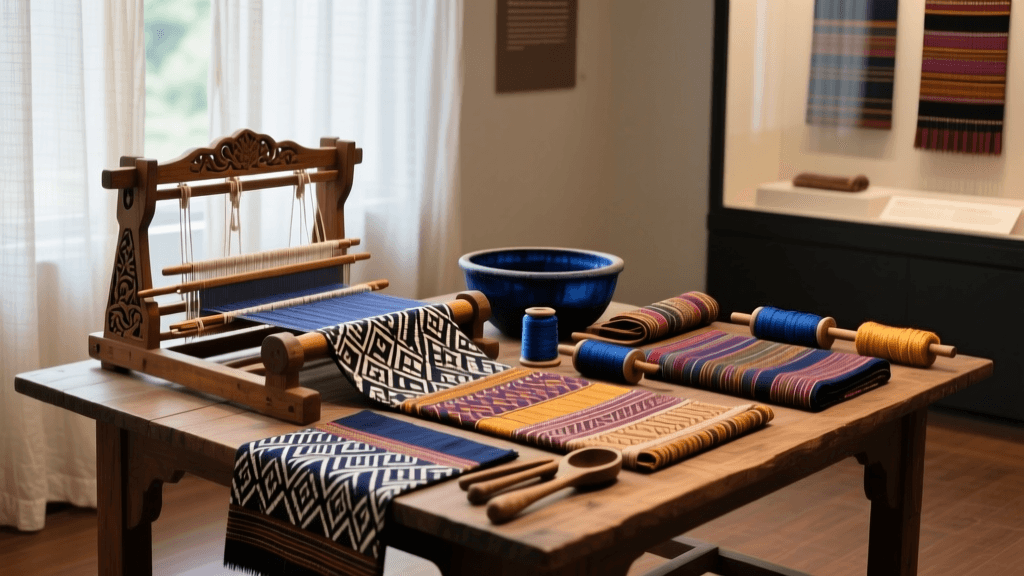
As the global fashion industry intensifies its pivot toward sustainable manufacturing in 2026, contemporary designers are increasingly looking to historical Asian dress traditions for solutions. Long before the modern zero-waste movement, the traditional Japanese kimono perfected the art of textile conservation through the Tanmono system. A Tanmono is a narrow, bolt-woven fabric, traditionally measuring between 36 and 38 centimeters (about 14 inches) in width and approximately 11.5 meters in length. This specific dimension was originally dictated by the physical constraints of hand-operated looms and the width of a human shoulder.
Unlike Western tailoring, which relies on complex, curved pattern pieces that generate significant offcut waste, kimono construction utilizes a purely rectilinear, T-shaped geometry. Every single centimeter of the Tanmono bolt is utilized in the final garment. According to research highlighted by the Victoria and Albert Museum, this structural philosophy not only eliminates textile waste but also allows the garment to be entirely disassembled, cleaned, and re-tailored across generations.
Deconstructing the T-Shaped Silhouette
The genius of kimono construction lies in its modularity. The garment is composed of eight primary rectangular panels, cut directly from the bolt without discarding the selvedge edges. In 2026, digital pattern drafting software tailored specifically for Asian traditional garments allows makers to visualize the drape of these panels based on precise 3D body scans, ensuring the Kitsuke (the art of dressing) achieves the perfect cylindrical silhouette without altering the fundamental zero-waste geometry.
Here is the standard breakdown of the eight panels comprising a women's kimono:
- Migoro (Main Body): Two long panels that form the front and back of the torso. They are folded over the shoulder, eliminating the need for a shoulder seam.
- Sode (Sleeves): Two rectangular panels attached to the Migoro, folded in half to create the iconic deep, pouch-like sleeves.
- Okumi (Front Overlaps): Two narrower panels (cut from a single width of fabric) sewn to the front edges of the Migoro to create the overlapping lapel necessary for the right-over-left closure.
- Eri (Collar): One long, narrow strip folded and attached to the neckline and down the front overlaps.
- Tomoeri (Collar Cover): A protective piece of fabric attached to the back of the neck collar to prevent soil from hair and skin oils.
- Kake-eri (Inner Collar): The inner lining of the collar, providing structural rigidity.
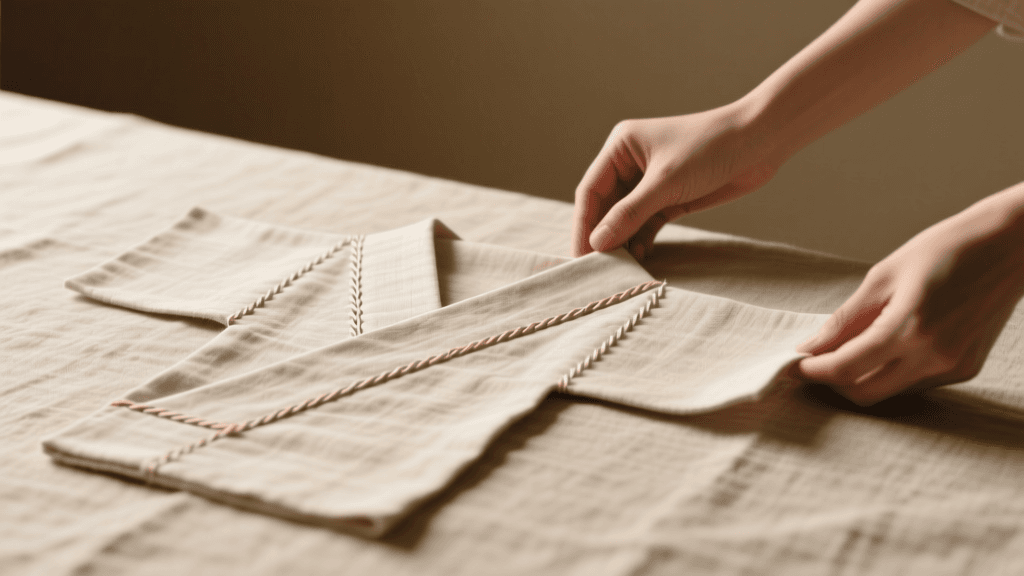
Because the selvedge edges (Mimi) are woven tightly to prevent fraying, they are never cut away. Instead, they are folded inward to form the seam allowances, a technique that preserves the structural integrity of the silk and ensures the fabric can be completely unpicked later.
The Genius of Arai-Hari (Wash and Stretch)
One of the most remarkable construction techniques in Asian dress traditions is Arai-hari. Because the kimono is sewn using a simple running stitch and the fabric is never cut into curved shapes, the garment is designed to be taken apart. Historically, and still practiced by specialized artisans in 2026, the kimono is unpicked into its original flat Tanmono panels. These panels are then washed, stretched on wooden boards (Shinshi) using hundreds of tiny pins to restore the silk's tension and dimensions, and finally re-sewn. This modular construction extends the life of a single garment for over a century, a stark contrast to the planned obsolescence of modern fast fashion. The Metropolitan Museum of Art notes that this cyclical lifecycle is a foundational element of Japanese textile culture, treating the fabric as a continuous, living material rather than a static object.
Traditional vs. 2026 Modern Construction Techniques
While the core geometry of the kimono remains unchanged, the tools and auxiliary materials used by Shitate-shi (kimono tailors) have evolved. Below is a comparison of traditional methods versus the adaptations seen in modern ateliers in 2026.
| Construction Phase | Traditional Method | 2026 Modern Adaptation |
|---|---|---|
| Pattern Marking | Shirushi-ito (marking threads) or charcoal | Water-soluble, UV-reactive digital tracing pens |
| Basting (Shitsuke) | Hand-spun silk or cotton basting thread | PVA water-soluble threads that dissolve in warm water |
| Seam Pressing | Kote (charcoal-heated brass iron) | Digital temperature-controlled steam irons with Teflon shoes |
| Body Measurement | Standardized Kujira-shaku (whalebone ruler) | 3D body scanning mapped to Kujira-shaku algorithms |
| Reinforcement | Hand-stitched Chikara-nui (bar tacks) | Micro-programmable automated bar-tacking for hidden stress points |
Step-by-Step: The Shitate (Tailoring) Process
Constructing a kimono requires a deep understanding of fabric grain, tension, and hidden stitches. The process of Shitate is meditative and highly precise.
1. Marking and Basting
The tailor begins by measuring the Tanmono using a Kujira-shaku ruler. In 2026, many makers use laser-guided measuring tapes to ensure absolute accuracy down to the millimeter. The fabric is marked, and the panels are temporarily joined using Shitsuke-ito (basting thread). The basting stitches are long and loose, designed to hold the heavy silk layers together without distorting the weave.
2. The Running Stitch (Nui)
The primary seam is sewn using a running stitch (Hon-nui). The stitch length is typically 2 to 3 millimeters. The critical rule of kimono sewing is that the knot of the thread must never be visible on either the inside or outside of the garment. Tailors achieve this by hiding the starting knot inside the seam allowance or between the folded layers of the selvedge. The tension of the thread must perfectly match the tension of the silk; if pulled too tight, the seam will pucker; if too loose, the structural integrity fails.
3. Hemming and Folding (Kuke)
Because the selvedge is preserved, the side seams are folded inward. The hem (Suso) and sleeve openings (Sodeguchi) require a technique called Kuke. This is a nearly invisible blind stitch where the needle catches only a single thread of the fabric's weave, rendering the hemming invisible from the outside. For heavy winter kimonos, tailors may insert a layer of cotton wadding (Wata-ire) into the hem, requiring specialized quilting stitches to secure the batting without piercing the outer silk shell.
Structural Reinforcements: Chikara-nui and Miyatsukuchi
Women's kimonos feature a unique structural element called the Miyatsukuchi—an open slit located just below the sleeve attachment on the side seams. This opening allows for ventilation and provides the necessary slack to adjust the Obi (sash) and smooth out the fabric across the torso during dressing. Because this open slit is a high-stress area, it must be reinforced.
Tailors use a technique called Chikara-nui (strength stitching). This involves a dense, hand-stitched bar tack at the top and bottom of the Miyatsukuchi slit. In 2026, while some high-end bespoke tailors still execute this by hand using heavy silk thread, many contemporary ateliers use micro-programmable sewing machines to apply a Chikara-nui that is mathematically identical to historical examples, ensuring the slit can withstand the tension of modern, dynamic movement.
Essential Tools for the 2026 Maker
For those looking to study or replicate Asian garment construction techniques today, the toolkit bridges the ancient and the cutting-edge:
- Shitate-ita (Tailoring Board): A long, smooth wooden board used to support the fabric while sewing. Modern versions often feature built-in LED edge-lighting to help the tailor see the grain of dark silk fabrics.
- Harite (Tension Pins): Heavy wooden blocks with pins, used to anchor the fabric to the tailor's body or the board, maintaining consistent tension while sewing the long running seams.
- Hera (Marking Spatula): Traditionally made of bamboo or bone, used to crease the silk. Modern makers often use polished Teflon or smooth acrylic Hera to prevent microscopic snags on delicate 2026 bio-silk blends.
- Kote (Iron): While traditional charcoal irons are beautiful artifacts, modern makers utilize lightweight, digital steam irons with precise humidity controls to press seams open without scorching protein-based silk fibers.
Sustainability and the Future of Zero-Waste Asian Dress
The construction techniques of the kimono are not merely historical curiosities; they are vital blueprints for the future of sustainable fashion. By studying the Tanmono system, modern designers learn that zero-waste is not a compromise on aesthetics, but a framework that dictates a completely different, highly elegant approach to the human form. As we move further into 2026, the integration of 3D scanning, bio-engineered threads, and digital looms with the ancient, unyielding logic of the T-shaped silhouette proves that the most sustainable garment is one designed to be unmade, reborn, and worn for a lifetime.