Hanfu in Kunqu Opera: 2026 Stage Revival & Costume Guide
The 2026 Renaissance: Hanfu Meets Traditional Chinese Opera
As we navigate the cultural landscape of 2026, the intersection of the Hanfu revival movement and traditional Chinese performing arts has reached an unprecedented zenith. For decades, traditional Chinese opera relied on Xifu—highly stylized, anachronistic stage costumes heavily influenced by Qing dynasty aesthetics and theatrical exaggeration. However, the 2026 stage season has ushered in a radical shift. Driven by a highly educated, younger demographic of theatergoers and a renewed emphasis on archaeological accuracy, premier Kunqu and Peking Opera troupes are now integrating historically accurate Hanfu (specifically Ming and Song dynasty silhouettes) into their most prestigious productions.
This evolution is not merely a visual upgrade; it fundamentally alters the choreography, textile sourcing, and performance dynamics of traditional theater. According to UNESCO's Intangible Cultural Heritage registry, Kunqu opera is one of the oldest and most refined forms of Chinese theater, characterized by its graceful, fluid movements and poetic librettos. In 2026, preserving this grace while adopting authentic Hanfu requires a masterful blend of historical tailoring and modern theatrical engineering.
Kunqu vs. Peking Opera: A Divergence in Costume Philosophy
While both art forms are pillars of Chinese performing arts, their approach to the 2026 Hanfu integration differs significantly. Peking Opera (Jingju) is inherently stylized, relying on bold colors, exaggerated shoulder pads, and heavy platform boots to convey character archetypes from a distance. As noted by the Encyclopedia Britannica's comprehensive guide to Peking Opera, the visual language of Jingju is symbolic rather than historically literal. Consequently, Peking Opera's adoption of Hanfu remains largely confined to experimental, avant-garde fringe festivals rather than mainstream repertory.
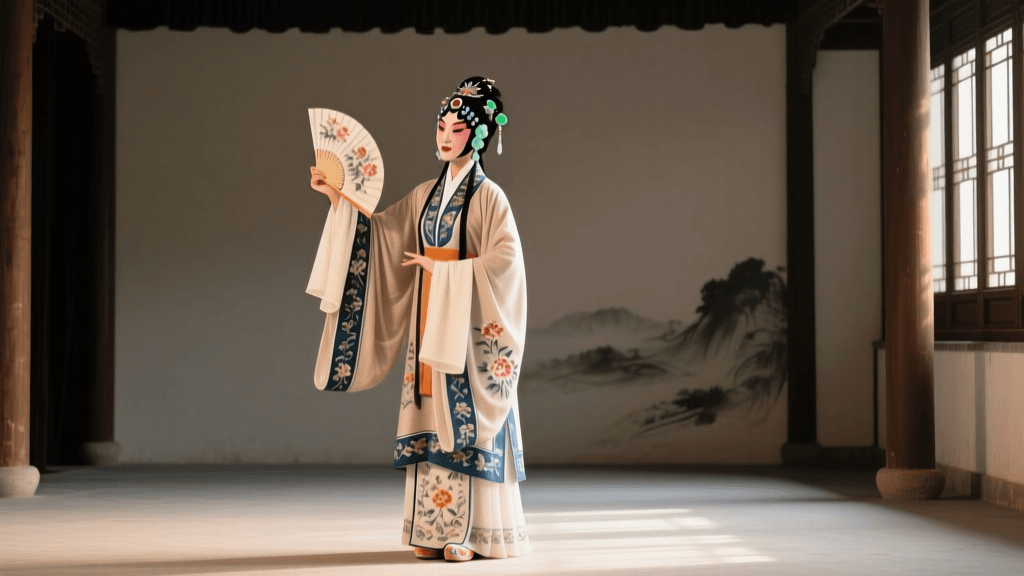
Kunqu, conversely, is the intimate, scholarly ancestor of Chinese opera. Its choreography relies on subtle sleeve movements, delicate fan work, and grounded, gliding footwork. This makes Kunqu the perfect canvas for the authentic Hanfu revival. The flowing lines of a Ming dynasty Pifeng (cloak) or the structured pleats of a Mamianqun (horse-face skirt) naturally amplify the elegant, melancholic beauty of Kunqu's signature dances. In 2026, the Jiangsu Kunqu Opera Theatre and the Shanghai Kunqu Opera Troupe have led the charge, debuting fully historically-costumed productions of The Peony Pavilion that have sold out months in advance.
The Shift Toward Historical Accuracy on Stage
The modern theatergoer in 2026 is highly literate in traditional garment construction. Audiences now scrutinize the direction of collar overlaps (ensuring the left lapel crosses over the right, or jiaoling youren), the accuracy of sleeve cuffs, and the authenticity of textile patterns. Costumers are moving away from cheap synthetic brocades, opting instead for meticulously researched silk weaves that mimic museum artifacts. The Metropolitan Museum of Art's Heilbrunn Timeline of Art History on Chinese Textiles serves as a frequent reference point for modern theatrical designers seeking to replicate the intricate damask and kesi (silk tapestry) techniques of the Ming era.
Essential Hanfu Garments for the 2026 Kunqu Stage
Adapting historical garments for the stage requires balancing visual authenticity with the physical demands of live performance. Here are the core Hanfu garments dominating the 2026 Kunqu stage, along with their specific theatrical adaptations:
- The Ming Dynasty Pifeng (Cloak): Worn by female leads (Dan roles), the Pifeng provides a stunning, elongated silhouette. For stage use, the side slits are reinforced with hidden silk gussets to allow for deep lunges and wide stances without tearing the delicate fabric.
- The Mamianqun (Horse-Face Skirt): The quintessential skirt of the Ming dynasty. On stage, the flat front and back panels (the "horse faces") are heavily embroidered with Suzhou-style Su Xiu threadwork to catch the stage lights, while the side pleats are engineered to flare dramatically during spinning movements.
- The Daopao (Taoist Robe): Utilized for male scholar or mystical roles, this garment features wide, flowing sleeves and a cross-collar. In 2026 productions, the hem is weighted with hidden lead beads to ensure the robe swings with a pendulum-like grace during rapid turns.
- The Shuitianyi (Water Field Vest): A patchwork vest historically worn by monks or ascetic characters. Modern stage versions use contrasting silk jacquards rather than actual patchwork to maintain a premium, unified aesthetic under theatrical lighting.
Traditional Xifu vs. 2026 Stage Hanfu: A Technical Comparison
Understanding the technical differences between traditional opera costumes and the new wave of stage Hanfu is crucial for collectors, performers, and historians alike.
| Feature | Traditional Theatrical Xifu | 2026 Stage Hanfu (Ming/Song Revival) |
|---|---|---|
| Silhouette | Exaggerated, padded shoulders, stiff collars, A-line skirts. | Natural shoulder lines, soft cross-collars, structured pleated skirts. |
| Sleeves | Extremely long, exaggerated white silk "Water Sleeves" (Shuixiu). | Authentic wide sleeves with subtle, integrated 30cm silk extensions. |
| Fastenings | Hidden modern zippers, velcro, and snap buttons for quick changes. | Authentic fabric ties and buttons, reinforced with hidden elastic loops. |
| Fabric Weight | Lightweight synthetic blends to prevent overheating under hot stage lights. | Heavyweight 30-momme silk crepe to ensure proper drape and movement. |
| Embroidery | Machine-embroidered, high-contrast metallic threads for visibility. | Hand-finished Su Xiu or high-density digital embroidery mimicking kesi silk. |
Sourcing and Crafting Stage-Ready Hanfu in 2026
For independent theater troupes, university performing arts programs, and serious collectors looking to acquire stage-ready Hanfu in 2026, off-the-rack options are rarely sufficient. The physical demands of opera require bespoke tailoring. Commissioning a stage-ready Ming dynasty Pifeng and Mamianqun set from a premium atelier in Suzhou or Hangzhou typically ranges from $1,200 to $3,500 USD, depending on the density of the embroidery and the grade of the silk.
Technical Specifications for Theatrical Movement
When commissioning garments for Kunqu or Peking Opera, you must provide your tailor with specific performance metrics. A standard Hanfu skirt is measured to the ankle, but a stage Mamianqun must be measured precisely 2.5 centimeters off the ground while the performer is wearing their specific theatrical shoes (often flat silk slippers for Kunqu, or elevated platform shoes for certain Peking Opera roles). This prevents the performer from tripping during the Yuanba (circular walking) step, a foundational technique where the upper body must remain perfectly still while the feet move rapidly.
Furthermore, the "water sleeves" (shuixiu) used in traditional opera are typically separate white silk extensions sewn onto the cuffs of the Xifu. In the 2026 Hanfu revival, costumers are dyeing the sleeve extensions to match the garment's primary color or using subtle gradient dyes (Jianyun) that transition from the sleeve's base color to pure white at the tip, maintaining the visual language of the water sleeve while adhering to a more historically grounded aesthetic.
The Future of Theatrical Textiles
The integration of Hanfu into traditional Chinese opera is more than a passing trend; it is a profound reclamation of cultural memory. As 2026 progresses, we are seeing the development of "smart silks"—textiles woven with micro-threads that reflect stage lighting more efficiently, reducing the need for heavy, heat-inducing theatrical spotlights. By honoring the archaeological realities of the Ming and Song dynasties while respecting the rigorous physical demands of the stage, today's costumers are ensuring that the visual poetry of Kunqu and Peking Opera remains as breathtaking as its vocal performances. Whether you are a theater director, a textile historian, or a devoted fan of traditional arts, the 2026 stage offers a masterclass in the living, breathing evolution of Asian traditions.