Zero-Waste Kimono Construction: Tanmono Cutting in 2026
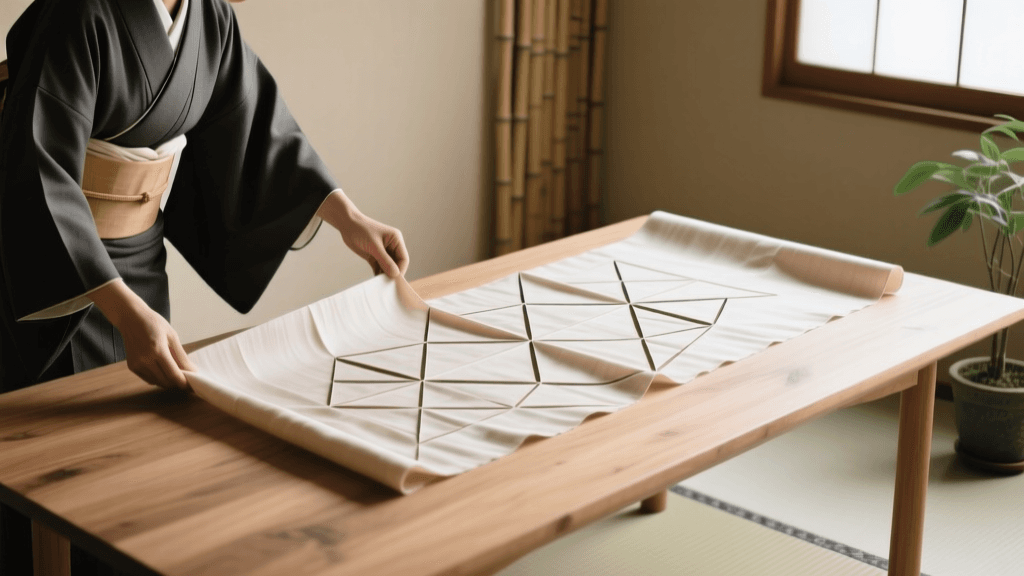
The Geometry of Sustainability: Revisiting the Tanmono in 2026
As the global fashion industry faces stringent environmental regulations and a consumer demand for circularity in 2026, modern pattern drafters are increasingly looking to the past for solutions. At the forefront of this sustainable renaissance is the traditional Japanese kimono and its foundational construction method: the tanmono (fabric bolt) cutting technique. Unlike Western tailoring, which relies on curved seams that inevitably leave 15% to 20% of fabric on the cutting room floor, the kimono is a masterclass in zero-waste geometric engineering.
According to historical archives and textile conservators, such as those documented by the Metropolitan Museum of Art's Heilbrunn Timeline of Art History, the kimono's structure is defined not by the shape of the human body, but by the shape of the loom. By understanding and adapting these centuries-old Asian dress traditions, today's designers and home sewists can create stunning, adaptable garments with absolute zero textile waste.
Anatomy of the Tanmono Bolt: Measurements and Mathematics
The foundation of the kimono is the tanmono, a narrow, continuous bolt of fabric. Historically, this width was dictated by the physical reach of the weaver operating a traditional backstrap or floor loom. Today, even with advanced digital Jacquard looms, the traditional dimensions are strictly maintained to preserve the integrity of the garment's construction.
Standard Dimensions for 2026 Production
- Women's Standard Width: 36 cm (approx. 14.1 inches)
- Men's Standard Width: 42 cm (approx. 16.5 inches)
- Total Length: 11.5 to 12 meters (approx. 12.5 to 13.1 yards)
In 2026, with the cost of premium Tango chirimen (crepe) silk rising to upwards of $1,200 per bolt due to sericulture labor shifts, maximizing yield is not just an eco-friendly choice—it is an economic necessity. The genius of the tanmono system is that the entire 12-meter length is utilized without discarding a single scrap.
Deconstructing the Straight-Line Cut: The 8 Panels
A standard kimono is constructed from eight primary rectangular panels. Because there are no curved armholes, princess seams, or tailored darts, the fabric can be completely disassembled, washed, re-dyed, and resewn—a practice known as arai-hari that extends the garment's life across generations.
- Migoro (Body Panels): Two full lengths of the bolt are cut to form the main front and back body. These are folded over the shoulders rather than cut at the shoulder line.
- Sode (Sleeves): Two rectangular panels are cut from the remaining fabric. The iconic curved bottom of the kimono sleeve is not achieved by cutting the fabric, but by folding and stitching the bottom edge inward, preserving the rectangle.
- Okumi (Front Overlaps): Two narrower panels are cut from the fabric leftover from the sleeve cutting. These are attached to the front migoro to create the overlapping lapel.
- Eri (Collar): The narrowest remnants of the bolt are sliced into thin strips to form the inner and outer collars.
As highlighted in the Victoria and Albert Museum's extensive research on kimono construction, this straight-line cutting method means the garment's shape is created entirely through the folding, overlapping, and tying of the obi (sash), rather than through destructive cutting.
Comparative Analysis: Zero-Waste Asian vs. Western Construction
To understand the efficiency of the tanmono method, we must compare it to other global construction techniques commonly used in 2026 apparel manufacturing.
| Construction Technique | Origin / Tradition | Fabric Waste % | Structural Adaptability | Assembly Time (Average) |
|---|---|---|---|---|
| Tanmono Straight-Cut | Japanese Kimono | 0% | High (Width adjustable via gussets) | 15-30 Hours (Hand/Machine hybrid) |
| Flat-Panel Curved Sleeve | Korean Hanbok (Baerae) | 5-8% | Medium (Requires curved seam drafting) | 10-20 Hours |
| Fitted Bodice Draping | Western Tailoring | 15-25% | Low (Cut specifically to one body) | 5-12 Hours (Industrial) |
| Jiaoling Youren Wrap | Chinese Hanfu | 2-5% | High (Wrap ties allow fluctuation) | 12-25 Hours |
Adapting Tanmono for Modern Sizing: The Machi Gusset
A common critique of the traditional tanmono system is its limitation regarding body width. Two 36 cm body panels yield a maximum circumference of roughly 144 cm (minus seam allowances). For many modern wearers in 2026, this is insufficient.
Traditional Japanese tailors solved this without breaking the zero-waste rule by utilizing the machi (gusset). If a wider fit is required, the tailor cuts narrow vertical strips from the very edges of the tanmono (the mimi, or selvedge edges, which are often left uncut in the bolt) and inserts them as underarm or side-seam gussets. This maintains the geometric integrity of the garment while expanding the circumference, proving that traditional Asian dress techniques are inherently inclusive when properly understood.
Stitching Techniques: Traditional Hand-Basting vs. 2026 Machinery
Authentic kimono construction relies heavily on shitsuke (basting) and kuke (blind stitching). The seams are intentionally left slightly loose to allow the silk to drape and breathe. In 2026, while purists still utilize hand-stitching with specialized silk threads like Gutermann Silk Finish Cotton, modern sustainable ateliers have adapted the technique for efficiency.
Using a straight-stitch only machine, such as the Juki TL-2010Q or the Bernina 590, equipped with a specialized walking foot, sewists can replicate the traditional 3mm to 4mm stitch length required for kimono seams without puckering the delicate chirimen or modern cupro-blend fabrics. The key is to avoid backstitching; instead, traditional knots are used at the start and end of seams to allow for future deconstruction.
"The brilliance of the kimono is not just in its beauty, but in its profound respect for the material. Every thread woven into the tanmono remains in the final garment, honoring the labor of the silkworm and the weaver." — Master Textile Conservator, Kyoto, 2026.
Sourcing Authentic Tanmono and Sustainable Alternatives
For sewists and designers looking to implement tanmono cutting in 2026, sourcing the correct fabric width is paramount. While importing authentic Nishijin-ori or Yuzen-dyed silk bolts from Kyoto remains the gold standard (with prices ranging from $800 to $3,000+ per bolt), the market for sustainable alternatives has expanded dramatically.
Modern eco-textile mills in Japan and South Korea are now producing zero-waste bolts woven to the exact 36cm specification using Tencel lyocell, recycled cupro, and organic hemp. These modern tanmono bolts typically retail between $90 and $180 online, making the zero-waste kimono construction method accessible to a global audience of sustainable fashion students and independent designers.
Storage and Care: The Tato Folding Method
Because the kimono is constructed of flat, straight panels, it is designed to be stored flat rather than hung, which prevents stress on the shoulder seams. The traditional tato folding method reduces the garment to a neat, flat rectangle that can be stacked in a drawer. In 2026, archival-quality, acid-free tatogami (wrapping paper) is widely available for approximately $15 to $25 per sheet, ensuring that both vintage silks and modern eco-blends are protected from environmental degradation while stored.
Conclusion
The tanmono cutting technique is far more than a historical artifact; it is a highly sophisticated, mathematically perfect approach to zero-waste garment construction. By studying the geometric brilliance of the Japanese kimono, modern designers and sewists in 2026 can break free from the wasteful paradigms of Western pattern drafting. Embracing these Asian dress traditions allows us to create garments that are not only structurally sound and beautifully draped but also profoundly respectful of our planet's limited resources.