Peking Opera Costumes: Sourcing Mang Robes and Kao Armor
The Codified Wardrobe of Jingju
Peking Opera, known as Jingju, is a cornerstone of Asian performance traditions and a globally recognized masterpiece of intangible cultural heritage. According to the UNESCO Intangible Cultural Heritage registry, Jingju is celebrated not just for its vocal and acrobatic prowess, but for its highly stylized, visual storytelling. At the heart of this visual language is the Xingtou—the traditional opera wardrobe. Unlike Western theatrical costuming, which often strives for historical accuracy, the Peking Opera wardrobe operates on a timeless, codified system. Garments are based loosely on Ming Dynasty aesthetics but are heavily exaggerated to denote character archetypes, social status, and moral alignment.
For modern performers, cultural festival organizers, and serious collectors, acquiring and wearing these garments requires a deep understanding of their anatomy, sourcing logistics, and the physical demands they place on the wearer. This guide focuses on two of the most iconic and complex garments in the Jingju wardrobe: the Mang (Python Robe) and the Kao (Armor).
The Mang (Python Robe): Regal Elegance on Stage
The Mang is the formal court robe worn by emperors, high-ranking officials, and noble figures. It features a round collar, an overlapping front closure, and wide, flowing sleeves. The garment is heavily embroidered with the 'python' motif—a mythical serpent that resembles a dragon but possesses four claws instead of five, adhering to ancient sumptuary laws that reserved the five-clawed dragon exclusively for the Emperor.
Color coding in the Mang is strictly regulated by theatrical convention:
- Yellow: Reserved exclusively for the Emperor and royal family members.
- Red: Worn by high-ranking officials, loyal ministers, and noble characters.
- Black: Indicates a rough, bold, or fierce personality, often worn by judges or formidable generals.
- White: Typically worn by young, handsome scholars or elderly, virtuous officials.
Actionable Advice for Performers: When wearing the Mang, the actor must also wear a Yudai (jade belt) around the waist. The belt should sit high, just below the ribcage, to elongate the lower body and provide a structural anchor for the heavy silk robe. The robe is worn over thick, padded undergarments to give the performer a commanding, broad-shouldered silhouette.
The Kao (Armor): Engineering Theatrical Combat
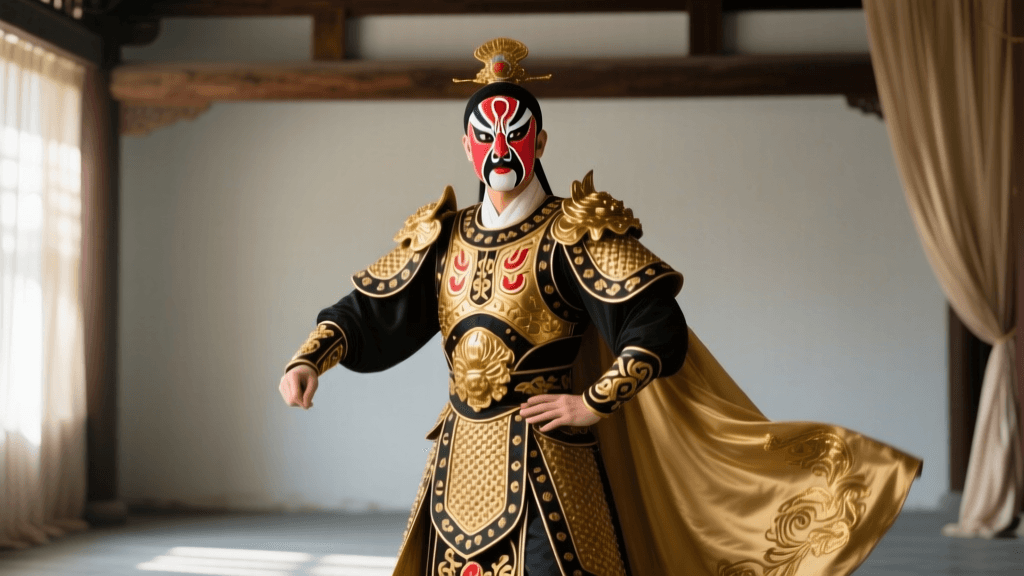
The Kao is the theatrical armor worn by generals and warriors. It is a marvel of theatrical engineering, designed to look like heavy metal plate armor while allowing the performer to execute high kicks, flips, and rapid spear routines. The Kao is divided into the Ying Kao (Hard Armor) and the Ruan Kao (Soft Armor).
The Ying Kao is the most visually striking, featuring the iconic Kaoqi—four triangular flags attached to a leather harness on the performer's back. These flags represent the general's command over an entire army. According to Britannica's guide to Peking Opera, the manipulation of these flags and the heavy armor requires years of specialized physical conditioning.
Actionable Advice for Performers: The Kaoqi harness must be tied tightly across the chest and shoulders using cotton binding tape. If tied too loosely, the flags will wobble during acrobatic combat sequences, ruining the illusion of the general's steadfastness. Performers should pad the shoulder straps with high-density foam to prevent the wooden flagpoles from bruising the trapezius muscles during long festival performances.
Sourcing Authentic Garments: Costs, Timelines, and Materials
Sourcing high-quality opera costumes requires navigating the divide between mass-produced festival wear and authentic, hand-embroidered theatrical garments. The premier hub for authentic Jingju embroidery is Suzhou, where the legendary Suxiu (Suzhou embroidery) technique is still practiced by master artisans. For a comprehensive look at historical textile techniques used in these garments, the Victoria and Albert Museum's Asian Collections offers extensive archival insights into Chinese theatrical textiles.
Below is a comparative guide for sourcing Mang and Kao garments for professional or high-level amateur use:
| Garment Type | Material & Embroidery | Cost Range (USD) | Lead Time | Best Use Case |
|---|---|---|---|---|
| Stock Mang Robe | Poly-satin, Machine Embroidery | $150 - $350 | 1 - 2 Weeks | Community festivals, amateur troupes |
| Custom Mang Robe | Heavy Silk Satin, Hand Suxiu | $1,800 - $4,500+ | 3 - 6 Months | Professional stage, serious collectors |
| Stock Ying Kao (Armor) | Velvet/Satin, Machine, Foam padding | $250 - $500 | 2 - 3 Weeks | Photography, light stage performance |
| Custom Ying Kao (Armor) | Silk, Hand-embroidered, Leather harness | $2,500 - $6,000+ | 4 - 8 Months | Acrobatic combat, lead theatrical roles |
Precision Measurements for Stage Mobility
Opera costumes are not tailored to hug the body; they are engineered to drape, flow, and amplify movement. However, specific anchor points must be measured with absolute precision to ensure the performer does not trip or suffer restricted blood flow during acrobatics.
When commissioning a custom Mang or Kao, provide the workshop with the following specific measurements:
- Shoulder-to-Floor Length: Measured from the base of the neck to the ankle bone. The robe must clear the floor by exactly 2 inches to prevent tripping during rapid stage crossings (Yuanba).
- Armhole Depth (Gusset): Opera garments feature deeply dropped armholes with diamond-shaped gussets. Measure the chest circumference at its widest point during a full inhalation, then add 4 inches to allow for the deep armhole construction.
- Waist Anchor Point: Measure the circumference of the torso exactly where the Yudai (jade belt) or armor harness will sit (usually 2 inches above the navel). This ensures the internal tying ribbons are placed correctly to bear the garment's weight.
Mastering the Shuixiu (Water Sleeves)
Both the Mang and many other opera garments feature Shuixiu, or 'water sleeves.' These are extensions of pure white silk attached to the cuffs of the robe. They are not merely decorative; they are vital props used to express emotions ranging from weeping and shyness to fury and dismissal.
Sizing and Material: For professional performers, water sleeves should measure between 18 and 24 inches in length beyond the wrist. The silk must be heavy enough to hold a fold when thrown over the arm, but light enough to ripple like water. Habotai silk (8mm to 10mm weight) is the industry standard. Before a performance, the sleeves must be heavily starched and ironed with a sharp crease down the center to ensure they snap open crisply during the Touxiu (flicking) technique.
Festival Preparation and Garment Care
Traditional opera garments are massive investments. The metallic threads used in authentic Suxiu embroidery are highly susceptible to tarnishing, oxidation, and snapping if mishandled.
'In Jingju, the actor does not wear the costume; the costume wears the actor. Treat the silk as you would your own skin.' — Traditional Peking Opera Wardrobe Proverb.
Actionable Maintenance Protocol:
- Never Fold: Folding will permanently crease the silk and snap the metallic embroidery threads. Always roll Mang robes around acid-free cardboard tubes, with the embroidered side facing outward.
- Steaming over Ironing: Never apply a direct iron to the embroidered sections. Use a professional upright steamer held 6 inches away from the fabric to release wrinkles.
- Post-Performance Airing: Performers sweat heavily beneath the padded undergarments. The inner lining of the Kao and Mang must be sprayed with a 70% isopropyl alcohol solution and hung in a climate-controlled room (below 45% humidity) for 24 hours before being returned to storage.
By understanding the profound symbolism, precise engineering, and meticulous care required for Peking Opera garments, performers and festival directors can ensure that the majestic legacy of Jingju continues to captivate audiences with every sweep of a water sleeve and every strike of a general's flag.