Mastering Tanmono: Zero-Waste Kimono Construction in 2026
The global fashion industry's aggressive pivot toward circularity and waste reduction in 2026 has brought renewed, intense scrutiny to historical garment construction methods. As modern brands struggle to eliminate the 15% to 20% of textile waste typically generated during curved pattern cutting, designers and historians are looking back to one of history's most ingenious zero-waste systems: the traditional Japanese Tanmono bolt and the straight-line construction of the kimono. Understanding this centuries-old Asian dress tradition provides a masterclass in sustainable engineering, offering actionable blueprints for the eco-conscious designers and makers of today.
The Anatomy of the Tanmono Bolt
Unlike Western textile manufacturing, which produces wide bolts of fabric (often 140cm to 150cm across) that are subsequently cut into curved, irregular pattern pieces, traditional Japanese textiles are woven into narrow, standardized bolts known as Tanmono. A standard Tanmono bolt measures approximately 36 to 40 centimeters in width and roughly 12 meters in length. This specific dimension is not arbitrary; it is mathematically calibrated to the human form and the straight-line cutting method.
Because the fabric is woven to this exact, narrow width, the selvedge (the tightly woven edge of the fabric) is preserved and utilized as a finished edge within the garment. This eliminates the need for overlocking, serging, or hemming the raw edges of the fabric panels. According to The Metropolitan Museum of Art's Heilbrunn Timeline of Art History, the evolution of the kimono from the kosode of the Edo period was intrinsically linked to the standardized loom widths of the era, creating a harmonious relationship between the weaver, the tailor, and the wearer that modern fast fashion has largely abandoned.
Straight-Line Cutting and the Zero-Waste Philosophy
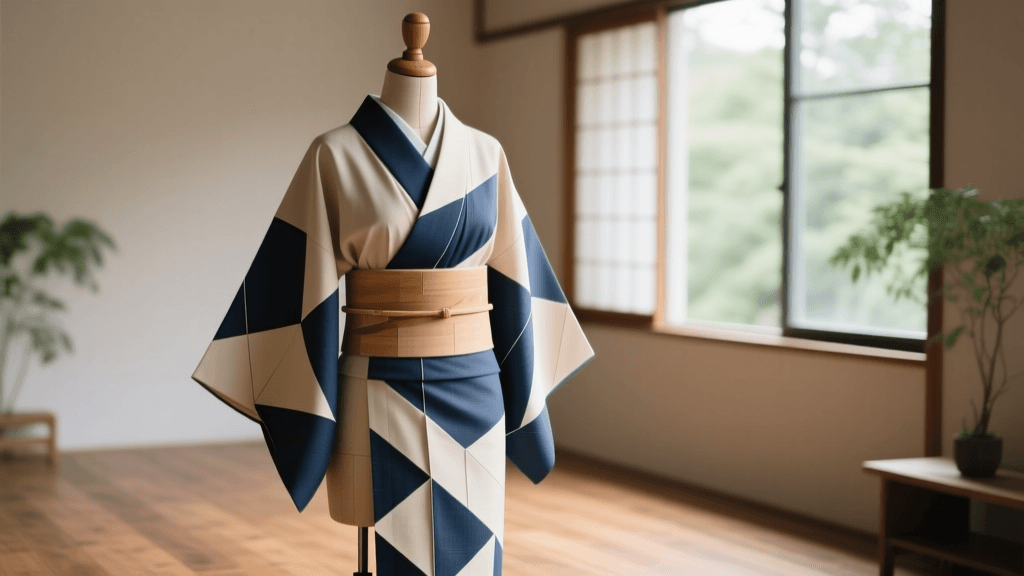
The core philosophy of kimono construction is the absolute refusal to waste material. A standard kimono is constructed from exactly eight rectangular panels cut directly from the single Tanmono bolt. Because the cuts are entirely linear—following the warp and weft threads of the weave—there are no off-cuts, no curved armholes, and no scrap fabric left on the cutting room floor. The entire 12-meter bolt is consumed in the creation of a single garment.
This geometric approach to garment construction stands in stark contrast to the jigsaw-puzzle nesting of modern CAD-driven pattern making. While modern software in 2026 can optimize curved pattern placement to reduce waste to around 8%, the Tanmono system achieves a true 0% waste metric. Furthermore, because the panels are rectangular, the structural integrity of the textile's grainline is perfectly maintained, resulting in a garment that drapes elegantly and wears evenly over decades.
The Eight Panels of the Kimono
To understand the genius of this system, one must break down the specific anatomy of the garment. Below is a structural comparison of the eight primary panels that comprise a standard women's kimono.
| Panel Name (Japanese) | English Translation | Quantity | Function and Placement |
|---|---|---|---|
| Migoro | Main Body | 2 | Forms the front and back main torso of the garment, draped over the shoulders. |
| Sode | Sleeves | 2 | Rectangular panels attached to the Migoro, featuring the iconic deep, open pouches. |
| Okumi | Overlap Panel | 2 | Narrower vertical strips added to the front edges to create the overlapping closure. |
| Eri | Collar | 1 (folded) | A long, narrow strip that is folded in half and attached to the neckline and overlaps. |
The precise mathematics of the Tanmono bolt dictate that the two Migoro panels and two Sode panels are cut from the primary length, while the narrower Okumi panels are created by splitting a remaining length of the bolt down the center. The Eri (collar) is sliced from the final remnants. Every single centimeter of the 36cm width and 12m length is accounted for.
The Art of the Seam: Tucked and Basted Construction
The zero-waste nature of the Tanmono system extends beyond the cutting phase and directly into the sewing techniques. In Western tailoring, seam allowances are typically 1cm to 1.5cm and are either serged and left inside the garment or bound. In kimono construction, seam allowances are remarkably generous—often 2cm to 3cm or more—and they are folded inward and tucked inside the seam itself.
This technique serves a dual purpose. First, it encloses all raw edges without the need for additional thread or binding, maintaining the zero-waste and minimal-resource ethos. Second, and most importantly, it allows for the garment to be easily taken apart. This brings us to the traditional practice of Arai-Hari (wash and stretch).
Arai-Hari: The Original Circular Economy
Historically, when a kimono became soiled, it was not washed as a complete garment. Instead, the basting stitches were removed, and the garment was reverted to its original eight flat, rectangular panels. These panels were then washed, stretched, and dried on large boards to restore the tension of the silk or hemp fibers. Once dry, the panels were simply re-basted and re-sewn into a fresh kimono. As highlighted by the Ellen MacArthur Foundation in their ongoing research into circular design, designing garments for disassembly is a cornerstone of modern textile recycling. The kimono has been executing this exact circular lifecycle for centuries, allowing a single textile to be resized, repaired, or repurposed across multiple generations.
2026 Applications: Tanmono in Modern Sustainable Design
As of 2026, the enforcement of stringent textile waste regulations across the European Union and parts of Asia has forced contemporary fashion houses to rethink their pattern-cutting methodologies. The Victoria and Albert Museum (V&A), in its extensive archives and analyses of the kimono, notes that the garment's modularity has long influenced avant-garde designers. Today, this influence has moved from the avant-garde into mainstream sustainable production.
Modern sustainable brands in 2026 are adopting 'neo-Tanmono' weaving techniques. By utilizing digital jacquard looms programmed to weave narrow, modular tubes or continuous rectangular grids, designers are creating contemporary streetwear, modular outerwear, and zero-waste workwear that mimic the straight-line construction of the kimono. Digital pattern-making software, such as the 2026 updates to CLO3D and Browzwear, now feature native 'Straight-Line Grid' modules inspired by Asian dress traditions, allowing designers to simulate drape and fit without introducing curved seam lines.
Step-by-Step: Drafting a Modern Zero-Waste Top Using Tanmono Principles
For the modern maker, tailor, or sustainable fashion student looking to apply these Asian dress traditions to a contemporary wardrobe, drafting a zero-waste wrap top using Tanmono principles is an accessible and highly rewarding project. Here is how to execute this technique in your own studio.
Step 1: Sourcing and Preparing the Textile Grid
You do not need a traditional 12-meter silk bolt to practice this technique. In 2026, many eco-textile suppliers offer 'modular bolt' options woven from organic hemp and recycled cotton blends at widths of 40cm. Purchase 4 meters of 40cm wide fabric. This will yield a cropped, modern wrap top or light jacket. Ensure you pre-wash the fabric to account for any natural fiber shrinkage before cutting.
Step 2: The Straight-Line Cut
Lay the fabric flat. Using a rotary cutter and a long quilting ruler, cut your panels strictly parallel to the selvedge.
- Back Panel: Cut a 70cm length (this will be folded over the shoulder).
- Front Panels: Cut two 70cm lengths.
- Sleeves: Cut two 50cm lengths.
- Collar/Ties: Split the remaining fabric down the center to create two long, 10cm wide strips for the collar and waist ties.
Step 3: Constructing the Enclosed Seam
When pinning your panels together (such as attaching the sleeves to the back panel), do not sew a standard 1cm seam. Instead, place the fabric wrong sides together and sew a 0.5cm seam. Trim one side of the seam allowance down to 0.25cm, fold the longer seam allowance over the trimmed edge, and topstitch it down. This creates a clean, enclosed 'flat-felled' seam that mimics the structural integrity and neat interior of a kimono seam, preventing fraying without the use of synthetic overlock threads.
Step 4: Designing for Disassembly
To truly honor the Arai-Hari tradition, construct the primary structural seams using a long basting stitch or a specialized breakaway thread. This ensures that in five or ten years, when the garment needs to be deep-cleaned, altered for a new wearer, or upcycled into a completely different silhouette, the seams can be snapped and removed in minutes, returning the garment to its original, pristine flat panels.
Conclusion
The construction techniques of the Japanese kimono represent far more than a historical curiosity; they are a masterclass in sustainable engineering, spatial awareness, and respect for raw materials. As the fashion industry in 2026 continues to grapple with the environmental fallout of curved, wasteful pattern cutting, the Tanmono bolt offers a proven, elegant alternative. By embracing straight-line construction, enclosed seams, and design for disassembly, modern makers and designers can weave the wisdom of Asian dress traditions into the very fabric of a sustainable future.