Tanmono Kimono Construction: Zero-Waste Techniques for 2026
The Renaissance of Zero-Waste Pattern Cutting in 2026
As the global fashion industry faces stringent sustainability mandates and a consumer demand for circular design in 2026, modern makers and designers are increasingly looking to historical Asian dress traditions for engineering solutions. At the forefront of this movement is the traditional Japanese kimono, a garment that represents the pinnacle of zero-waste, modular pattern cutting. Unlike Western tailoring, which relies on curved pattern pieces that inevitably leave behind 15% to 20% of fabric as offcut waste, the kimono is constructed entirely from straight lines and rectangular panels. According to the Ellen MacArthur Foundation, transitioning to zero-waste design is critical for the future of textile ecosystems, making the centuries-old kimono construction method more relevant today than ever before.
Understanding the Tanmono Bolt System
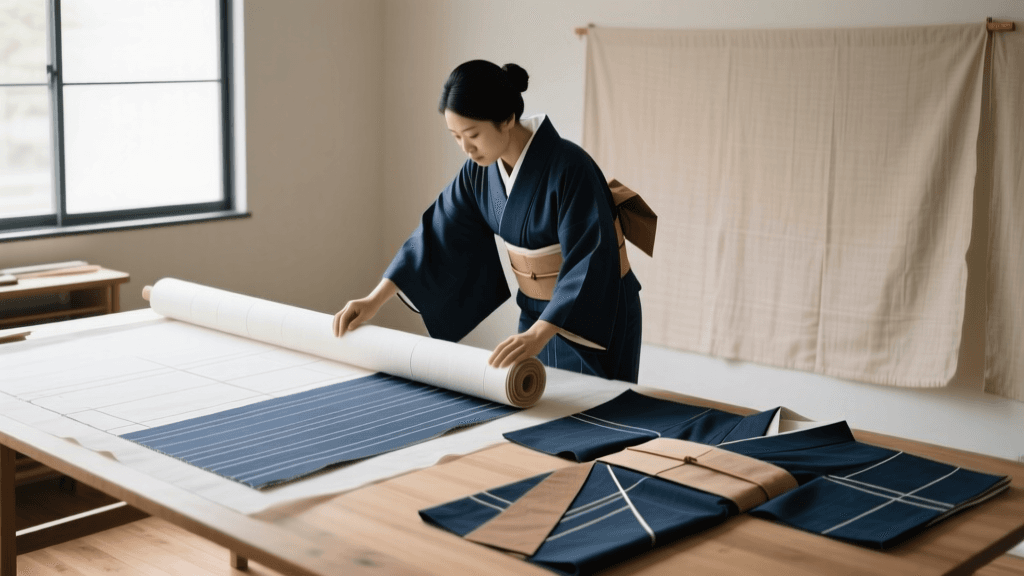
The secret to the kimono's zero-waste geometry lies in its foundational textile format: the tanmono. A standard tanmono is a narrow, continuous bolt of fabric woven specifically to the dimensions required for a single adult garment. Historically dictated by the width of the traditional backstrap or floor loom, the standard dimensions have remained remarkably consistent.
- Width: Approximately 36 to 38 centimeters (14 to 15 inches).
- Length: Approximately 11.5 to 12 meters (12.5 to 13.1 yards).
Because the fabric is woven to this exact specification, the garment is not cut from a wide sheet of cloth. Instead, the 12-meter bolt is sliced into specific rectangular lengths. Every single centimeter of the tanmono is utilized in the final garment, from the main body panels to the collar and sleeve extensions. There is literally zero fabric waste generated during the cutting phase.
Straight-Line Geometry: The Anatomy of the Kimono
To understand the brilliance of this construction technique, one must examine how the rectangular panels are allocated. The Metropolitan Museum of Art's Heilbrunn Timeline of Art History notes that the kimono's T-shape is an architectural marvel of textile conservation, relying on folding and seaming rather than cutting away excess material to fit the human form.
| Feature | Western Tailoring (2026 Standard) | Tanmono Kimono Construction |
|---|---|---|
| Pattern Shape | Curved, contoured to body measurements | Straight lines, geometric rectangles |
| Fabric Waste | 15% - 25% offcut waste | 0% waste (entire bolt utilized) |
| Sizing Flexibility | Fixed; difficult to alter significantly | Highly modular; easily resized via seams |
| End-of-Life | Difficult to upcycle due to irregular shapes | Panels can be unstitched and rewoven/reused |
The Core Panels
A standard women's kimono requires the tanmono bolt to be cut into eight primary rectangular sections:
- Migoro (Body Panels): Two long panels that form the front and back of the main body.
- Sode (Sleeves): Two rectangular panels that are folded in half and seamed to create the iconic hanging sleeve.
- Okumi (Overlaps): Two narrower panels cut from the remaining fabric, attached to the front edges to create the overlapping front closure.
- Eri (Collar): A long, folded strip that forms the neckband.
- Kake-eri (Collar Cover): A protective, often decorative overlay for the back of the neck.
The Genius of Modular Seam Allowances
Perhaps the most innovative aspect of kimono construction—and a technique heavily studied by 2026 sustainable fashion researchers—is the treatment of seam allowances. In Western garment construction, seam allowances are typically trimmed, graded, and serged to reduce bulk, permanently locking the garment into its current size.
In kimono construction, the seam allowances are left entirely intact and uncut. When the panels are sewn together, the excess fabric is folded inward and hidden. This serves two vital purposes:
- Future Resizing: If the wearer's body changes, or if the garment is passed down to a taller or wider family member, the kimono can be completely disassembled, the deep seam allowances let out, and the garment resewn to new dimensions.
- Textile Preservation: When a kimono reaches the end of its wearable life, it is taken apart. The panels, now flat rectangles again, can be cleaned, re-dyed, or repurposed into other items like haori jackets, futon covers, or children's clothing without being compromised by irregular cuts or serged edges.
Hidden Stitches: The Art of Kuke
The structural integrity of the kimono relies heavily on kuke, a traditional blind-stitching technique. Because the garment is unlined in its summer iteration (hitoe) or lined in winter (awase), the interior finish must be as pristine as the exterior. Makers in 2026 utilize the hon-guke method, catching only one or two threads of the face fabric to secure hems and sleeve openings. This creates an invisible finish on the outside while allowing the fabric to drape naturally without the stiffness caused by machine topstitching. The stitch spacing is meticulously maintained at 2 to 3 millimeters, requiring immense patience and skill.
2026 Sustainable Material Sourcing for Tanmono
While traditional silk rinzu (satin weave) and tsumugi (slubbed silk) remain highly prized, the 2026 market has seen an explosion of sustainable, eco-conscious tanmono bolts tailored for modern zero-waste makers.
- Lotus Silk Blends: Woven in specialized facilities in Vietnam and Japan, lotus fiber extracted from lotus stems offers a breathable, silk-like drape with a fraction of the water footprint. A standard 12-meter bolt retails for approximately $320 USD in 2026.
- Peace Silk (Ahimsa) Crepe: Harvested without harming the silkworm, modern Ahimsa silk is woven on jacquard looms to mimic traditional chirimen (crepe) textures. Expect to pay around $280 USD per bolt.
- Recycled PET Kimono Cotton: For casual yukata construction, high-density cotton blended with recycled marine plastics provides excellent structure for the okumi and eri panels, costing roughly $120 USD per bolt.
Step-by-Step: Assembling a Modern Hitoe Kimono
For makers looking to apply these Asian dress traditions to their 2026 portfolio, constructing an unlined hitoe kimono is the best entry point. Here is a streamlined workflow:
Step 1: Measuring and Marking the Bolt
Do not use chalk or washable markers that might stain modern sustainable dyes. Instead, use the traditional hera (a bamboo or bone spatula) to crease the fabric along the straight grain. Measure the migoro panels based on the wearer's height plus 30 centimeters for the ohashori (the waist fold unique to women's kimono).
Step 2: Cutting and Basting
Slice the bolt into the eight rectangular sections. Before any permanent stitching, baste the panels together using a long running stitch. This allows you to drape the garment on a form or the wearer to adjust the kata-haba (shoulder width) and sode-guchi (sleeve opening) without committing to the final seam.
Step 3: Sewing the Seams
Using a fine needle (size 9 or 10 for silk/lotus blends), sew the main body seams with a consistent 3-millimeter running stitch. Fold the generous seam allowances inward. For the hem, utilize the kuke blind stitch to ensure the bottom edge remains fluid and unbroken.
Step 4: Attaching the Collar (Eri)
The collar requires precise geometric folding. The eri is folded over a core of stiffened cotton or modern bio-resin interfacing to maintain the sharp V-shape at the nape of the neck. Hand-stitch the collar to the body, ensuring the tension does not pucker the lightweight 2026 sustainable fabrics.
Conclusion
The construction techniques embedded in the traditional Japanese kimono are not mere historical curiosities; they are advanced, time-tested solutions to the modern fashion industry's most pressing environmental crises. By adopting the tanmono bolt system, utilizing straight-line geometry, and preserving modular seam allowances, today's designers and makers can create garments that are deeply respectful of both Asian cultural heritage and the planet's limited resources. As we move through 2026, the integration of these ancient Asian dress traditions with next-generation sustainable textiles proves that true innovation often requires looking to the wisdom of the past.