Zero-Waste Kimono Construction: Tanmono Techniques 2026
The Renaissance of Zero-Waste: Kimono Construction in 2026
In the contemporary 2026 fashion landscape, the global industry's urgent pivot toward circularity and zero-waste design has brought renewed, intense scrutiny to historical garment construction. While modern sustainable brands are just now developing algorithms to minimize textile offcuts, traditional Asian dress mastered the art of zero-waste centuries ago. At the forefront of this historical mastery is the Japanese kimono, a garment engineered entirely without curved cuts or discarded scraps. Understanding the construction techniques of the kimono offers modern sewists, designers, and cultural historians a masterclass in sustainable engineering.
According to the Metropolitan Museum of Art's Heilbrunn Timeline of Art History, the kimono's structural brilliance lies not in complex tailoring, but in its profound respect for the textile itself. By treating the fabric as a sacred, unbroken canvas, traditional Japanese artisans developed a system of flat-pattern cutting that ensures every single thread woven into the cloth remains part of the final garment. In 2026, as textile waste reaches critical global thresholds, revisiting these techniques is not merely an act of historical preservation, but a vital blueprint for the future of sustainable garment making.
Understanding the Tanmono Bolt
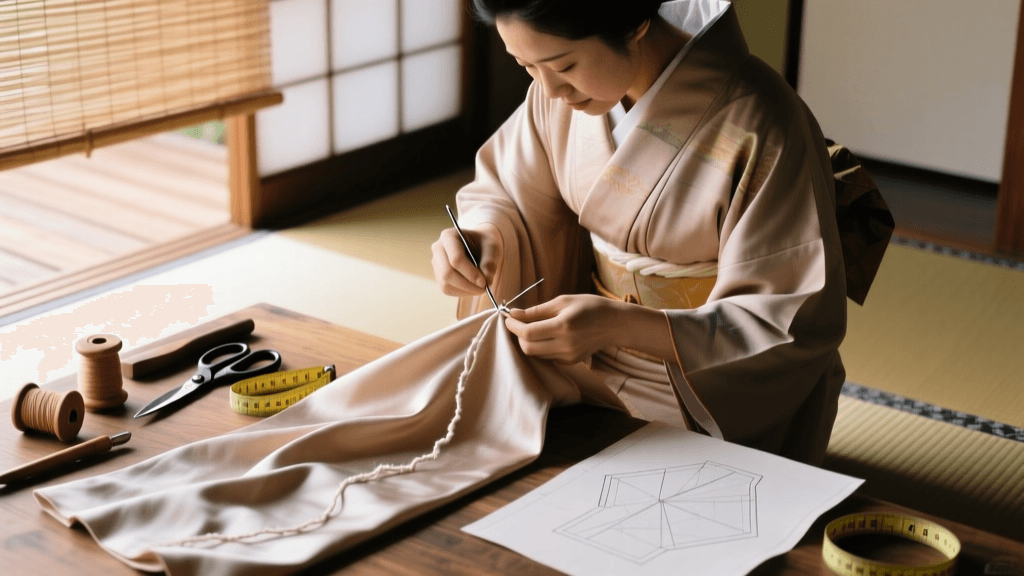
The foundation of all kimono construction is the Tanmono (反物), a traditional bolt of fabric. Unlike Western textiles that are produced in wide yardage (often 150cm or 60 inches wide) and subsequently cut into curved pattern pieces, a Tanmono is woven to a highly specific, narrow dimension. A standard Tanmono bolt measures approximately 36 centimeters (about 14 inches) in width and 12 meters (about 13 yards) in length.
This specific width is not arbitrary. Historically, it was dictated by the physical limitations of a single weaver operating a traditional backstrap or floor loom, as well as the natural width of hand-spun silk or cotton threads. More importantly, this 36cm width perfectly maps to the proportions of the human body. The fabric is woven with tightly bound selvedges known as mimi, which are so meticulously finished that they never fray and are intentionally left visible inside the seams of the garment, eliminating the need for hemming or serging the raw edges.
The Mathematics of the Bolt
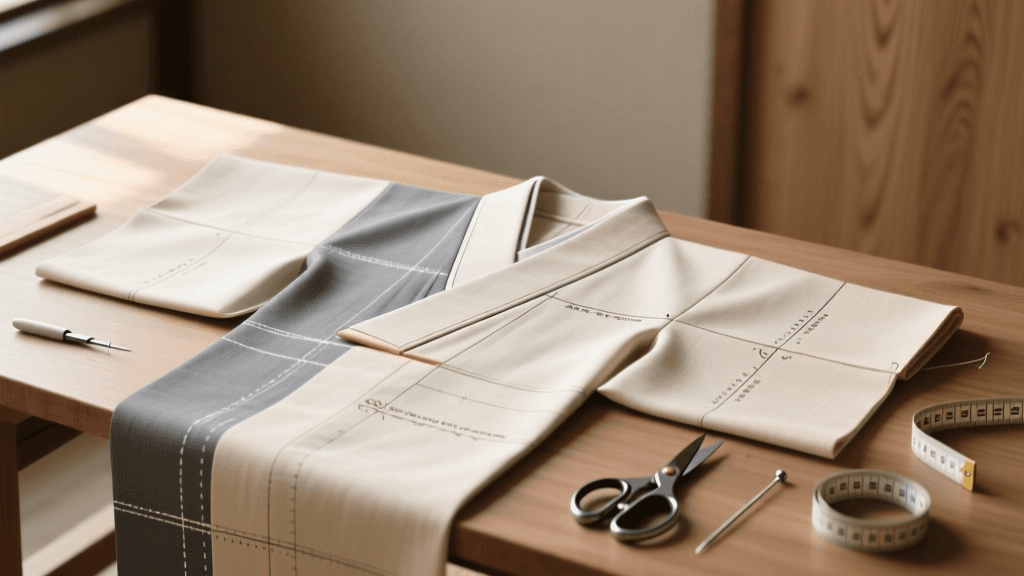
A single 12-meter Tanmono bolt contains exactly enough fabric to construct one complete adult kimono, comprising eight distinct rectangular pieces:
- Migoro (Body Panels): Two main panels, each utilizing a full width of the bolt.
- Sode (Sleeves): Two sleeves, cut from a single width folded or seamed.
- Eri (Collar): One long, narrow strip cut from a half-width of the fabric.
- Okumi (Front Overlap Panels): Two narrower panels for the front closures, cut from the remaining half-widths.
Because every component is a rectangle or a square, the entire bolt is consumed. There are zero offcuts. The only 'waste' is the tiny amount of fabric taken up by the seam allowances, which are folded inward and preserved for future alterations.
Core Construction: The Art of the Straight Line
Western tailoring relies on Choku-dachi (curved cutting) to mold flat fabric to the three-dimensional curves of the human body, creating armholes, shoulder slopes, and darts. Kimono construction utilizes a strict straight-line cutting method. The garment is essentially a T-shaped tube that drapes and folds around the body, secured by the obi (sash).
This straight-line philosophy extends to the sewing process. Kimono seams are exclusively straight lines, sewn either by hand using a running stitch (guinui) or, in modern 2026 adaptations, by machine. The absence of curved seams means that the structural integrity of the garment relies entirely on the drape of the fabric and the precision of the rectangular geometry.
The Secret of the Seam Allowance
Perhaps the most revolutionary aspect of kimono construction, especially when viewed through a 2026 sustainability lens, is the treatment of seam allowances. In Western garment construction, seam allowances are typically trimmed, graded, and serged or overlocked to prevent fraying. This permanently locks the garment into its current size and shape.
In kimono construction, seam allowances are left exceptionally wide—often 2 to 3 centimeters—and are folded inward, encasing the raw selvedge edges. They are never trimmed. This technique, known as nuishiro, serves a dual purpose. First, it adds weight and structure to the seams, helping the garment hang beautifully. Second, and most importantly, it future-proofs the garment. Because the fabric is never cut away, a kimono can be completely unpicked (toka), washed in a process called arai-hari, stretched, and resewn to fit a completely different body type or to update the sleeve length for a new generation. The Victoria and Albert Museum's Asian collections frequently highlight this cyclical nature of Japanese textiles, where a single garment can serve multiple owners over a century simply by being disassembled and reimagined.
Comparison: Traditional Kimono vs. Western Tailoring
To fully grasp the paradigm shift required to adopt Asian flat-pattern techniques, it is helpful to compare them directly with standard Western tailoring methods.
| Construction Feature | Western Tailoring (2026 Standard) | Traditional Kimono (Tanmono) |
|---|---|---|
| Pattern Drafting | Curved lines, darts, armholes, shoulder slopes. | Straight lines, pure rectangles and squares. |
| Fabric Waste | 15% to 30% offcuts discarded during cutting. | 0% offcuts; entire bolt is utilized. |
| Seam Finishing | Trimmed, serged, or overlocked permanently. | Wide, untrimmed allowances folded inward. |
| Sizing & Fit | Customized to individual body curves. | Standardized; adjusted via wrapping and obi placement. |
| End-of-Life | Difficult to resize; often downcycled or discarded. | Unpicked, washed, and resewn for new wearers. |
Step-by-Step Guide: Constructing a Basic Kimono Sleeve (Sode)
For modern makers looking to integrate these techniques into their 2026 sewing repertoire, mastering the sode (sleeve) is the perfect entry point. The sleeve is a masterclass in folding rather than cutting.
Materials and Measurements
- Fabric: 1.5 meters of fabric (ideally 36cm wide, but 45cm works for modern adaptations).
- Thread: 100% silk or high-quality cotton thread, matched to the fabric weight.
- Tools: Sharp fabric shears, silk pins, and a long quilting ruler.
Construction Steps
- Cut the Rectangle: Cut a single rectangular panel measuring the desired sleeve width (typically 34cm) by the desired sleeve depth (typically 50cm to 100cm for a formal furisode). For a standard everyday sleeve, 50cm is ideal.
- Fold and Pin: Fold the rectangle in half horizontally, right sides together. The fold line will become the top of the shoulder.
- Sew the Back Seam: Sew a straight line down the back edge of the sleeve, leaving a 2cm seam allowance. Stop sewing 20cm from the bottom edge. This opening is the furikake, which allows the sleeve to drape elegantly and provides ventilation.
- Create the Pouch: Sew the bottom edge of the sleeve closed, again using a 2cm allowance. This creates the deep pocket characteristic of kimono sleeves, traditionally used to carry small items like tissues or amulets.
- Finish the Opening: Fold the 2cm seam allowances of the furikake opening inward and slip-stitch them together by hand so no raw edges are visible.
- Attach to the Body: Sew the top folded edge of the sleeve to the migoro (body panel), leaving the underarm portion of the sleeve unattached to create the yatsuguchi (underarm opening), which is crucial for the kimono's breathability and range of motion.
2026 Sourcing and Modern Adaptations
Sourcing authentic Tanmono in 2026 requires navigating a blend of traditional heritage mills and modern digital marketplaces. Premium silk Tanmono from the renowned Nishijin-ori weaving district in Kyoto currently averages between ¥60,000 and ¥150,000 per bolt, reflecting the intense labor and raw silk costs. However, cotton and synthetic-blend Tanmono, often produced in regions like Fukui or Aichi, are highly accessible, ranging from ¥15,000 to ¥30,000.
For Western sewists or those designing for diverse body types, the traditional 36cm width can sometimes be restrictive. In 2026, several specialized online textile importers offer 'wide-loom' Asian textiles woven specifically to mimic the selvedge-to-selvedge aesthetic of the Tanmono but at widths of 45cm or 50cm. When using these wider fabrics, makers must calculate the excess width into deep internal tucks rather than cutting it away, thereby preserving the zero-waste philosophy.
Furthermore, modern makers are increasingly utilizing the machi (gusset) technique. By inserting a narrow, contrasting rectangular panel under the arm or at the side seams, the kimono's circumference can be expanded to comfortably fit a wider variety of 2026 body types without compromising the structural integrity or the straight-line aesthetic of the garment.
The Future of Flat-Pattern Construction
As institutions like the George Washington University Museum and The Textile Museum continue to exhibit and study historical Asian garments, the conversation is shifting from mere preservation to active application. The kimono is not a relic; it is a highly sophisticated, sustainable technology.
'To cut fabric is to wound it. To fold and seam it is to honor its creation.' — Traditional Japanese weaving proverb, frequently cited in modern zero-waste design seminars.
By adopting the Tanmono methodology, straight-line cutting, and untrimmed seam allowances, today's designers and home sewists can drastically reduce their textile footprint. The kimono teaches us that true luxury in fashion does not come from discarding the excess, but from possessing the ingenuity to use every single thread. As we move further into 2026, the ancient wisdom of Asian dress traditions remains one of our most powerful tools for building a sustainable, circular fashion future.