Mastering Kimono Tanmono Construction: Zero-Waste Cutting in 2026
The Renaissance of Zero-Waste Pattern Cutting
In the global fashion landscape of 2026, sustainability is no longer a niche trend but a foundational requirement. As modern designers scramble to develop zero-waste pattern-cutting algorithms and AI-driven fabric mapping to reduce textile landfill contributions, traditional Asian garment construction offers a masterclass that has been perfected over centuries. At the forefront of this historical blueprint is the Japanese kimono, specifically its reliance on the tanmono (fabric bolt) system. Unlike Western tailoring, which carves curved shapes out of wide fabric and discards the negative space, the tanmono system utilizes every single thread of the woven bolt. For contemporary makers, textile students, and sustainable fashion advocates, understanding the structural genius of the tanmono is essential for bridging ancient wisdom with 2026 eco-conscious manufacturing.
The Anatomy of the Tanmono Bolt
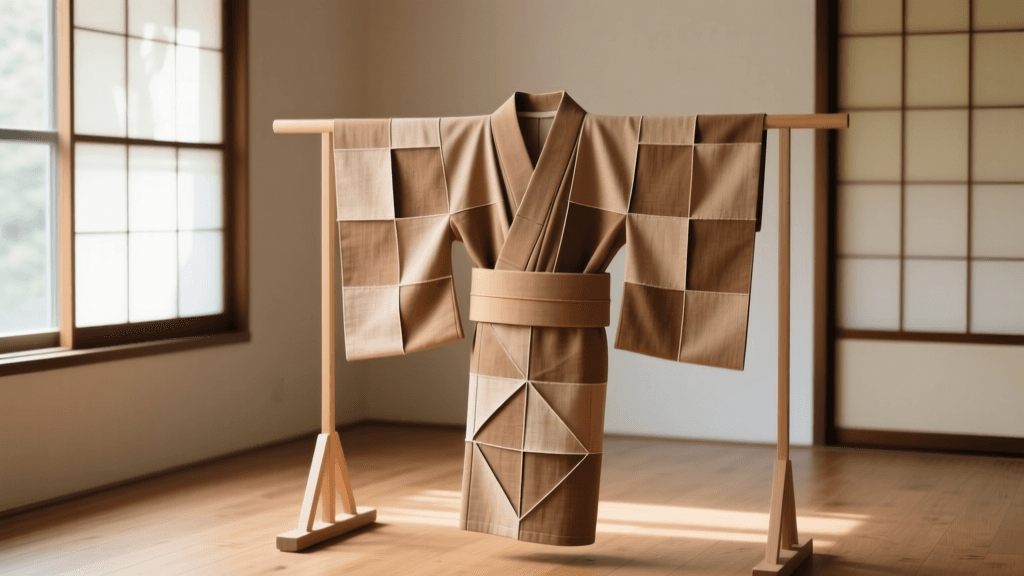
The foundation of kimono construction is not a flat pattern drafted on wide muslin, but rather the dimensions of the loom itself. A standard tanmono bolt is woven to a highly specific, narrow width—typically between 36 and 40 centimeters (about 14 to 15.5 inches)—and a continuous length of 11 to 12 meters (approximately 12 to 13 yards). This exact yardage is calculated to yield one complete adult kimono with zero leftover scraps.
When working with a tanmono in 2026, whether you are using vintage silk or modern sustainably woven hemp blends, the narrow width dictates the entire geometry of the garment. The kimono is constructed entirely from straight, rectangular panels. The main body panels (migoro), the overlapping front panels (okumi), the sleeves (sode), and the collar (eri) are all cut as straight rectangles directly from the bolt. Because the fabric is never cut on a curve, the structural integrity of the selvedge is maintained, and the garment can be entirely disassembled, cleaned, and re-sewn—a vital maintenance practice that extends the life of silk garments for generations.
The Straight-Seam Philosophy: Eliminating Fabric Waste
Western garment construction relies heavily on the armscye (armhole) and the shoulder slope, requiring curved seams that inherently generate offcuts. The kimono bypasses this entirely through a drop-shoulder, T-shaped silhouette. The sleeves are attached to the body panels via straight horizontal seams, and the side seams run vertically from the hem to the underarm.
However, the brilliance of this construction lies in how it handles the underarm area. Instead of a curved gusset or a tailored armscye, the kimono features the miyatsukuchi—an open, unsewn vent under the arm where the sleeve meets the body. This opening serves multiple critical functions:
- Ventilation: It allows air to circulate through the garment, regulating body temperature in humid Japanese summers.
- Mobility: It provides ease of movement without pulling the main body panels out of alignment.
- Draping Adjustment: It allows the wearer to adjust the ohashori (the waist tuck) smoothly without bunching fabric under the arms.
According to historical textile analyses preserved by institutions like the Victoria and Albert Museum, this modular, rectangular approach to dressmaking reflects a deep cultural respect for the material. The fabric is treated as a continuous, unbroken canvas, and the construction merely folds and binds it to the human form.
Construction Comparison: Western Tailoring vs. Tanmono
To fully grasp the paradigm shift required when moving from Western sewing to traditional Asian dressmaking, consider the following structural comparison:
| Feature | Western Tailoring (Standard 2026) | Kimono Tanmono Construction |
|---|---|---|
| Fabric Width | 115 cm to 150 cm (45 to 60 inches) | 36 cm to 40 cm (14 to 15.5 inches) |
| Seam Geometry | Curved (armscyes, princess seams) | Strictly straight and rectangular |
| Fabric Waste | 15% to 20% average offcut waste | 0% (entire bolt is utilized) |
| Underarm Finish | Closed, curved armscye seam | Open vent (miyatsukuchi) |
| Hem Allowance | Narrow rolled hem or serged edge | Deep, wide fold (suso) acting as weight |
| Seam Allowance | 1 cm to 1.5 cm, often pressed open | 1.5 cm to 2 cm, folded inward and hidden |
Step-by-Step: Drafting and Sewing the Sode (Sleeve)
The sode (sleeve) is perhaps the most iconic element of the kimono, particularly the deep, swinging sleeves of the furisode. Constructing a sode using traditional methods requires precision, patience, and specialized hand-sewing techniques that remain highly relevant for luxury bespoke makers in 2026.
1. Cutting and Folding the Panel
A standard sleeve requires a rectangular panel cut from the tanmono. For a standard sleeve depth, the panel is cut to roughly 55 cm in length (which will fold in half to create a 27.5 cm drop from the shoulder) and the full width of the bolt (approx. 38 cm). The fabric is folded exactly in half horizontally, creating the shoulder line. The side and bottom edges are sewn together, but crucially, the bottom corner nearest the body is left open to create the furi (the swinging pocket). This pouch historically held small items like tissues or coins.
2. The Art of Shitsuke (Basting)
Before any permanent stitching occurs, the silk layers must be basted using shitsuke thread. In 2026, while modern makers might be tempted to use pins, traditionalists know that pinning delicate silk chirimen or rinzu weaves causes permanent micro-holes. Use a long, running basting stitch with soft, unspun silk basting thread to secure the 1.5 cm seam allowances inward.
3. Kuke (Blind Hemming) and Seam Finishing
Kimono seams are rarely visible from the outside. The side seams of the sleeve are finished using kuke stitching—a blind catch-stitch that secures the folded seam allowance to the back of the fabric without piercing the front face. When using a sewing machine for the primary structural seams in a modern adaptation, set your machine to a straight stitch of 2.5 mm length, using a Microtex 60/8 needle and 100% silk thread to prevent the fabric from puckering. However, the final closing of the sleeve opening and the attachment to the body (sodetsuke) should be done by hand to ensure the drape remains fluid.
Sourcing Materials and Costs in 2026
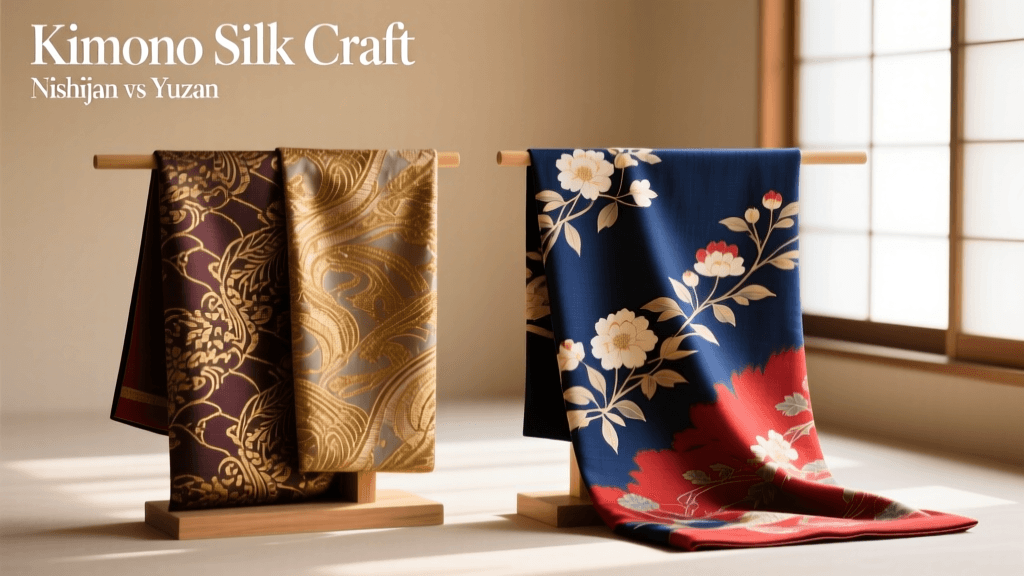
For makers looking to practice tanmono construction today, sourcing the correct narrow-width fabric is the first hurdle. The global supply chain in 2026 has seen a resurgence in artisanal, narrow-loom weaving, driven by the slow-fashion movement. Resources documented by the Metropolitan Museum of Art's Asian Art Department highlight the historical importance of regional weaving centers like Nishijin in Kyoto, which still operate today, albeit with fewer master weavers.
Here is what you can expect when sourcing materials for a kimono project in 2026:
- Vintage Silk Tanmono (Deadstock): Sourced from online Japanese auction houses or specialized vintage textile dealers in Kyoto and Tokyo. Expect to pay between $120 and $250 USD for an unworn, mid-20th-century bolt. These are excellent for practice and offer high-quality, hand-dyed Yuzen patterns.
- Modern Artisan-Woven Silk (Chirimen/Habotai): Commissioning a new bolt from a traditional weaving cooperative in Japan or a specialized narrow-loom weaver in Europe/US will cost between $600 and $1,200 USD. This reflects the intensive labor and the 2026 premium on sustainable, natural-dye practices.
- Contemporary Sustainable Blends: Several modern textile startups in 2026 are weaving zero-waste bolts using Tencel, organic hemp, and peace silk blends on 40cm shuttle looms. These typically retail for $200 to $400 USD per bolt and are machine-washable, making them ideal for everyday modern kimono styling.
Modern Tools for Traditional Methods
While the geometry of the tanmono remains unchanged, the tools available to the 2026 garment maker have evolved. Digital fabric mapping software now allows designers to visualize the placement of intricate woven patterns across the 12-meter bolt before a single cut is made, ensuring that motifs align perfectly across the back seam (se-nu). Furthermore, ultrasonic cutting tools are increasingly used in high-end ateliers to seal the edges of synthetic-blend tanmono, preventing fraying during the lengthy basting and fitting process without adding the bulk of a serged edge.
Conclusion: The Future is Rectangular
The construction techniques of the Japanese kimono prove that zero-waste fashion is not a modern invention, but a historical standard that we are only now relearning. By embracing the constraints of the tanmono bolt—the narrow width, the straight seams, and the hidden allowances—makers in 2026 can create garments that are not only breathtakingly beautiful but inherently sustainable. The kimono teaches us that true luxury lies not in how much fabric we can cut away, but in how respectfully we can honor the textile we are given.