Tang Dynasty Hanfu: Silk Road Trade & Cross-Cultural Style
The Cosmopolitan Hub of Chang'an
When discussing the evolution of traditional Chinese clothing, few eras are as vibrant and globally interconnected as the Tang Dynasty (618–907 CE). The capital city of Chang'an (modern-day Xi'an) was the eastern terminus of the Silk Road and one of the largest, most cosmopolitan cities in the world, boasting a population of over one million. This massive influx of foreign diplomats, monks, and merchants fundamentally altered the sartorial landscape of China. The traditional Hanfu of the Tang era absorbed immense cross-cultural influences, blending indigenous Chinese weaving techniques with the silhouettes, motifs, and practicalities of Central Asian and Persian dress.
As noted by the Metropolitan Museum of Art, the Tang dynasty was a period of unprecedented cosmopolitanism, where foreign fashions were not merely tolerated but enthusiastically adopted by the imperial court and the urban elite. This article explores the specific garments born from this historical trade route and provides a comprehensive, actionable guide for modern enthusiasts looking to source, size, and style authentic Tang-revival Hanfu.
Sogdian Merchants and the Textile Revolution
The primary conduits of Silk Road fashion were the Sogdians, an Eastern Iranian people who dominated the overland trade routes between China and the Mediterranean. The Met's research on Sogdian art highlights how these merchants brought more than just raw silk; they introduced new weaving structures and aesthetic preferences. The most significant technical import was the weft-faced compound twill, known in the West as samite. This technique allowed for denser, more durable fabrics with complex, multi-colored geometric and figural patterns that differed vastly from the lightweight, warp-faced silks traditionally favored in early Han China.
According to the UNESCO Silk Roads Programme, the exchange of textile techniques along these routes led to the creation of hybrid fabrics. Chinese weavers adapted the Sogdian samite technique to produce heavy, opulent brocades that became the standard for Tang court robes, perfectly suited for the structured, voluminous silhouettes that defined the era's fashion.
Key Garments Born from Cross-Cultural Exchange
The Fanlingpao (Lapel Robe)
The most iconic example of Silk Road influence is the Fanlingpao. Originally, the Chinese Yuanlingpao featured a closed round collar. However, influenced by the riding coats of Turkic and Sogdian horsemen, Tang tailors adapted the collar so it could be unbuttoned and folded down into a lapel. This lapel style was highly practical for horseback riding and active movement, and it quickly became a unisex fashion staple in Chang'an. Women frequently wore the Fanlingpao as a statement of modernity and worldly sophistication, often pairing it with leather riding boots and striped trousers.
The Banbi (Half-Sleeve Jacket)
Another nomadic import was the Banbi, a short-sleeved or half-sleeved jacket worn over a long-sleeved inner shirt. Originally designed for the practical needs of nomadic archers who required freedom of movement in their arms, the Banbi was adopted by Tang women as a stylish layering piece. It was often made from heavily patterned brocade and worn over a sheer, long-sleeved silk blouse, creating a striking contrast of textures and colors.
Sasanian Motifs: The Pearl Roundel
Visual motifs on Tang textiles heavily reflect Sasanian Persian origins. The 'pearl roundel'—a circular border made of pearl-like dots enclosing confronting animals such as lions, winged horses, or boars—became a dominant pattern in Tang silk weaving. These motifs were originally associated with Persian royalty and divine glory but were seamlessly integrated into Chinese textile design, symbolizing the prestige of foreign trade goods.
A Collector’s Guide to Buying Tang-Style Revival Hanfu
For modern practitioners of the Hanfu revival movement, sourcing historically accurate Tang garments requires an understanding of specific terminology, measurements, and market dynamics. Here is your actionable guide to purchasing Tang-revival Hanfu.
Search Terms and Product Names
When shopping on platforms like Taobao, AliExpress, or specialized Hanfu boutiques, use the following specific terms to avoid generic costume pieces:
- Fanlingpao (翻领袍): For the lapel-collar robe. Ensure the product description mentions 'Tang system' (唐制).
- Banbi (半臂): For the half-sleeve jacket.
- Poqun (破裙): The multi-panel pleated skirt worn by women. Look for 'Jiansequn' (间色裙) for the classic alternating-color stripe pattern popular in the early-to-mid Tang era.
- Damo (幞头): The traditional black headwear for men, featuring rigid or soft wings depending on the specific Tang sub-era.
Sizing and Measurements
Tang silhouettes are characterized by volume and drape. Modern sizing often runs too small, so pay strict attention to flat garment measurements rather than standard S/M/L charts:
- Arm Span: Tang robes require generous fabric. Look for an arm span (sleeve tip to sleeve tip) of at least 160cm to 180cm to achieve the authentic, draped sleeve pooling effect.
- Robe Length: Measure from the prominent vertebra at the base of your neck down to your ankle bone. For most adults, this will be between 120cm and 135cm. The hem should graze the top of the foot.
- Chest and Waist: Because the Fanlingpao is secured with a belt, the flat chest measurement should be at least 15cm to 20cm larger than your actual chest circumference to allow for the overlapping wrap and comfortable layering.
Fabric Selection and Cost Breakdown
The fabric dictates both the historical accuracy and the price of the garment. Below is a comparison chart to help you budget and select the right material for your needs.
| Fabric Type | Historical Equivalent | Modern Cost (USD) | Drape & Use Case |
|---|---|---|---|
| Polyester-Cotton Blend | N/A (Modern compromise) | $40 - $80 | Stiff, durable. Good for daily wear and beginners, but lacks historical sheen. |
| Silk-Cotton Jacquard | Mid-tier Tang Brocade | $120 - $250 | Excellent drape with woven patterns. Ideal for events and photography. |
| Pure Mulberry Silk | Tang Ling (Damask) | $200 - $400 | Lightweight, fluid, breathable. Perfect for summer Banbi and inner layers. |
| Weft-Faced Samite | Sogdian-influenced Jin | $500 - $800+ | Heavy, structured, opulent. Museum-grade replicas for serious collectors. |
Timing Your Purchase
Specialized Hanfu boutiques rarely hold large inventories of complex Tang garments. Most operate on a pre-order model. Expect a 45 to 60-day manufacturing window for custom-woven jacquards and embroidered sets. To secure significant discounts (often 20% to 30% off retail), time your purchases around China's major e-commerce festivals:
- The '618' Mid-Year Festival (June 18): Ideal for ordering summer-weight silks and sheer layers.
- Singles Day (November 11): The best time to pre-order heavy winter brocades, lined Fanlingpao, and fur-trimmed accessories for the following year's spring events.
Styling the Tang Silhouette
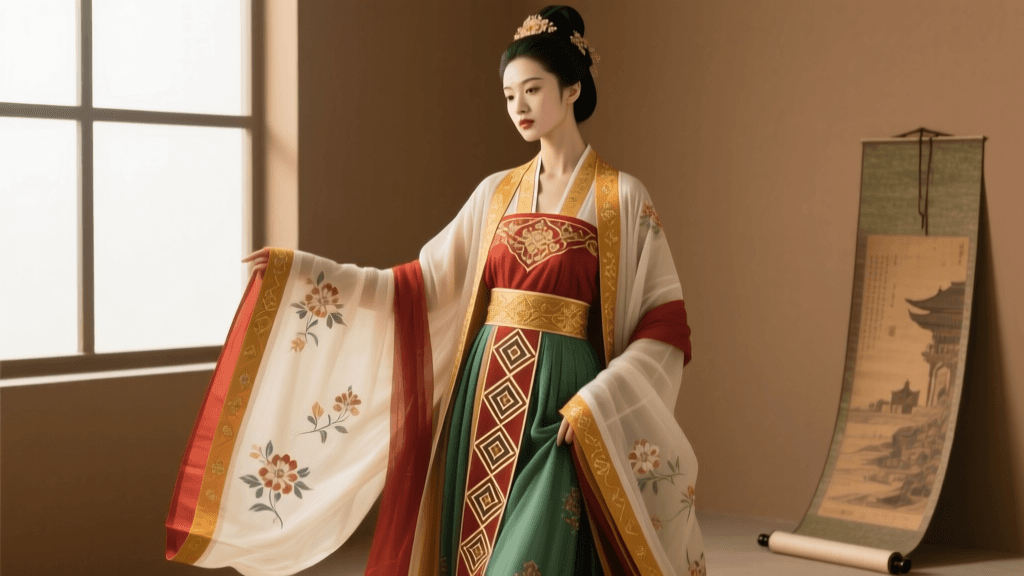
To complete the cross-cultural Tang look, styling is just as important as the garments themselves. Men should pair their Fanlingpao with a leather belt featuring metal plaques (a direct nod to nomadic utility belts) and black leather boots. Women can achieve the iconic high-Tang silhouette by tying their Poqun skirt exceptionally high, just below the bust, and securing it with a wide silk sash. For accessories, look for hairpins featuring the Buyao (步摇) design—tassels that sway with movement, often incorporating pearls and gold filigree that reflect the immense wealth flowing into Chang'an via the Silk Road. Makeup should embrace the bold aesthetics of the era, including the application of Huadian (花钿), decorative floral or geometric appliqués placed on the forehead between the eyebrows.
Conclusion
The Hanfu of the Tang Dynasty is a testament to China's historical openness to global exchange. The integration of Sogdian weaving techniques, Persian motifs, and nomadic silhouettes created a fashion ecosystem that was uniquely cosmopolitan. By understanding the historical roots of the Fanlingpao and Banbi, and by carefully navigating the modern revival market with precise measurements and fabric knowledge, today's wearers can authentically celebrate the vibrant, interconnected legacy of the Silk Road.