Silk Road Style: Tang Dynasty Hufu and Banbi Hanfu Guide
The Silk Road's Sartorial Revolution in Tang China
When we envision traditional Chinese clothing, the flowing, wide-sleeved silhouettes of the Han Dynasty or the structured elegance of the Ming Dynasty often come to mind. However, the Tang Dynasty (618–907 CE) represents a radical, vibrant departure from indigenous norms, driven entirely by the historical trade routes of the Silk Road. As the cosmopolitan capital of Chang'an (modern-day Xi'an) swelled with Sogdian merchants, Persian diplomats, and Turkic nomads, their sartorial traditions deeply infiltrated the Chinese elite's wardrobe. This cross-cultural exchange birthed Hufu (foreign dress) and popularized the Banbi (half-sleeve jacket), creating a fusion of Han elegance and nomadic practicality that still captivates modern Hanfu enthusiasts today.
According to the UNESCO Silk Roads Programme, the exchange of textiles and garments was just as vital as the trade of spices and precious metals. The Silk Road was not merely a commercial artery; it was a superhighway of aesthetic and cultural osmosis. Tang women, known for their relative social freedom and penchant for equestrian sports, eagerly adopted the fitted, practical garments of Central Asian nomads, fundamentally altering the trajectory of traditional Chinese fashion.
Decoding Hufu: The 'Foreign Dress' of the Tang Elite
Hufu literally translates to 'clothing of the Hu' (a historical umbrella term for nomadic and foreign peoples to the north and west of China). Unlike traditional Hanfu, which prioritized voluminous layers and floor-sweeping skirts, Hufu was designed for the saddle and the harsh climates of the steppes. The Tang Dynasty saw aristocratic women donning Hufu to play polo, ride horses, and attend cosmopolitan banquets.
The core components of Tang Hufu included:
- Fanlingpao (Lapel Robe): A robe featuring a folded, asymmetrical lapel, heavily influenced by Sogdian and Persian tailoring. It was often belted tightly at the waist with a leather or brocade sash.
- Kua (Trousers): Fitted trousers that allowed for ease of movement, a stark contrast to the wide-legged ku of earlier Han periods.
- Xue (Boots): Structured leather riding boots with a slight heel, replacing the soft, flat cloth slippers of traditional Han attire.
The Metropolitan Museum of Art notes that Sogdian weavers and their distinct textile patterns were highly prized in Tang China. Garments were frequently woven with 'pearl roundels'—circular borders enclosing confronting animals like lions, peacocks, or winged horses—motifs that originated in Sassanian Persia but were eagerly adopted and localized by Chinese silk weavers.
The Banbi: A Half-Sleeve Marvel of Cultural Exchange
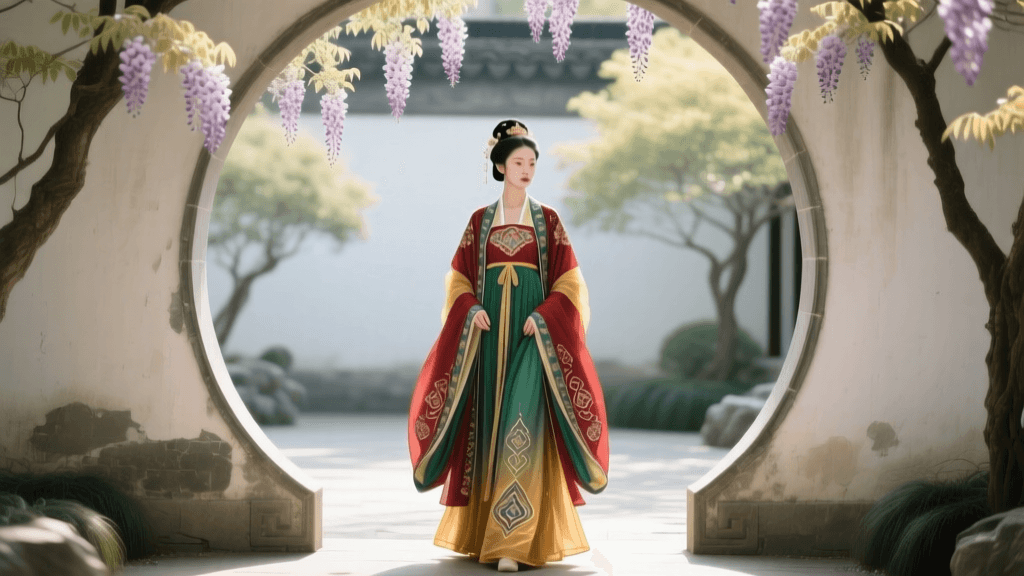
While Hufu represented a full nomadic ensemble, the Banbi (half-sleeve jacket) was a versatile layering piece that bridged the gap between foreign utility and Han modesty. Originally a practical garment for laborers and soldiers, the Banbi was elevated to high fashion during the Tang era. Worn over a long-sleeved inner shirt (Danyi) or a flowing chest-high skirt (Qixiong Ruqun), the Banbi featured short, cap-like sleeves and a cross-collar or round-collar design. It allowed women to showcase the luxurious, patterned silks of their under-layers while providing core warmth and structural silhouette.
Comparison: Traditional Hanfu vs. Silk Road-Influenced Garments
| Garment Feature | Traditional Hanfu (Pre-Tang) | Silk Road Hufu & Banbi (Tang) |
|---|---|---|
| Sleeve Shape | Broad, flowing, floor-draping | Narrow, fitted, wrist-length (Hufu) or Cap-sleeve (Banbi) |
| Collar Style | Cross-collar right over left (Jiaoling Youren) | Round collar or folded lapel (Fanling) |
| Lower Body | Flowing skirts (Qun) or wide-legged trousers | Fitted trousers (Kua) tucked into boots |
| Footwear | Soft cloth shoes, cloud-toe slippers | Structured leather riding boots (Xue) |
| Primary Motifs | Clouds, dragons, indigenous florals | Pearl roundels, confronting horses, lions |
Modern Revival: Sourcing and Styling Tang Hufu Today
For modern Hanfu revivalists, integrating Tang Dynasty Hufu and Banbi into a contemporary wardrobe offers a unique, structured alternative to the ethereal Wei-Jin or Song Dynasty styles. However, because Hufu relies on precise tailoring rather than voluminous draping, purchasing and styling these garments requires specific attention to measurements, fabrics, and historical accuracy.
Actionable Buying Guide for Tang-Style Hanfu
When shopping from modern Hanfu vendors (such as those based in Chengdu or Caoxian), use the following guidelines to ensure authenticity and proper fit:
- The Fanlingpao (Lapel Robe): Look for vendors offering 'Tang Dynasty Round Collar Robe' (Tangzhi Yuanlingpao) with an optional folded lapel. Ensure the fabric has a medium-to-heavy drape. Heavy silk crepe, brocade, or high-grade polyester jacquard are ideal. Cost: $80–$250 depending on material.
- The Banbi (Half-Sleeve Jacket): Banbi should hit exactly at the natural waist or slightly below. Look for 'Tang Banbi' with woven motifs rather than printed ones to mimic historical samite textiles. Cost: $40–$120.
- Footwear (Xue): Avoid modern combat boots. Search for 'Hanfu riding boots' or 'Tang leather boots' featuring a pointed or slightly rounded toe and a shaft height of 5 to 8 inches. Cost: $50–$150.
Critical Measurements for Hufu
Unlike traditional Hanfu, which forgives sizing errors through overlapping wraps and wide sleeves, Hufu requires exact tailoring. When ordering custom or made-to-measure Hufu, provide these specific metrics:
- Shoulder Width: Measure from the edge of one acromion (shoulder bone) to the other. The seam of a Fanlingpao must sit exactly on the shoulder bone, not dropped.
- Sleeve Length: Measure from the shoulder bone to the ulnar styloid (the prominent bone on the outside of the wrist). Hufu sleeves should end precisely at the wrist to allow for leather bracers or unimpeded movement.
- Bust and Waist: Hufu is meant to be belted. Provide your natural waist measurement (the narrowest part of the torso) so the vendor can place the belt loops or tailoring darts correctly.
Styling and Layering Tips
To achieve an authentic Tang cosmopolitan look, layering is essential. Pair a fitted, long-sleeved silk Danyi (inner shirt) beneath a heavily brocaded Banbi. For the lower half, tuck straight-leg linen or silk-blend trousers into leather boots. Accessorize with a 'Diexie' belt—a leather belt featuring hanging metal rings and plaques, originally used by nomads to carry tools and weapons, which became a massive fashion statement in Tang China.
Care and Maintenance for Silk Road Textiles
Modern reproductions of Tang Hufu often utilize jacquard weaves and metallic threads to replicate historical Sogdian samite. These fabrics are delicate. Never machine wash brocades or metallic-threaded Banbi. Instead, spot clean with a damp cloth and mild silk detergent, or opt for professional dry cleaning. Store your Fanlingpao on wide, padded wooden hangers to maintain the structural integrity of the shoulders, and keep the garments in breathable cotton garment bags away from direct sunlight to prevent the vibrant, historically accurate dyes (like safflower red and indigo) from fading.
Conclusion
The integration of Hufu and the Banbi into Tang Dynasty fashion is a testament to China's historical openness to global influences. The Silk Road did not just bring new goods to Chang'an; it brought new silhouettes, new motifs, and a new sense of sartorial freedom. By understanding the cross-cultural roots of these garments and applying precise, actionable buying and styling techniques, modern wearers can authentically revive and celebrate one of the most dynamic eras in Asian fashion history.