Iconic Hanfu: Recreating Outfits of China's Historical Figures

The Power of the Silhouette: Dressing Through Chinese History
Traditional Chinese clothing, or Hanfu, is far more than a collection of ancient garments; it is a woven tapestry of political power, philosophical shifts, and artistic expression. Throughout China's dynastic history, specific historical figures have not only worn the fashion of their time but actively shaped it, using silhouettes and textiles to project authority, intellect, or refined elegance. For modern Hanfu enthusiasts and historical costumers, recreating these iconic looks requires more than just buying a replica. It demands an understanding of historical tailoring, structural layering, and fabric behavior.
In this comprehensive guide, we will explore the signature styles of three iconic historical figures—Empress Wu Zetian of the Tang Dynasty, the legendary poet Li Qingzhao of the Song Dynasty, and the noblewomen of the Ming court. We will break down the exact measurements, fabric requirements, and modern sourcing costs needed to accurately recreate their legendary wardrobes.
Wu Zetian: Tang Dynasty Opulence and the Qixiong Ruqun
As the only female emperor in Chinese history, Wu Zetian (624–705 AD) utilized fashion as a tool of political domination and divine right. The Tang Dynasty was an era of unprecedented cosmopolitanism and wealth. According to the Metropolitan Museum of Art's Heilbrunn Timeline of Art History, the Tang capital of Chang'an was a global hub where Silk Road trade introduced vibrant dyes, exotic motifs, and flowing silhouettes that defined the era's opulent aesthetic.
Recreating the Chest-High Ruqun (Qixiong Ruqun)
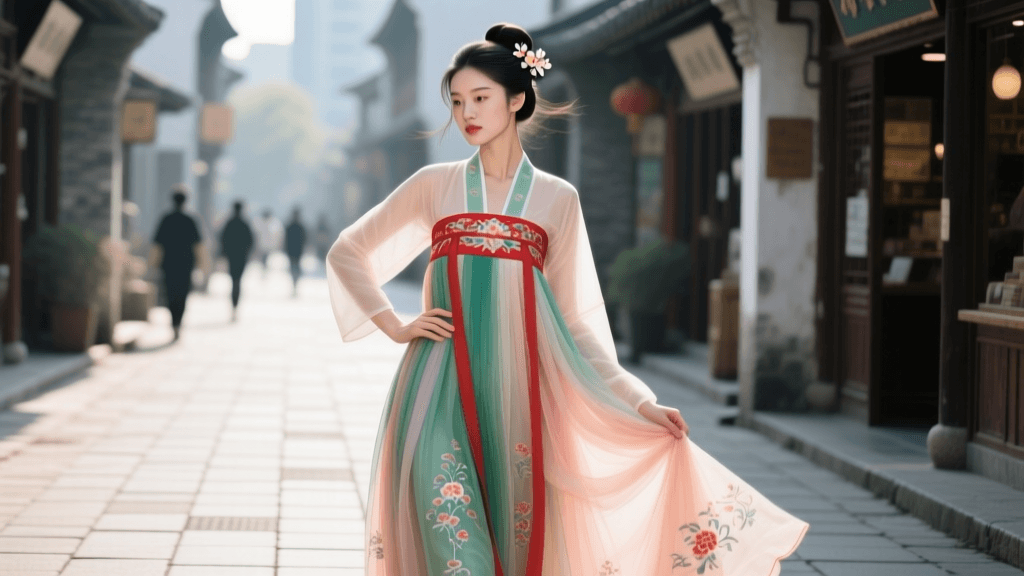
Wu Zetian’s iconic silhouette is defined by the Qixiong Ruqun (chest-high skirt) paired with a Daxiushan (large-sleeved sheer overcoat) and a Pibo (draped silk shawl). This style elongates the lower body, creating a statuesque, imposing presence.
- Skirt Measurements: The skirt must sit above the bust line. For a modern recreation, the skirt length should be your total height minus 130 cm (to account for the torso and head). The width of the fabric must be at least 300 cm to allow for a secure, overlapping wrap that prevents the skirt from slipping down.
- The Pibo Shawl: A standard Pibo should be 25 cm wide and 250 cm long. It is draped over the elbows and cascades down the back, adding kinetic movement to the outfit.
- Fabric Selection: Historically, heavy silk damasks and gold-woven brocades were used. For modern wearers seeking historical accuracy without the crushing weight, opt for a 19mm silk charmeuse for the skirt and a 12mm silk georgette for the sheer Daxiushan overcoat. Avoid stiff cottons, as they destroy the fluid drape required for Tang styling.
- Estimated Cost: A high-quality, custom-tailored Tang ensemble using genuine mulberry silk typically ranges from $180 to $350 USD when commissioned from specialized Taobao artisans.
Li Qingzhao: Song Dynasty Minimalism and the Beizi
Moving from the extravagant Tang to the intellectually rigorous Song Dynasty (960–1279 AD), we find Li Qingzhao (1084–1155 AD), China’s most celebrated female poet. The Song era was heavily influenced by Neo-Confucianism, which favored restraint, modesty, and understated elegance over ostentatious displays of wealth. The silhouettes became narrower, and the colors shifted to muted, natural tones.
Sourcing and Styling the Beizi (Long Overcoat)
Li Qingzhao’s literary persona is inextricably linked to the Beizi, a straight-collared, long overcoat worn open at the front, revealing a pleated skirt and inner top beneath. The Beizi represents the ultimate expression of Song literati elegance.
- Garment Proportions: The Beizi should feature a straight, parallel collar that extends down the front. The side slits are remarkably high, often reaching the armpit, which allows for ease of movement and reveals the layers beneath. The ideal length falls just below the knee or mid-calf.
- Sleeve Construction: Unlike the massive sleeves of the Tang, Song sleeves are relatively narrow, typically measuring 35 cm to 45 cm in width at the cuff, tapering slightly toward the shoulder.
- Fabric Selection: To capture the essence of a Song scholar-poet, avoid shiny silks. Instead, use textured, matte fabrics. High-quality ramie, lightweight linen, or a 16mm silk crepe de chine in colors like celadon, slate blue, or pale lotus pink are historically appropriate and visually stunning.
- Estimated Cost: Because Song garments rely on cut and fabric texture rather than heavy embroidery, a premium linen or crepe Beizi set can be sourced for $90 to $160 USD.
Ming Court Ladies: Structured Majesty and the Mamianqun
The Ming Dynasty (1368–1644 AD) saw a return to Han-centric cultural norms and the establishment of highly structured, formalized dress codes. While Empress Xiaoduan and other court ladies wore elaborate phoenix crowns, the most enduring legacy of Ming fashion is the Mamianqun, or 'horse-face skirt,' which was worn by both nobility and commoners.
The Anatomy of the Horse-Face Skirt
The Mamianqun is a marvel of structural engineering. It features two flat, unpleated panels (the 'horse faces') at the front and back, with deeply pleated sections on the sides. The intricate silk weaving techniques required for Ming court garments are deeply tied to China's sericulture heritage, recognized by UNESCO as an Intangible Cultural Heritage.
- Pleat Calculations: A traditional Mamianqun requires precise mathematical pleating. For a standard 5 cm pleat depth, you will need approximately 4.5 meters of fabric. The waistband must be calculated as: (Your Waist Circumference / 2) + 15 cm for the overlapping wrap.
- The Ao (Jacket): The skirt is paired with a Piling Ao (cross-collared or standing-collared jacket). The Ming jacket features a distinctive 'pipa sleeve'—curved and tapered at the wrist, providing a structured, architectural silhouette.
- Fabric Selection: Ming garments heavily utilized Zhijin (gold-woven silk) and heavy brocades. For modern winter or formal wear, a 30mm silk brocade or a high-density jacquard polyester (for budget-conscious buyers) provides the necessary stiffness to hold the pleats sharply.
- Estimated Cost: A heavily brocaded Mamianqun and matching Ao set is the most expensive to produce, ranging from $200 to over $500 USD for authentic silk jacquard weaves.
Comparative Guide: Historical Styles for the Modern Wardrobe
When deciding which historical era to recreate, consider your local climate, the formality of the event, and your budget. The table below provides a quick-reference comparison for modern Hanfu practitioners.
| Historical Figure | Dynasty | Signature Garment | Ideal Modern Fabric | Est. Cost (USD) |
|---|---|---|---|---|
| Wu Zetian | Tang | Qixiong Ruqun | Silk Charmeuse / Georgette | $180 - $350 |
| Li Qingzhao | Song | Beizi Overcoat | Ramie / Linen / Crepe | $90 - $160 |
| Ming Court | Ming | Mamianqun & Ao | Silk Brocade / Jacquard | $200 - $500+ |
Practical Advice for Aspiring Hanfu Enthusiasts
Recreating historical garments requires attention to foundational details that are often overlooked by casual buyers. To ensure your outfit is both historically grounded and comfortable, follow these actionable guidelines:
1. Never Skip the Undergarments (Zhongyi)
Hanfu is a layered system. Wearing a Tang or Ming outer garment directly over modern clothing ruins the silhouette and causes friction damage to delicate silks. Always wear a Zhongyi (inner cotton or linen shirt and trousers). For chest-high skirts, a structured Moxiong (tube top) with silicone grip lining is essential to prevent the heavy silk skirt from slipping throughout the day.
2. Sizing and the 'Wrap' Allowance
Unlike Western clothing, Hanfu relies on wrapping and tying rather than zippers or buttons. When ordering custom pieces, always provide your exact bust, waist, and hip measurements. Artisans will add the necessary 'wrap allowance' (usually 15-20 cm) to ensure the right side of the garment crosses over the left side securely, adhering to the traditional Jiaoling Youren (right-over-left) rule.
3. Maintenance and Storage
Silk brocades and gold-woven threads (Zhijin) used in Ming-style garments should never be machine washed or aggressively wrung, as this destroys the structural integrity of the pleats and metallic threads. Spot clean when possible, or use professional dry cleaning services familiar with traditional textiles. Store pleated Mamianqun skirts by hanging them from clip-hangers, ensuring the flat 'horse-face' panels are aligned to prevent the side pleats from warping over time.
4. Navigating the Modern Market
While platforms like AliExpress offer cheap, mass-produced Hanfu, serious enthusiasts should look toward specialized independent studios on Taobao or dedicated international Hanfu boutiques. Look for sellers who provide detailed 'flat-lay' measurements (garment dimensions laid flat) rather than just generic S/M/L sizing charts. For further reading on the structural evolution and historical context of Ming dress, the Met Museum's essay on the Ming Dynasty highlights the incredible craftsmanship and societal rules that governed these garments.
Pro Tip: When wearing a Song Dynasty Beizi in modern settings, it can be effortlessly styled over a simple turtleneck and wide-leg trousers for a fusion look that maintains the garment's intellectual, minimalist spirit while adapting to contemporary urban life.
By understanding the historical context and structural requirements of these iconic garments, you do more than just wear a costume; you participate in the living continuation of Asia's rich sartorial heritage.