The Art of Suzhou Embroidery in Traditional Chinese Garments
The Legacy of Su Xiu: Suzhou Silk Embroidery
Suzhou embroidery, universally known as Su Xiu, represents the pinnacle of Chinese textile arts. Originating in the Jiangsu province over 2,000 years ago, this meticulous craft has historically been intertwined with the creation of imperial robes, ceremonial garments, and luxury domestic textiles. According to the UNESCO Intangible Cultural Heritage list, the broader tradition of Chinese sericulture and silk craftsmanship forms the foundational bedrock upon which Su Xiu was built, relying on the highest grades of cultivated mulberry silk.
What sets Suzhou embroidery apart is its astonishing refinement. Master artisans possess the rare skill of splitting a single strand of silk thread into 16, 32, or even 64 microscopic filaments. This technique allows for seamless color gradients and photorealistic textures, most famously seen in the rendering of koi fish scales, peony petals, and the delicate plumage of cranes. The Metropolitan Museum of Art notes that Chinese silk embroidery has long served as a primary medium for artistic expression, rivaling painting and calligraphy in its cultural significance.
The Four Great Embroideries of China
While Su Xiu is the most renowned, it is part of a broader tapestry of regional styles. Understanding these distinctions is crucial for collectors and garment enthusiasts.
| Style | Origin | Defining Characteristics | Common Garment Applications |
|---|---|---|---|
| Su Xiu (Suzhou) | Jiangsu | Delicate, flat stitches, subtle color blending, double-sided embroidery | Bespoke Qipao, Ming-style Hanfu collars |
| Shu Xiu (Sichuan) | Sichuan | Bold colors, satin stitches, often features pandas and carp | Theatrical costumes, ceremonial sashes |
| Xiang Xiu (Hunan) | Hunan | Chiaroscuro effects, lion and tiger motifs, textured stitches | Decorative panels, outerwear accents |
| Yue Xiu (Guangdong) | Guangdong | Vibrant contrast, gold and silver thread couched onto silk | Wedding Qipao (Kwa), traditional bridal jackets |
Integrating Su Embroidery into Hanfu and Qipao
The Hanfu Revival and Embroidered Motifs
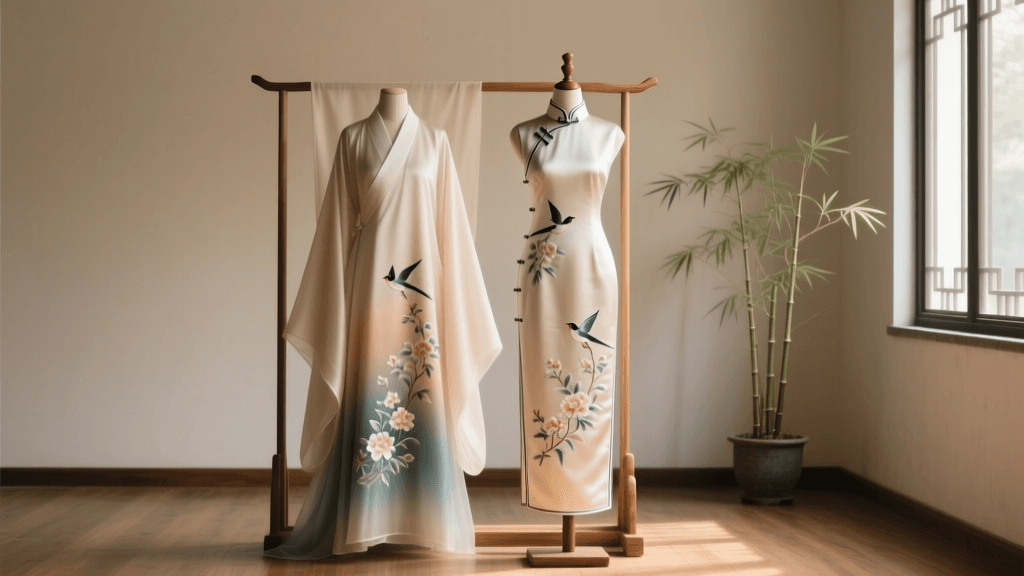
In the modern Hanfu movement, embroidery is not merely decorative; it is a marker of formality and historical accuracy. For Ming Dynasty-style garments, such as the Aoqun (jacket and skirt) or the iconic Mamianqun (horse-face skirt), embroidery is strategically placed on the collar, cuffs, and the flat front/back panels of the skirt. Artisans frequently utilize traditional motifs like the baotuan (rank badge) or floral scrolls. High-end Hanfu brands often employ a mix of digital printing for the base fabric and hand-embroidered accents to balance cost and authenticity.
The Bespoke Qipao (Cheongsam)
The 1920s and 30s Shanghai Qipao relied heavily on Su Xiu to elevate the form-fitting silhouette. Unlike the all-over patterns of Western fabrics, a hand-embroidered Qipao features asymmetrical, flowing motifs that originate from the hem or shoulder, drawing the eye across the garment. The Victoria and Albert Museum highlights how Chinese textiles adapted to modern tailoring while retaining centuries-old embroidery techniques, creating a fusion of Art Deco geometry and traditional flora.
Actionable Guide: Commissioning a Custom Embroidered Qipao
Commissioning a hand-embroidered Qipao is a significant investment in wearable art. Here is what you need to know before approaching an atelier in Shanghai, Suzhou, or a specialized overseas boutique.
- Measurements Required: Beyond standard bust, waist, and hips, you must provide your hollow-to-hem measurement (for exact skirt length), shoulder width, armhole depth, and neck circumference. Precision is vital as silk crepe de chine has zero stretch.
- Cost Expectations: A fully hand-embroidered, custom-tailored Qipao using premium silk brocade and Su Xiu techniques typically starts at $1,500 USD and can exceed $8,000 USD for master-level, dense embroidery covering over 40% of the garment.
- Timeline: Expect a waiting period of 3 to 8 months. The design phase alone, including drafting the embroidery stencil and selecting silk thread dye lots, takes 4 to 6 weeks.
- Design Advice: Opt for 'negative space.' The beauty of Su Xiu lies in the contrast between the embroidered motif and the sheer or matte silk background. Overcrowding the fabric diminishes the visual impact and adds unnecessary weight.
Actionable Guide: Sourcing and Verifying Authentic Hanfu Embroidery
For those purchasing ready-to-wear Hanfu, distinguishing between machine embroidery, digital printing, and authentic handwork is essential for valuation.
How to Verify Hand Embroidery
- Examine the Reverse Side: Turn the fabric over. Hand embroidery will show individual, tiny knots and thread ends. Machine embroidery often features a continuous looping pattern or a stiff, paper-like backing that has been torn away, leaving micro-tears in the silk.
- Check the Thread Sheen: Authentic silk thread possesses a triangular prism-like structure that refracts light at different angles, creating a shimmering, multi-dimensional effect. Polyester machine threads have a flat, plastic-like shine.
- Look for Gradients: Machine embroidery struggles with true color blending. If a peony petal transitions seamlessly from deep crimson to pale pink, it is likely the result of an artisan splitting silk threads into 1/16th strands and blending them by hand.
Caring for Silk Embroidered Textiles
Silk and hand-spun embroidery threads are highly sensitive to pH imbalances, friction, and UV light. Proper maintenance ensures these garments become heirlooms.
- Washing: Never machine wash or dry clean hand-embroidered silk unless explicitly advised by the artisan (some dry-cleaning chemicals dissolve silk sericin). Instead, hand wash in cold water using a pH-neutral detergent specifically formulated for protein fibers, such as Eucalan Fine Fabric Wash or The Laundress Silk Delicate.
- Drying: Never wring the fabric. Roll the garment in a clean, dry cotton towel to press out excess moisture, then lay it flat on a drying rack away from direct sunlight to prevent the silk dyes from fading.
- Storage: Store embroidered Hanfu and Qipao flat in a breathable cotton garment bag. Stuff the embroidered areas with acid-free tissue paper to prevent the heavy stitches from creasing or crushing the surrounding silk base over time.
"To master Su Xiu is to master patience. A single koi fish eye may take three days of stitching with a thread thinner than a human hair, but it is this dedication that gives the silk its soul." — Traditional Suzhou Artisan Proverb
Whether you are investing in a bespoke Qipao for a milestone celebration or curating a collection of historically accurate Hanfu, understanding the profound depth of Suzhou silk embroidery transforms the way you wear and appreciate Asian traditional garments.