Tang Dynasty Silk Drape Analysis: Academic Research 2026
The intersection of ancient weaving techniques and modern computational physics has birthed a new era in Chinese fashion history education. As of 2026, leading academic institutions are no longer relying solely on two-dimensional murals from the Mogao Caves or surviving, degraded textile fragments to understand the sartorial elegance of the Tang Dynasty (618–907 CE). Instead, researchers are employing advanced 3D fabric drape analysis to digitally reconstruct historical garments with unprecedented physical accuracy. This methodological shift is revolutionizing how students, historians, and contemporary designers understand the mechanics of traditional Chinese clothing.
The Physics of Tang Dynasty Silks: Bending and Shear
To accurately simulate historical garments, academics must first understand the mechanical properties of ancient textiles. The Tang Dynasty was renowned for its diverse silk production, ranging from lightweight, translucent silk gauze (luo) to heavy, opulent warp-faced compound twills (jin). According to ongoing research published in the Textile Research Journal, the drape of a fabric is governed by its bending stiffness, shear hysteresis, and tensile elongation.
In 2026, university labs utilize the Kawabata Evaluation System for Fabrics (KES-F) alongside non-destructive micro-CT scanning to analyze surviving silk artifacts. By extracting precise mechanical data from these ancient threads, researchers can create digital material twins. This allows academic software to calculate exactly how a five-meter-long silk ribbon would cascade over the shoulders of a Tang court lady, factoring in the specific humidity and gravity of the historical environment.
Furthermore, the integration of AI-driven predictive modeling in 2026 allows researchers to simulate how these fabrics would have aged over centuries, accounting for the degradation of sericin and the loss of natural dye weights. This temporal drape analysis helps historians understand how a garment's silhouette might have shifted from its initial creation to its eventual burial.
Deconstructing the Pibo and Banbi
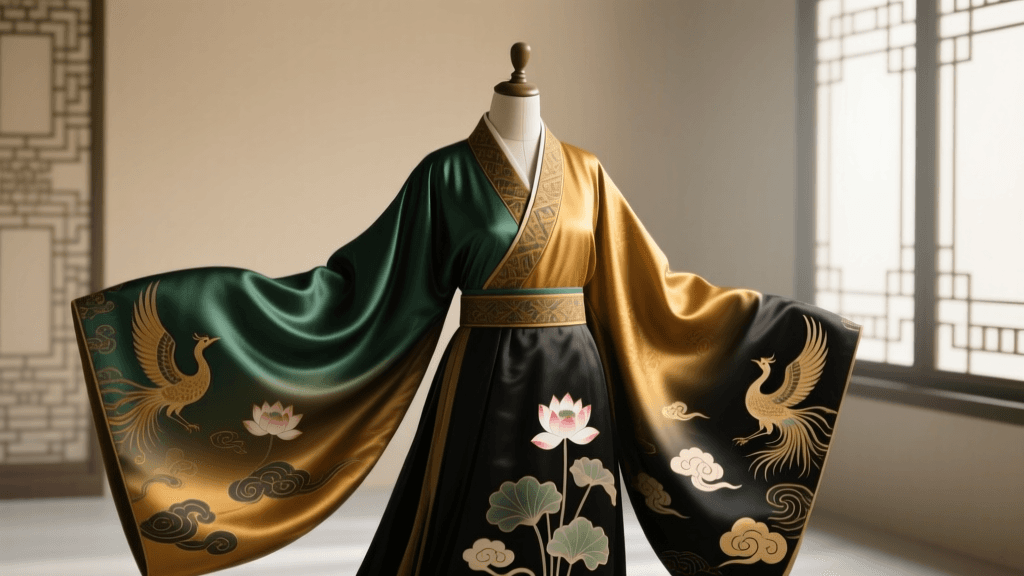
Two iconic elements of Tang fashion that benefit immensely from 3D drape analysis are the Pibo (a long, flowing silk shawl) and the Banbi (a short-sleeved jacket worn over a long-sleeved robe). Historical paintings often depict the Pibo defying gravity, looping elegantly around the arms. For decades, art historians debated whether these depictions were stylized exaggerations or accurate representations of heavily weighted silk ends.
Through 2026's advanced physics engines, researchers at institutions aligned with the Smithsonian's National Museum of Asian Art have proven that the Pibo was likely woven with a denser warp at the extremities, or subtly weighted with metallic threads, to achieve the dramatic, sweeping drape seen in murals. Conversely, the Banbi, often made of stiff brocade, exhibits high shear rigidity, causing it to sit structured and boxy on the shoulders, contrasting sharply with the fluid under-robe.
Digital Twin Technology and Simulation Software in 2026
The educational curriculum for fashion history in 2026 heavily incorporates digital twin technology. Students are taught to translate historical weaving drafts into algorithmic patterns, which are then simulated using next-generation textile software. This pedagogical approach bridges the gap between the ancient loom and the modern screen.
Comparison of 2026 Digital Textile Simulation Platforms
| Software Platform (2026 Editions) | Historical Accuracy Features | Drape Physics Engine | Primary Academic Use Case |
|---|---|---|---|
| CLO3D v8.0 | Custom yarn-level weave mapping; KES-F data import | FEM (Finite Element Method) with historical gravity toggles | Reconstructing complex layered Ruqun ensembles |
| Marvelous Designer 2026 | Algorithmic pattern drafting based on ancient loom widths | Particle-based simulation optimized for lightweight Luo gauze | Visualizing the aerodynamics of the Pibo in motion |
| Browzwear VStitcher '26 | Integration with museum artifact databases for texture matching | True-to-life shear and bend resistance modeling | Analyzing the structural tension of the Banbi jacket |
By utilizing these platforms, students can test hypotheses regarding ancient tailoring. For instance, traditional Chinese garments were primarily constructed using straight cuts to minimize waste of the precious silk woven on narrow looms. 3D drape analysis allows students to see how these geometric, zero-waste patterns transform into fluid, three-dimensional forms once subjected to gravity and the human body's topography, a core concept highlighted in the Metropolitan Museum of Art's Heilbrunn Timeline of Art History.
Bridging Ancient Weaving and Modern Academic Research
The academic research of 2026 does not exist in a vacuum; it is deeply intertwined with the physical preservation efforts of global museums. When a fragmented piece of Tang silk is discovered, conservationists and computer scientists collaborate. The physical fragment is tested for its tensile strength and flexibility. This empirical data is then fed into simulation software to 'repair' the garment digitally, predicting how the intact weave would have draped.
This methodology has profound implications for the education of future textile conservators. Students learn that understanding the drape and stress points of a garment is crucial for designing appropriate, non-damaging storage mounts. A heavy brocade robe requires a vastly different internal support structure than a delicate silk gauze robe to prevent long-term fiber degradation.
Informing the Xin Zhongshi (New Chinese Style) Movement
The rigorous academic research conducted in university labs directly influences the booming Xin Zhongshi (New Chinese Style) fashion movement of 2026. Contemporary designers looking to create historically grounded yet modern garments rely on these academic drape studies to inform their material choices.
If a designer wishes to recreate the ethereal look of a Tang dynasty court dress using modern, sustainable fibers, they must match the drape coefficient of the original silk. Academic databases now provide open-access 'drape profiles' of historical textiles. A designer can query the database for the bending stiffness of an 8th-century samite, and the system will recommend modern eco-friendly cellulose blends or lab-grown spider silks that mimic those exact physical properties.
This synergy ensures that the Xin Zhongshi movement is not merely an exercise in superficial visual aesthetics—slapping a traditional collar onto a modern western bodice—but a deep, structural homage to the engineering and physics of ancient Chinese tailoring. Moreover, international design weeks in Shanghai and Paris have begun featuring dedicated 'Academic Heritage' runways, where collections are explicitly credited to university research labs. This validation elevates traditional garment study from a niche historical pursuit to a foundational pillar of global luxury fashion innovation.
The Future of Sartorial Archaeology
As we progress through 2026, the boundary between archaeology, physics, and fashion design continues to blur. Chinese fashion history education has evolved from memorizing dynastic timelines and silhouette shapes to understanding the complex interplay of material science, gravity, and human movement. By leveraging 3D fabric drape analysis, researchers are ensuring that the tactile reality of ancient Asian traditions is preserved, understood, and reimagined for generations to come.
The digital preservation of these mechanics means that even if physical artifacts eventually succumb to the ravages of time, their physical essence—the way they moved, breathed, and interacted with the human form—will remain immortalized in the digital archives of 2026 and beyond.