Tang Dynasty Hanfu Evolution: Court Fashion & Modern Sizing Guide
The Golden Age of Silk: Tang Dynasty Court Fashion
The Tang Dynasty (618–907 AD) is universally celebrated as the golden age of Chinese arts, culture, and cosmopolitan exchange. During this era, the capital city of Chang'an was the largest and most diverse metropolis in the world, serving as the eastern terminus of the Silk Road. This unprecedented connectivity resulted in a vibrant fusion of domestic traditions and foreign influences, profoundly impacting traditional Chinese clothing. Court fashion during the Tang era was characterized by its opulence, bold color palettes, and a departure from the restrictive, modest silhouettes of previous dynasties. Women in the Tang court enjoyed a degree of social freedom that was reflected in their dress, which featured daring necklines, voluminous skirts, and intricate textile patterns inspired by Persian and Central Asian motifs.
Evolution of the Ruqun: From Han Modesty to Tang Opulence
To understand Tang court fashion, one must examine the evolution of the Ruqun (襦裙), the foundational two-piece garment system consisting of a top (ru) and a wrap-around skirt (qun). According to the Metropolitan Museum of Art's Heilbrunn Timeline of Art History, the Tang era saw an unprecedented influx of foreign ideas, which transformed the traditional Hanfu silhouette. While the Han Dynasty favored slender, modest profiles with skirts tied at the natural waist, and the Wei-Jin period introduced flowing, ethereal layers with wide sleeves, the Tang Dynasty radically elevated the waistline and expanded the volume of the garments. The aesthetic ideal shifted toward a fuller, more voluptuous figure, championed by iconic court figures like Consort Yang Guifei. This required garments that elongated the lower body and accentuated the bust and shoulders.
| Dynasty | Silhouette & Aesthetic | Skirt Placement | Sleeve Style |
|---|---|---|---|
| Han (202 BC–220 AD) | Slender, modest, grounded | Natural waist | Narrow to moderate width |
| Wei/Jin (220–420 AD) | Ethereal, flowing, layered | Natural to high waist | Wide, trailing sleeves |
| Tang (618–907 AD) | Voluptuous, bold, opulent | Above the bust (Qixiong) | Extremely wide, floor-grazing |
Key Garments of the Tang Court
Qixiong Ruqun (Chest-High Skirt)
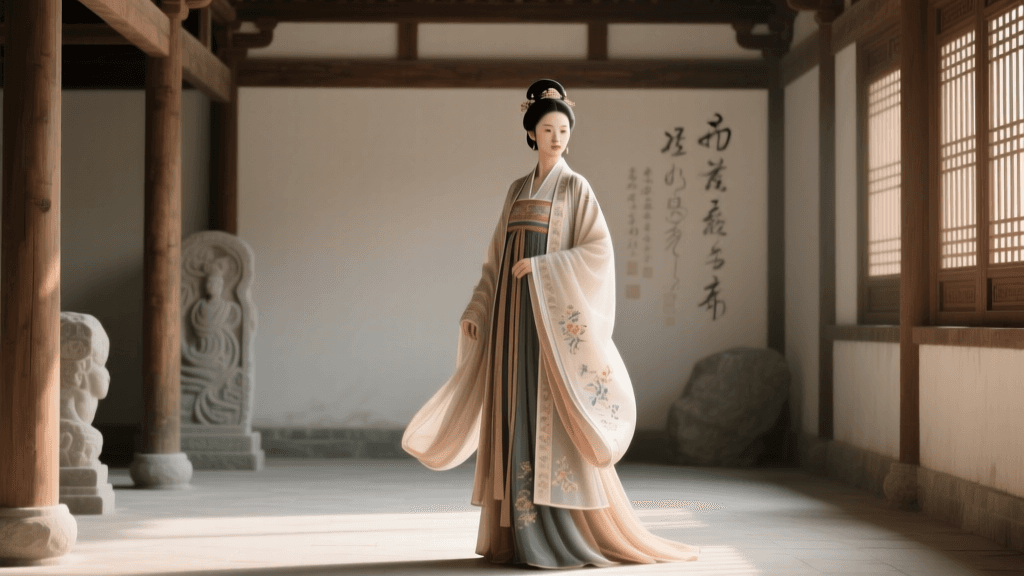
The most iconic garment of the Tang Dynasty is the Qixiong Ruqun (齐胸襦裙), or chest-high skirt. Unlike earlier styles where the skirt was tied at the waist, the Qixiong skirt was secured high on the torso, directly above the bust, using long fabric ties. This design created the illusion of extraordinarily long legs and a flowing, regal posture. The top worn beneath or tucked into the skirt was often a low-cut, short-sleeved blouse that revealed the collarbone and upper chest, a bold stylistic choice that highlighted the era's confident, cosmopolitan spirit. Court ladies would often layer a translucent silk shawl over the shoulders to add depth and movement to the ensemble.
Banbi (Half-Sleeve Jacket)
Originally adapted from military and male servant attire, the Banbi (半臂), or half-sleeve jacket, became a staple of female court fashion. Worn over the inner blouse and skirt, the Banbi featured short, cap-like sleeves and a cross-collared or round-collared neckline. It was often crafted from heavily brocaded silks and served both as a practical layering piece for variable temperatures and as a canvas for displaying wealth through intricate woven patterns. The contrast between the short sleeves of the Banbi and the massive, trailing sleeves of the underlying blouse created a striking visual hierarchy.
Pibo (Silk Stole)
No Tang court ensemble was complete without the Pibo (披帛), a long, lightweight silk stole draped over the shoulders and arms. Originating from Central Asian and Buddhist artistic influences, the Pibo added a dynamic, ethereal quality to the wearer's movements. As noted in the Victoria and Albert Museum's Asian collections, these stoles were often painted or woven with gold thread, fluttering behind the wearer like wings and emphasizing the graceful, sweeping gestures of court dances and daily promenades.
Textiles and Motifs: The Wealth of the Silk Road
The Tang Dynasty's mastery of silk weaving reached new heights, heavily influenced by Sogdian and Persian weavers who traveled the Silk Road. The Tang Dynasty historical records on Britannica highlight the empire's vast trade networks, which brought in new dyeing techniques and motifs. Court fabrics featured large, circular medallions (roundels) enclosing paired birds, lions, or mythical beasts, alongside lush floral patterns like the peony, which symbolized wealth and honor. The color palette was equally extravagant; while imperial yellow was reserved for the emperor, court women favored vibrant crimsons, deep purples, and emerald greens, achieved through expensive plant and mineral dyes. The use of gold-leaf appliqué and metallic threads woven directly into the silk brocade further elevated the garments to wearable art.
Practical Guide: Sourcing and Sizing Modern Tang Hanfu
For modern Hanfu enthusiasts looking to recreate Tang Dynasty court fashion, understanding historical accuracy alongside modern wearability is crucial. Sourcing a high-quality Qixiong Ruqun requires specific measurements, as the fit differs vastly from modern Western clothing or even other Hanfu styles like the Ming Dynasty Mamianqun.
Essential Measurements for Tang Hanfu
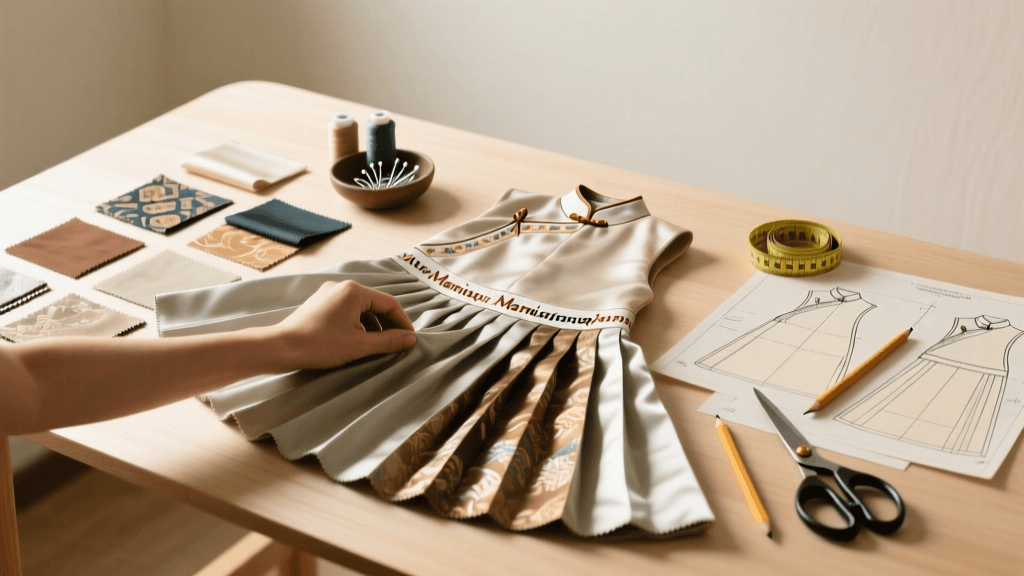
When ordering a custom or made-to-measure Tang Hanfu set, you must provide the following specific metrics to ensure the chest-high skirt does not slip and the sleeves drape correctly:
- Upper Bust (Underbust): Measure directly under the bust where the skirt ties will sit. This is the most critical measurement for a Qixiong Ruqun to prevent the garment from sliding down.
- Full Bust: Measure around the fullest part of the chest. The inner blouse must accommodate this without pulling at the cross-collar.
- Skirt Length (Drop): Measure from the underbust down to the floor while wearing the shoes you intend to use. Tang skirts were designed to pool slightly on the floor; add 2 to 3 inches (5-8 cm) to your exact floor measurement for historical accuracy.
- Arm Span: Measure from wrist to wrist with arms outstretched. Tang court sleeves were exceptionally wide. For a historically accurate court look, the sleeve length should extend at least 6 inches (15 cm) past the fingertips, with a sleeve width of 20 to 24 inches (50-60 cm) at the opening.
Fabric Selection and Cost Expectations
The choice of fabric dictates both the historical authenticity and the cost of the garment. Modern mass-produced Hanfu often relies on polyester chiffon and jacquard, which are durable and affordable but lack the breathable, fluid drape of historical textiles.
- Entry-Level ($30 - $60 USD): Typically made from polyester chiffon (for the Pibo and outer layers) and polyester jacquard (for the skirt). These are excellent for beginners, photography, and casual conventions, though they can trap heat in summer.
- Mid-Range ($80 - $150 USD): Features cotton-linen blends, viscose, or high-grade synthetic silks. The skirts often feature woven metallic threads and embroidered roundels. Brands in this tier offer better structural integrity for the skirt ties, which is vital for heavy skirts.
- Museum-Grade / Authentic Silk ($200 - $450+ USD): For serious collectors, garments crafted from genuine raw silk, silk gauze (Luo), and traditional brocade (Zhijin). These fabrics offer the exact luminous sheen and lightweight drape seen in Tang Dynasty murals. Expect to pay a premium for hand-finished hems and natural plant dyes.
Styling and Wearability Tips
Wearing a Qixiong Ruqun requires specific undergarments for modern modesty and comfort. It is highly recommended to wear a strapless corset top or a specialized Hanfu inner tube top (Moxiong) beneath the blouse. This provides a grippy surface for the skirt ties to anchor against, preventing the heavy brocade skirt from slipping during movement. When tying the skirt, use the traditional double-loop knot, pulling the silk ties taut across the back and securing them firmly at the side or front. Finally, style the hair in a high, elaborate updo adorned with gold buyao (step-hairpins) and fresh or silk peonies to complete the quintessential Tang Dynasty court aesthetic.