Tang Dynasty Court Fashion: Evolution and Modern Ruqun Guide
The Evolution of Ruqun: From Han Simplicity to Tang Opulence
Traditional Chinese clothing, broadly referred to today under the umbrella of Hanfu, is not a monolith. It is a dynamic tapestry that evolved significantly across dynasties, reflecting shifting political climates, economic prosperity, and cultural exchanges. Nowhere is this evolution more visibly striking than in the transition from the conservative silhouettes of the Han Dynasty to the cosmopolitan opulence of the Tang Dynasty court fashion.
At the core of this evolution is the Ruqun (襦裙), a two-piece ensemble consisting of a top garment (ru) and a wrap-around skirt (qun). While the fundamental concept remained, the cut, drape, and styling transformed dramatically.
| Dynasty | Skirt Position | Sleeve Style | Dominant Fabrics | Court Influence |
|---|---|---|---|---|
| Han (202 BCE–220 CE) | Natural Waist | Narrow, Curved | Hemp, Early Silk | Conservative, Ritualistic |
| Wei/Jin (220–420 CE) | Natural Waist | Wide, Flowing | Lightweight Silk | Literati, Ethereal |
| Tang (618–907 CE) | Chest-High (Qixiong) | Broad, Rounded | Heavy Brocade, Gauze | Cosmopolitan, Opulent |
As noted by historians at the Metropolitan Museum of Art, the Tang Dynasty was a period of unprecedented wealth and international trade along the Silk Road. This influx of foreign ideas, textiles, and aesthetics liberated court fashion from the strict Confucian modesty of earlier eras, giving rise to bolder, more expressive silhouettes.
Decoding Tang Court Fashion: The Qixiong Ruqun
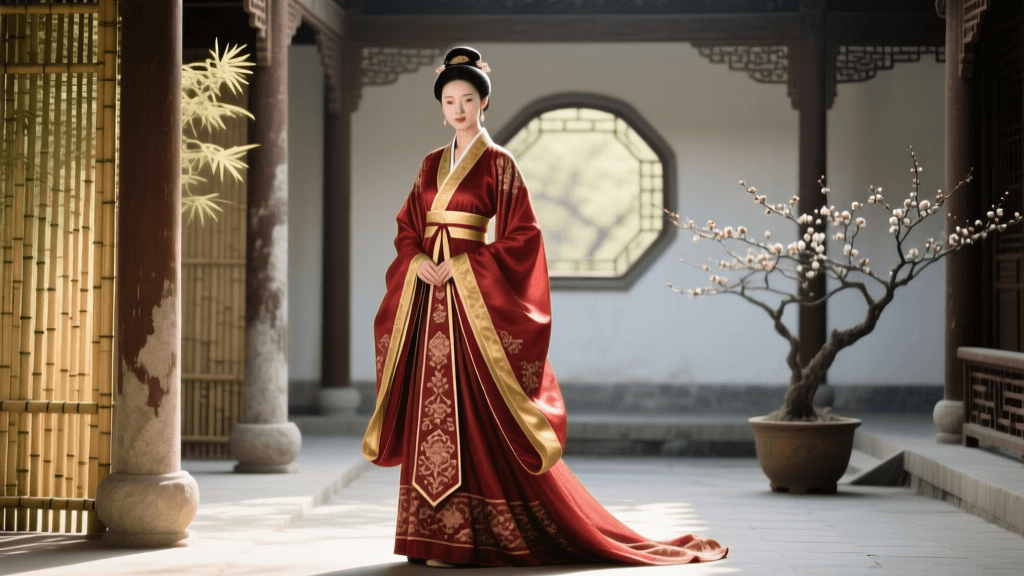
The crowning achievement of Tang women's court fashion was the Qixiong Ruqun (齐胸襦裙), or the chest-high skirt. Unlike previous dynasties where the skirt was tied at the natural waist, Tang court ladies tied their voluminous skirts high up, just above the bust. This created an elongated, elegant silhouette that emphasized a statuesque grace.
Court ladies layered their outfits with a Banbi (半臂), a short-sleeved half-jacket worn over the inner top, and draped a Pibo (披帛)—a long, flowing silk shawl—across their arms. The Pibo was often made of sheer, lightweight gauze, contrasting beautifully with the heavy, heavily patterned brocades of the skirt. According to a cultural analysis by BBC Culture, this layered, flowing aesthetic remains one of the most iconic and recognizable symbols of ancient Chinese elegance, heavily romanticized in modern media and the contemporary Hanfu revival movement.
Historical Motifs and Color Symbolism in Tang Court Fashion
To truly replicate Tang Dynasty court fashion, one must look beyond the silhouette and examine the textiles. The Tang elite favored bold, saturated colors made possible by advanced dyeing techniques and imported pigments. Pomegranate red, saffron yellow, and indigo blue were highly prized. The famous 'pomegranate skirt' (石榴裙) was a staple of the Tang wardrobe, often referenced in classical poetry to describe the captivating allure of court women.
Motifs were equally lavish. Unlike the subtle, nature-inspired embroidery of later dynasties like the Song or Ming, Tang textiles featured large, repeating circular medallions (团窠) filled with confronting beasts, floral scrolls, or mythical birds like the phoenix and peacock. These patterns were heavily influenced by Sogdian and Persian textiles brought via the Silk Road. When sourcing a modern reproduction, look for jacquard woven fabrics featuring these large-scale, symmetrical medallion patterns rather than small, scattered floral prints, which are more characteristic of Ming or Qing dynasty aesthetics.
Actionable Guide: Sourcing and Wearing Modern Tang-Style Ruqun
For modern enthusiasts, historical accuracy and practical wearability must be balanced. The modern Hanfu market has exploded, with industry reports from Sixth Tone highlighting a multi-billion dollar industry driven by young consumers seeking cultural connection. Here is how you can source, size, and wear a Tang-style Qixiong Ruqun today.
Sizing and Measurements for Qixiong Ruqun
Buying a chest-high skirt requires different measurements than standard modern clothing. When ordering from specialized Hanfu boutiques on platforms like Taobao, AliExpress, or independent Western vendors, you must provide the following:
- Underbust Circumference: The most critical measurement. The skirt's waistband will sit here. Measure snugly.
- Bust Circumference: To ensure the top garment (ru) fits comfortably without gaping.
- Height / Skirt Length: A standard Qixiong skirt is usually 120cm to 140cm long. For a wearer who is 160cm (5'3') tall, a 120cm skirt will graze the floor, creating the proper courtly drape. Add 10cm for every additional 5cm of height.
Fabric Selection and Cost Breakdown
The fabric dictates both the historical accuracy and the price point. Tang court fashion favored rich textures and vibrant dyes.
- Entry-Level ($30 - $60 USD): Typically made from polyester chiffon and jacquard. While affordable and durable for daily wear or conventions, polyester lacks the breathable drape of historical textiles and can feel stifling in summer.
- Mid-Tier ($80 - $150 USD): Features silk-cotton blends, rayon, and high-quality synthetic brocades. This is the 'sweet spot' for most enthusiasts, offering a beautiful drape, rich colors, and comfortable wear for extended periods.
- High-End Custom ($250 - $800+ USD): Crafted from 100% Mulberry silk, silk gauze (Luo), and featuring hand-embroidered motifs (such as peonies or phoenixes). These pieces are investment garments meant for formal events, tea ceremonies, or historical reenactments.
Step-by-Step Wearing Guide: Securing the Chest-High Skirt
The most common complaint among modern Hanfu wearers is that the Qixiong skirt slips down. Historical court ladies likely had servants to help dress them and used different tying techniques or inner garments to secure the heavy silk. Here is a practical, modern solution to keep your skirt securely in place all day.
- Prep the Anti-Slip Band: Purchase a silicone anti-slip waistband (widely available on Amazon or Hanfu accessory shops for under $10). Wrap it around your underbust, over your inner shirt. The silicone grips both your clothing and the skirt's inner lining.
- Wrap the Skirt: Hold the skirt behind your back. Bring the two front panels across your chest, overlapping them slightly. Ensure the hem is even and grazing the floor.
- The First Tie: Take the attached ribbons and pull them tightly across your back, crossing them, and bring them back to the front. Tie a firm, flat square knot right in the center of your chest.
- The Double-Loop Secure: Instead of just letting the ribbons hang, take the long ends, loop them under the main waistband on your left and right sides, and pull them back up to the front knot. This creates tension that anchors the skirt to the silicone band.
- Drape the Pibo: Drape your silk shawl over both arms, letting the ends hang down past your wrists. For a classic Tang court look, allow the center of the shawl to rest behind your neck or upper back, securing it lightly with a hidden brooch if necessary.
Completing the Look: Tang Court Hair and Makeup
A Tang court lady's ensemble was incomplete without her elaborate grooming. Hair was swept up into voluminous buns, often adorned with gold and jade hairpins (簪) or fresh peonies. For modern wearers, a high bun padded with a foam hair rat and secured with U-pins provides an authentic silhouette without the need for waist-length hair.
Makeup was equally dramatic and multi-layered. The classic Tang court makeup routine included a white lead base (replaced today by a light, brightening foundation), heavy rouge applied to the cheeks and blending into the eyelids, and the iconic Huadian (花钿)—a floral appliqué painted or pasted between the eyebrows. Modern enthusiasts can easily recreate the Huadian using delicate gold leaf stickers or specialized face gems, adding an undeniable touch of imperial opulence to the overall presentation.
Conclusion
The evolution of the Ruqun from the modest, waist-tied skirts of the Han Dynasty to the breathtaking, chest-high silhouettes of the Tang court represents a fascinating journey through Chinese social history. Today, wearing a Qixiong Ruqun is not merely an act of cosplay; it is a tactile connection to an era of unparalleled artistic and cultural flourishing. By understanding the historical context, selecting the right fabrics, and mastering the practical art of dressing, modern wearers can confidently step into the elegance of Tang Dynasty court fashion.