Murasaki Shikibu & The Junihitoe: Heian Fashion Legacy
The Literary Icon Who Defined Japanese Elegance
When discussing the foundational pillars of traditional Japanese clothing, few historical figures cast as long a shadow as Murasaki Shikibu. Best known as the author of The Tale of Genji—widely considered the world’s first novel—Murasaki was not merely a storyteller; she was the ultimate arbiter of Heian court aesthetics. Living during the Heian period (794–1185), an era characterized by a profound devotion to beauty, poetry, and refined sensibilities, Murasaki documented the intricate sartorial codes that dictated social standing, romantic intrigue, and seasonal awareness. Her meticulous descriptions of courtly garments did more than record history; they solidified a fashion legacy that continues to influence Japanese textile arts, kimono layering, and color theory over a millennium later.
For Murasaki and her contemporaries, fashion was not a superficial pursuit but a vital language. In a society where high-ranking women were largely sequestered behind sudare (bamboo blinds) and kicho (portable screens), a woman’s face was rarely seen by men outside her immediate family. Instead, her identity, taste, and emotional state were communicated through the edges of her sleeves and the layered hems of her robes peeking out from behind the blinds. Murasaki’s genius lay in her ability to use these textile clues as narrative devices, turning the jūnihitoe (twelve-layer robe) into a canvas of unspoken dialogue.
Deconstructing the Jūnihitoe: Anatomy of the Twelve-Layer Robe
The jūnihitoe is the most iconic garment of the Heian aristocracy, yet its name—translating literally to "twelve layers"—is something of a misnomer. Depending on the season, the wearer's rank, and the specific court occasion, the ensemble could consist of anywhere from ten to over twenty distinct layers of silk. The sheer volume and weight of the garment were intended to project an aura of majestic stillness and immovable authority. A fully assembled formal jūnihitoe could weigh up to 20 kilograms (44 lbs), requiring immense physical endurance to wear.
To understand Murasaki’s fashion legacy, one must understand the architecture of the ensemble. The foundational layers included:
- Kosode: The basic, small-sleeved undergarment worn closest to the skin, usually made of white or unbleached silk.
- Nagabakama: Long, flowing, pleated trousers tied at the waist, often extending past the feet to create a sweeping silhouette.
- Hitoe: An unlined inner robe that served as the base for the subsequent colorful layers.
- Itsutsuginu: The core "five-layer" set of brightly colored robes, though courtiers often wore more than five to display wealth.
- Uchiginu: A stiff, beaten-silk robe worn over the colorful layers to provide structure and a smooth surface for the outer garments.
- Uwagi: The primary outer robe, featuring the most intricate weaving and dyeing techniques.
- Karaginu: A short, Chinese-style jacket with stiff, wing-like shoulders, worn only by women of the highest rank.
- Mo: A long, apron-like train attached at the waist and dragging behind the wearer, often dyed with auspicious patterns.
Kasane no Irome: The Art of Color Layering
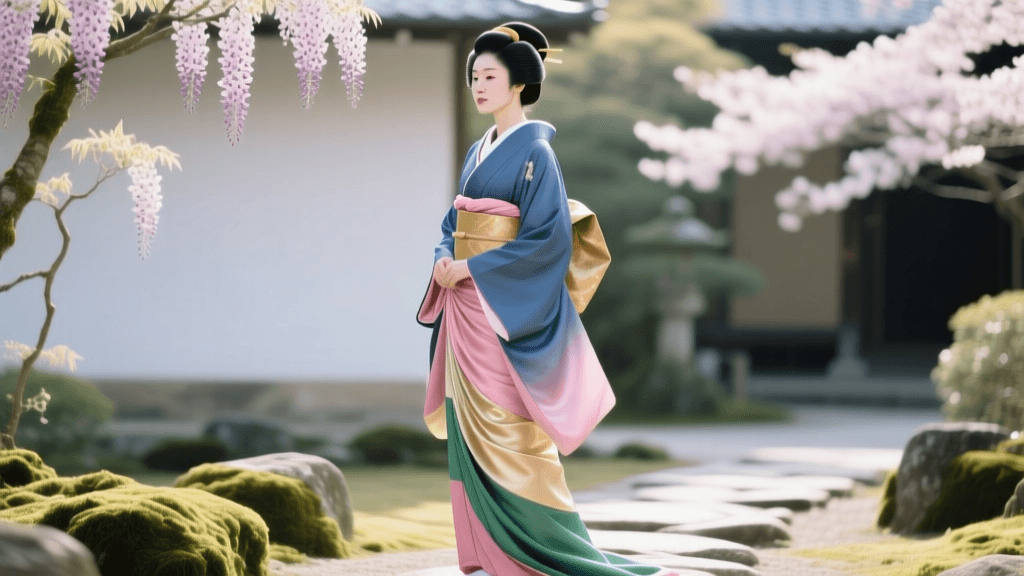
Murasaki Shikibu’s writings frequently highlight the concept of kasane no irome, the highly codified system of color layering. Because the robes were worn in descending sizes, the hems, collar edges, and sleeve cuffs of the inner layers were intentionally left visible beneath the outer layers. The specific combination of these overlapping colors was dictated by the exact week of the season, the wearer's age, and the specific court event.
A woman who mismatched her seasonal colors or wore a winter palette in the spring would face severe social ostracization and become the subject of cruel court gossip—a dynamic Murasaki exploited brilliantly in her novels. The subtle gradation of colors mimicked the natural world, reflecting a deep Shinto and Buddhist reverence for the ephemeral beauty of nature.
Table: Classic Kasane no Irome Combinations
| Season | Combination Name | Outer Layer Color | Inner Layer Color | Natural Inspiration |
|---|---|---|---|---|
| Spring | Sakura (Cherry Blossom) | White | Pink | White petals over dark branches |
| Summer | Fuji (Wisteria) | Lavender | Deep Green | Wisteria vines hanging in forests |
| Autumn | Kiku (Chrysanthemum) | Bright Yellow | Crimson | Autumn flowers against turning leaves |
| Winter | Yuki (Snow on Ice) | Stark White | Light Blue | Fresh snow resting on frozen ponds |
Experiencing Heian Fashion Today: Rentals, Costs, and Etiquette
While the jūnihitoe is no longer worn in daily life, its legacy survives. Today, it is reserved almost exclusively for the Japanese Imperial Family during coronations and royal weddings. However, cultural enthusiasts, historians, and travelers can still experience the weight and majesty of Murasaki’s era through specialized heritage studios in Kyoto. According to the Japan National Tourism Organization, participating in traditional dress experiences is one of the most immersive ways to understand the country's cultural heritage.
Renting and wearing a reproduction jūnihitoe requires careful planning, as the garment is vastly different from a standard kimono rental. Below is a practical, actionable guide for those looking to step into the Heian court.
Practical Guide to Booking a Junihitoe Experience
- Cost Expectations: Authentic, multi-layered jūnihitoe rentals are a premium service. Expect to pay between ¥38,000 and ¥55,000 ($250–$370 USD) per person. This fee typically includes the rental, professional dressing assistance, a 2-hour photography session, and access to a traditional tatami studio.
- Measurements and Sizing: Standard rental sets are tailored for heights between 150 cm and 165 cm (4'11" to 5'5"). While the width is universally adjustable via koshihimo (tying sashes), the sleeve length (sode-take) is fixed at approximately 105 cm. If you are taller than 170 cm, you must contact the studio at least 30 days in advance to arrange custom-length nagabakama and outer robes.
- Timing and Preparation: Allocate exactly 2.5 hours for the dressing process. The layers must be aligned with millimeter precision using specialized clips and ties. Wear a low-cut sports bra and fitted leggings beneath your clothes to make the transition easier, and bring your own white tabi (split-toe socks) if you have large feet, as studio rentals typically only stock up to 25 cm.
- Physical Etiquette: Because the ensemble weighs up to 20 kg, walking is done via a slow, sliding shuffle (suriashi). Do not attempt to lift the heavy mo (train) yourself; studio assistants will arrange it for seated portraits. Keep your arms slightly elevated at the wrists to allow the kasane sleeve layers to cascade properly for photographs.
The Enduring Legacy in Modern Kimono
Though the physical jūnihitoe was abandoned during the Kamakura period (1185–1333) in favor of more practical samurai-class garments, the aesthetic principles codified by Murasaki Shikibu never disappeared. As detailed in analyses of Heian Period art and culture, the transition from the layered jūnihitoe to the single-layer kosode (the direct ancestor of the modern kimono) forced the intricate color combinations to be painted or dyed directly onto the fabric, rather than layered physically.
Today, the legacy of kasane no irome is most visible in the modern kimono’s date-eri (decorative false collar) and han-eri (removable collar cover). When a modern kimono wearer pairs a pale pink han-eri with a deep crimson date-eri peeking out at the nape of the neck, they are directly echoing the sleeve-layering techniques of Murasaki’s heroines. Furthermore, the strict seasonal rules of Heian fashion dictate modern kimono motifs; wearing a cherry blossom motif in autumn remains a major faux pas, proving that the literary icon's rigid, beautiful fashion codes still govern Japanese sartorial elegance a thousand years later.