Tang Dynasty Court Fashion: Evolution and Modern Hanfu Guide
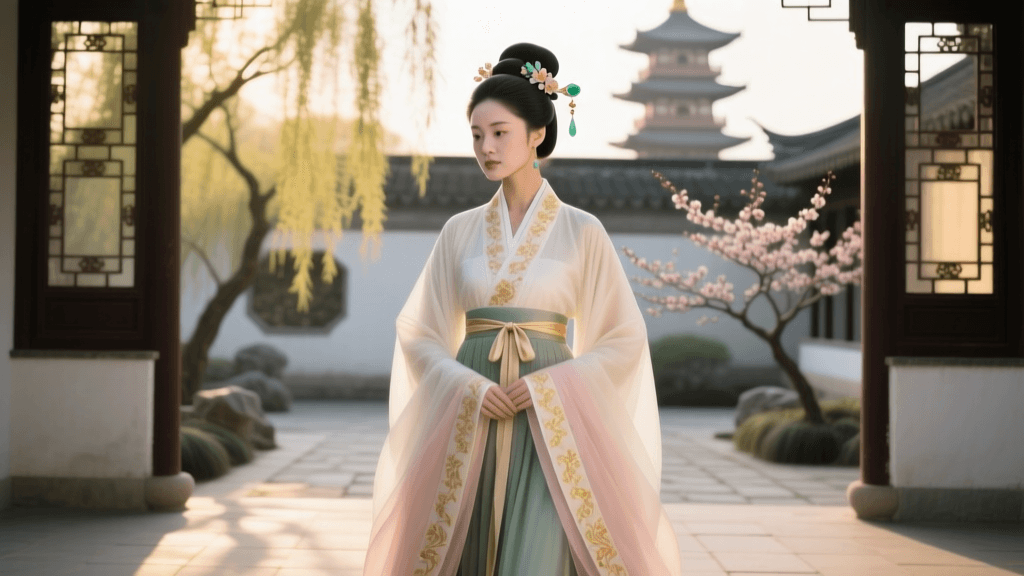
The Cosmopolitan Canvas of Tang Dynasty Court Fashion
The Tang Dynasty (618–907 CE) is widely regarded as the golden age of Chinese arts, culture, and global trade. At the heart of this flourishing empire was its capital, Chang'an, a bustling metropolis where merchants, diplomats, and scholars from across the world converged. This unprecedented cultural exchange profoundly influenced Tang court fashion, transforming it into a vibrant, cosmopolitan canvas. According to the UNESCO Silk Roads Programme, the influx of Sogdian, Persian, and Central Asian textiles introduced new motifs, weaving techniques, and silhouettes to the Chinese imperial wardrobe, creating a unique sartorial legacy that continues to captivate historians and modern Hanfu enthusiasts alike.
Unlike the restrictive and modest garments of later dynasties, Tang court fashion was characterized by its boldness, fluidity, and opulence. Women of the court enjoyed a remarkable degree of social freedom, which was directly reflected in their clothing. They embraced vibrant colors, intricate patterns, and daring silhouettes that celebrated the natural form. Today, the revival of these garments—categorized under the umbrella of Tangzhi Hanfu (Tang-system Hanfu)—offers a fascinating intersection of historical preservation and modern styling.
The Evolution of the Silhouette: Early to Late Tang
The Tang Dynasty spanned nearly three centuries, and its court fashion was far from static. The evolution of the silhouette can be divided into three distinct phases, each reflecting the shifting political and cultural tides of the empire.
Early Tang (618–712 CE): Emerging from the preceding Sui Dynasty, Early Tang fashion favored a slender, elongated silhouette. Skirts were high-waisted, tied above the bust, and paired with narrow-sleeved tops. The aesthetic was relatively modest, emphasizing vertical lines and graceful restraint.
High Tang (712–765 CE): This era, particularly during the reign of Emperor Xuanzong and his beloved consort Yang Guifei, marked the zenith of Tang opulence. The beauty ideal shifted toward voluptuousness and fullness. Garments became significantly wider, featuring sweeping, floor-dragging skirts, dramatically flared sleeves, and bold, contrasting color palettes. The Metropolitan Museum of Art notes that this period saw the peak of Central Asian influence, with pearl roundels and exotic animal motifs dominating luxury silk brocades.
Late Tang (765–907 CE): Following the An Lushan Rebellion, the empire's stability waned, but court fashion became even more hyper-ornate. The silhouette grew heavier and more complex, with multiple layered shawls, exaggerated hairpieces, and dense, intricate embroidery that signaled a retreat into lavish escapism.
Comparative Chart: Tang Dynasty Court Silhouettes
| Era | Silhouette Ideal | Skirt Style & Rise | Sleeve Proportions | Dominant Textile Motifs |
|---|---|---|---|---|
| Early Tang | Slender, elongated, modest | A-line, tied at underbust | Narrow, fitted to wrist | Simple florals, geometric stripes |
| High Tang | Voluptuous, broad, opulent | Bell-shaped, tied at chest (Qixiong) | Wide, flared, floor-dragging | Pearl roundels, Sogdian lions, peonies |
| Late Tang | Heavy, layered, hyper-ornate | Voluminous, multi-layered hems | Extremely wide, drooping | Dense auspicious birds, complex brocades |
Deconstructing the Tang Court Wardrobe
To accurately recreate or adapt Tang court fashion today, one must understand the foundational garments that made up the ensemble.
Qixiong Ruqun (Chest-High Skirt Ensemble)
The most iconic garment of the Tang Dynasty is the Qixiong Ruqun. Unlike standard waist-high skirts, the Qixiong skirt is tied securely above the bust, under the armpits. This creates the illusion of incredibly long legs and a flowing, statuesque posture. It is typically paired with a short, lightweight inner top (Shan) and a wide-sleeved outer jacket.
Banbi (Half-Sleeve Jacket)
Originally adapted from military and working-class attire, the Banbi was adopted by court women as a stylish layering piece. It is a short-sleeved jacket worn over the inner top and tucked into or worn over the skirt. In the High Tang era, Banbi were often crafted from richly patterned silks, adding a layer of textural contrast to the ensemble.
Pibo (Silk Shawl)
No Tang court outfit was complete without the Pibo, a long, flowing silk scarf draped over the shoulders and arms. Originating from Central Asian and Buddhist iconography, the Pibo added dynamic movement to the wearer's silhouette. As noted by the Victoria and Albert Museum, the mastery of Chinese silk weaving allowed for these shawls to be spun incredibly fine, allowing them to float ethereally behind the wearer as she walked.
Practical Guide: Sourcing and Styling Tang Hanfu Today
For modern Hanfu enthusiasts, historical reenactors, and cosplayers, acquiring an accurate Tang-style ensemble requires attention to specific measurements, fabric choices, and budgeting. Here is an actionable guide to building your wardrobe.
1. Precise Measurements for the Qixiong Ruqun
The most common mistake modern buyers make with Tang Hanfu is improper sizing of the chest-high skirt, leading to slipping or restricted breathing. Follow these measurement rules:
- Upper Chest (Xia Xiong): Measure the circumference of your ribcage directly under your bust. Add 2 to 3 cm for ease and breathing room. If the skirt relies on ties rather than elastic, ensure the inner tie is anchored to this exact measurement.
- Skirt Length (Hollow to Hem): Measure from your underbust down to the floor while wearing the shoes you intend to use. For historical accuracy, High Tang skirts should pool slightly on the floor (add 5 cm to your floor measurement). For practical modern wear, subtract 2 cm to prevent tripping.
- Pleat Ratio: Authentic Tang skirts utilized knife pleats or box pleats. Look for vendors offering a minimum 3:1 fabric-to-waist ratio to ensure the skirt flows properly without looking stiff.
2. Fabric Selection and Historical Accuracy
The choice of fabric dictates the drape and historical validity of the garment.
- Silk Brocade and Damask (Zhi Jin): For High Tang outer jackets and Banbi, silk brocade provides the necessary structure and luxurious sheen. Expect to pay between $150 and $400 USD for authentic silk sets from specialized heritage brands like Zhong Ling or Shisun.
- Silk Chiffon and Crepe: Ideal for the Pibo and inner Shan tops. These fabrics mimic the lightweight, ethereal qualities seen in Tang dynasty murals. Costs range from $60 to $120 USD.
- Modern Synthetics (Polyester/Jacquard): For beginners or those on a budget, high-quality polyester jacquard offers a similar visual weight to brocade at a fraction of the cost ($30 to $60 USD on platforms like Taobao or AliExpress), though it lacks the breathability of natural fibers.
3. Accessorizing the Tang Court Look
The Tang court was famous for its elaborate grooming. To complete the look, invest in a Buyao (a dangling hairpin that sways with movement) and a Shufu (a wide-toothed crescent comb) to secure a high, voluminous updo. Additionally, the application of Huadian (forehead decals made of gold leaf, pearl, or modern cosmetic stickers) between the eyebrows is a hallmark of High Tang court makeup, directly inspired by the legendary Princess Shouyang.
Conclusion
The evolution of Tang Dynasty court fashion is a testament to an era of unparalleled openness, artistic brilliance, and cultural synthesis. From the slender grace of the Early Tang to the unapologetic opulence of the High Tang, these garments tell the story of an empire that embraced the world. Today, the meticulous revival of Tangzhi Hanfu allows us to not only study this history but to wear it. By understanding the precise measurements, historical textiles, and structural anatomy of the Qixiong Ruqun and Pibo, modern wearers can step into the cosmopolitan canvas of Chang'an, keeping the golden age of Chinese fashion vibrantly alive.