The 2026 Guide to Tailoring a 14th-Century Cotehardie
The year 2026 has ushered in a remarkable renaissance for historical European martial arts (HEMA), medieval reenactment, and the broader European folk dress revival community. As enthusiasts demand higher levels of historical accuracy, the days of poorly fitted, machine-sewn polyester tunics are firmly in the past. Today, the focus is on meticulous craftsmanship, authentic materials, and period-correct tailoring techniques. At the forefront of this movement is the 14th-century cotehardie, a garment that represents one of the most significant shifts in the history of European clothing.
The 14th-Century Tailoring Revolution
Before the mid-14th century, European clothing was largely constructed using geometric shapes—rectangles, triangles, and gussets—draped loosely over the body. The cotehardie marked a radical departure from this tradition. It was one of the first garments to feature curved seams, tailored to follow the natural contours of the human torso. According to the Victoria and Albert Museum's medieval collections, this shift required a new understanding of fabric manipulation, moving from simple draping to complex cutting and fitting. The cotehardie was worn by both men and women, though the length and specific tailoring details varied by gender and social class. For modern reenactors, mastering this garment is a rite of passage that bridges the gap between amateur costuming and serious historical interpretation.
Sourcing Authentic Textiles in 2026
The foundation of any accurate cotehardie is the fabric. In 2026, the market for historically accurate, natural-fiber textiles is more robust than ever, with specialized mills in the United Kingdom, Scandinavia, and Eastern Europe producing period-correct weaves. The most historically accurate choice for a cotehardie is a medium-to-heavy weight wool, woven in a 2/2 twill or tabby weave, which provides the necessary structure and drape. Linen was primarily used for undergarments (chemises and braies), though lighter weight wool or wool-linen blends were occasionally used for summer wear by the lower classes.
2026 Historical Textile Comparison Chart
| Material | Weave Structure | Weight (g/m²) | Estimated 2026 Cost | Best Application |
|---|---|---|---|---|
| Fulled Wool | 2/2 Twill | 450 - 550 | $55 - $75 / yard | Outer Cotehardie (Winter/Autumn) |
| Worsted Wool | Tabby | 250 - 350 | $40 - $60 / yard | Outer Cotehardie (Spring/Summer) |
| Bleached Linen | Tabby | 180 - 220 | $25 - $35 / yard | Undergarments (Chemise/Braies) |
| Unbleached Linen | Tabby | 200 - 250 | $20 - $30 / yard | Lining and Interfacing |
Drafting the Pattern: The Draping Method
While flat-patterning is common in modern sewing, the most historically plausible method for achieving the skin-tight fit of a 14th-century cotehardie is draping directly on a dress form or the wearer's body. Begin by preparing a muslin toile (mock-up). Pin the fabric along the center front and center back, then smooth the fabric over the chest and waist, pinning the side seams. The defining feature of the cotehardie is its multi-panel construction; many extant examples and manuscript illustrations suggest the use of four to eight panels to achieve the dramatic curve at the waist and the flare at the hips.
When marking your seam lines, ensure that the waistline sits at the natural narrowest point of the torso. The garment should fit snugly enough to support the bust (for women) or provide a smooth, tailored silhouette (for men) without restricting breathing. Once the toile is perfectly fitted, carefully remove it, transfer the markings to your final wool fabric, and add a generous 1-inch seam allowance to accommodate historical flat-felled seams.
Mastering the Grande Assiette Sleeve
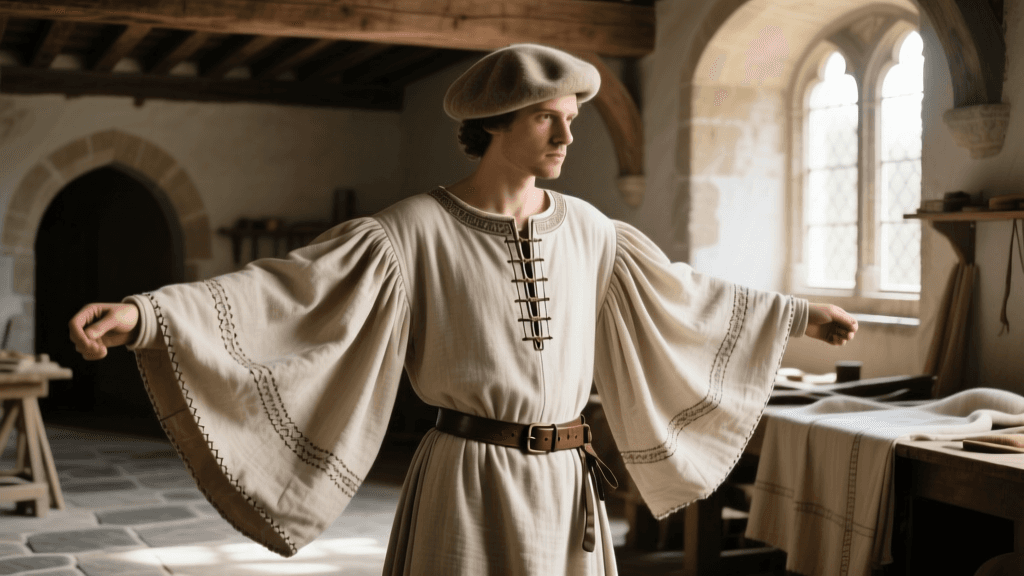
The most technically demanding aspect of the cotehardie is the sleeve. By the late 14th century, the standard set-in sleeve evolved into the grande assiette (great gusset) sleeve. This design features a deeply extended armhole that reaches almost to the side seam, with a large, diamond-shaped gusset inserted under the arm. Extant manuscripts, such as those preserved in the British Library's medieval archive, frequently depict figures with incredible arm mobility, a direct result of this tailoring innovation. For modern practitioners of historical European martial arts, the grande assiette sleeve is essential, as it allows for the full range of motion required for sword fighting and archery without the garment riding up or tearing at the shoulder.
To draft this sleeve, extend your armhole scye down the side seam by at least 3 to 4 inches. The sleeve cap itself will be relatively shallow but wide, and the underarm gusset must be carefully shaped to match the curve of the extended armhole. Baste the gusset in place and test the range of motion before committing to your final hand-sewn seams.
Hand-Sewing Techniques and Thread Preparation
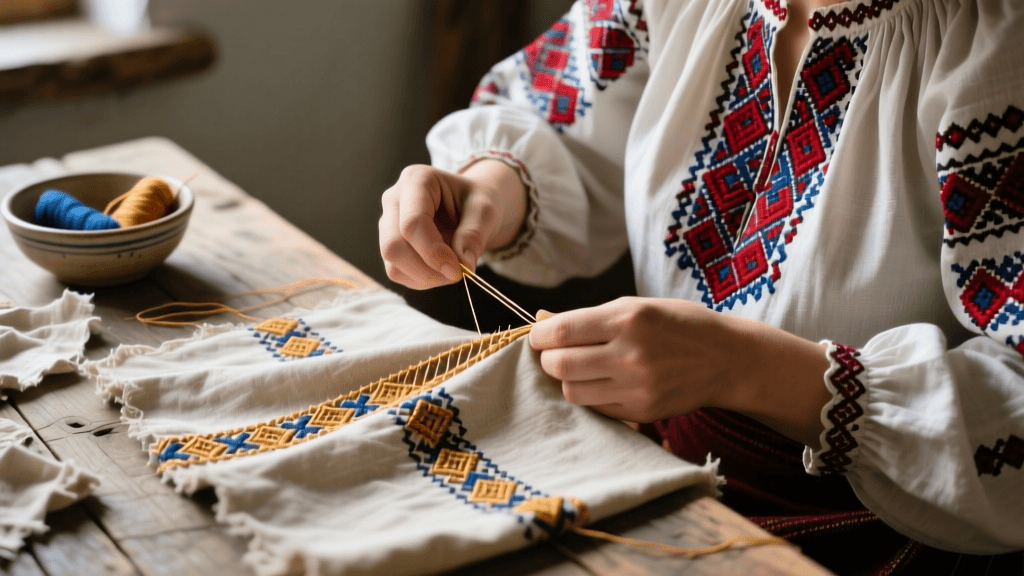
To achieve true historical accuracy in 2026, machine sewing must be abandoned in favor of period-correct hand-sewing techniques. Research from the Textile Research Centre in Leiden highlights that medieval garments were constructed using incredibly fine, tightly spun linen or silk threads, sewn with a running stitch for long seams and a backstitch for high-stress areas.
- Thread Preparation: Use 35/2 or 60/2 linen thread. Before sewing, run the thread through a block of pure beeswax. This prevents tangling, reduces friction, and increases the thread's tensile strength.
- The Running Stitch: For the main panels, use a running stitch at a density of 8 to 10 stitches per inch. This provides flexibility and mimics the elasticity of modern machine stitching.
- The Backstitch: Reserve the backstitch for the armholes, the insertion of the grande assiette gussets, and the waistline, where the garment undergoes the most mechanical stress.
- Seam Finishing: Press all seams open and flat-fell them using a hem stitch, or fold the raw edges together and whipstitch them down to prevent fraying. This eliminates the need for modern sergers and provides a clean, durable interior.
Fitting and Adjustments for Modern Bodies
One of the greatest challenges in recreating medieval European folk dress is adapting historical silhouettes to modern bodies, which are shaped by different diets, posture, and lifestyle habits. The 14th-century ideal favored a slightly rounded belly for men and a high, supported bust for women. If your modern posture includes rounded shoulders from computer work, you may need to adjust the back panels of your cotehardie to prevent the fabric from pulling horizontally across the shoulder blades. Incorporating a linen canvas interlining, pad-stitched to the wool, can provide the structural support needed to maintain the garment's historical silhouette while accommodating modern anatomical realities.
Accessorizing for the 2026 Festival Season
A cotehardie is never worn in isolation. To complete your 14th-century ensemble for the 2026 reenactment season, focus on historically accurate accessories. For men, a leather belt with a cast-brass D-shaped buckle, worn low on the hips, is essential. Attach a historically accurate kidney pouch or a tasseled drawstring purse. For women, a woven tablet-woven belt featuring geometric motifs, paired with a veil and a wimple or a simple linen barbette, completes the look. Footwear should consist of hand-lasted, turnshoe construction leather boots or shoes, featuring the slightly pointed toe (poulaine) that became fashionable in the latter half of the century.
Conclusion
Tailoring a 14th-century cotehardie is a demanding but deeply rewarding endeavor. By sourcing authentic wools, mastering the complex geometry of the grande assiette sleeve, and committing to the meditative practice of hand-sewing, you do more than just create a costume—you resurrect a vital piece of European textile heritage. As the 2026 historical reenactment season approaches, your meticulously crafted cotehardie will stand as a testament to the enduring legacy of medieval craftsmanship, allowing you to step into the past with unparalleled authenticity and grace.