Romanian Ie Blouse Construction & Patterns Guide 2026
The Enduring Legacy of the Romanian Ie in 2026
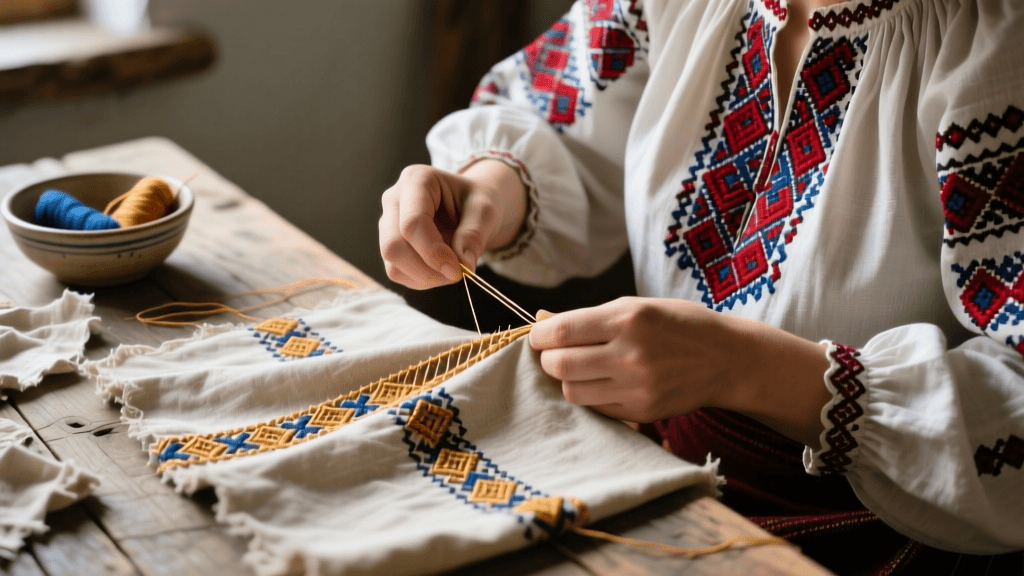
The traditional Romanian blouse, universally known as the Ie, represents one of the most sophisticated examples of European folk dress construction. Recognized globally for its intricate geometric embroidery and zero-waste pattern drafting, the art of the traditional blouse with embroidery on the shoulder was officially inscribed on the UNESCO Intangible Cultural Heritage list, cementing its status as a masterpiece of textile engineering. As we navigate the sustainable fashion landscape of 2026, the Ie has experienced a massive resurgence among contemporary makers, historical reenactors, and slow-fashion designers who are drawn to its mathematically precise, zero-waste rectangular construction.
Unlike modern Western tailoring, which relies on curved armholes, princess seams, and complex darts to contour the body, the Ie achieves its voluminous, elegant silhouette entirely through strategic gathering, smocking, and the insertion of geometric gussets. For researchers and garment makers exploring the vast archives of the Europeana Traditional Costume Collection, understanding the structural logic of the Ie offers a masterclass in historical pattern making. This comprehensive guide breaks down the construction patterns, fabric sourcing, and embroidery techniques required to draft an authentic Romanian Ie in 2026.
Anatomy of the Ie: Zero-Waste Rectangular Construction
The foundational philosophy of the Ie is absolute fabric conservation. Historically, hand-woven linen was incredibly labor-intensive to produce on warp-weighted or horizontal pedal looms, meaning not a single scrap of fabric could be wasted. The pattern is drafted entirely using straight lines, utilizing the full width of the woven cloth.
The Core Structural Components
- Ciupag (The Neckline and Bodice Gather): The central front and back panels are not cut with a curved neckline. Instead, a large rectangular piece of fabric is gathered tightly at the top to form the neck opening, creating a subtle, textured ruffle.
- Altita (The Shoulder Band): A rectangular strip of fabric, usually heavily embroidered, that bridges the front/back bodice panels and the sleeve. It sits squarely on the shoulder and acts as the structural anchor for the garment.
- Incret (The Smocked Sleeve): The wide, rectangular sleeve is gathered into the altita using complex honeycomb smocking, allowing for immense mobility and a dramatic, bell-like drape.
- Rivers (Râurile): Vertical bands of embroidery that flow down the length of the sleeve, visually elongating the arm and contrasting with the horizontal geometry of the altita.
- Pava (The Underarm Gusset): A square or diamond-shaped piece of fabric inserted at the underarm intersection to provide three-dimensional mobility to a strictly two-dimensional, rectangular grid.
Fabric Selection: Sourcing Authentic Materials in 2026
The success of an Ie relies heavily on the drape and weave density of the base fabric. In 2026, the global shift toward regenerative agriculture has made authentic, mill-woven European flax linen more accessible than it has been in decades. However, the specific thread count and preparation of the linen are critical for the traditional thread-counting embroidery techniques.
| Fabric Type | 2026 Avg. Cost (per meter) | Shrinkage Rate | Best Use in Ie Construction |
|---|---|---|---|
| Hand-woven Romanian Linen | €55 - €75 | 8% - 10% | Main body, sleeves (ideal for thread-counting) |
| Organic Hemp/Linen Blend | €40 - €60 | 5% - 7% | Heavyweight winter Ie, structural gussets |
| Evenweave Cotton/Bamboo | €25 - €35 | 3% - 5% | Practice garments, modern lightweight summer blouses |
| Raw Silk Noil | €80 - €110 | 2% - 4% | Festive/bridal Ie (historically reserved for nobility) |
Crucial Preparation Step: Because traditional linen can shrink up to 10%, you must pre-wash and boil your fabric before cutting. In 2026, most heritage weavers recommend a hot wash at 60°C followed by a high-heat tumble dry or flat-line drying in direct sunlight to naturally bleach the flax fibers before pattern drafting begins.
Drafting the Pattern: Measurements and Gussets
To draft the Ie, you abandon standard curved slopers. Instead, you work with a grid based on the width of your woven fabric (traditionally 40cm to 60cm wide for hand-loomed textiles, though modern mill-woven linen often comes in 140cm widths). If using modern wide linen, you must cut it down to historical loom widths to maintain the correct proportion of gathers.
Calculating the Pava (Gusset)
The pava is the secret to the Ie's comfort. Without curved armholes, lifting your arms would pull the entire blouse upward. The pava solves this. 1. Measure the circumference of the upper arm and add 15cm for ease. 2. Cut a perfect square (typically 15cm x 15cm or 20cm x 20cm). 3. The square is inserted at the intersection of the side seam, the sleeve seam, and the bodice panel. When the arm is lowered, the gusset folds inward invisibly; when raised, it provides a full range of motion without stressing the linen.
The Altita: Mastering Shoulder Embroidery
The altita is the most complex and heavily guarded element of the Ie. Historically, the geometric patterns encoded in the altita communicated the wearer's region, marital status, and social standing. Constructing the altita requires a separate rectangular band of fabric that is embroidered before it is attached to the bodice and sleeves.
The Punctul Românesc (Romanian Stitch)
While cross-stitch is common in broader European folk dress, the Ie frequently utilizes the punctul românesc (Romanian stitch), also known as the two-sided Italian stitch or square stitch. This technique creates a dense, interlocking geometric grid that looks identical on both the front and back of the fabric.
- Grid Mapping: The altita is divided into horizontal registers. The top register features the largest, most complex motifs (often solar symbols, horns, or stylized trees).
- Thread Selection: In 2026, traditional hand-spun wool has been largely supplemented by high-quality mercerized cotton and silk floss. Makers are increasingly using naturally dyed threads—walnut hulls for deep browns, woad for historical blues, and madder root for vibrant reds.
- Tension Control: Because the altita sits on the shoulder and undergoes friction, the embroidery must be worked with a slightly looser tension than the base fabric to prevent the linen from puckering when worn.
Smocking the Ciupag: Geometric Gathers
The neckline (ciupag) and the sleeve cuffs are secured using traditional smocking, which serves both a structural and decorative purpose. Unlike modern elastic gathering, historical smocking uses a grid of running stitches that are then pulled and secured with secondary decorative threads.
The Honeycomb Smocking Technique
- Thread Counting: Using a blunt tapestry needle, pull a contrasting thread through the linen every 4th warp thread, creating perfectly spaced horizontal rows.
- The Gathering: Pull the threads simultaneously to compress the fabric. A 60cm wide sleeve panel will compress down to roughly 15cm at the cuff.
- The Locking Stitch: Using a thick, contrasting silk or wool yarn, work a surface honeycomb or trellis stitch over the gathers. This locks the fabric into a permanent, elastic-like state without the use of rubber or synthetic elastic, which degrades over time.
Finishing Techniques and 2026 Market Trends
As the demand for authentic, museum-quality European folk dress grows in 2026, the finishing techniques of the Ie have become a benchmark for haute couture and slow fashion houses alike. Seams are traditionally finished using flat-felled seams or microscopic hand-rolled hems, ensuring the interior of the garment is as flawless as the exterior.
Furthermore, the modern revival has seen a fusion of historical construction with contemporary body positivity. Because the Ie is entirely rectangular and relies on adjustable smocking, it is inherently size-inclusive. A single master pattern can be graded simply by adding more rectangular width to the sleeves and bodice panels, making it a highly adaptable garment for diverse body types without ever altering the fundamental historical silhouette.
Whether you are a textile conservator, a historical costumer, or a sustainable fashion designer, mastering the construction of the Romanian Ie provides a profound connection to the ingenuity of ancestral European makers. By honoring the zero-waste geometry and the mathematical precision of the altita, we ensure that these extraordinary textile traditions continue to thrive in the modern wardrobe.