The Ultimate Guide to Tai Chi and Wushu Practice Wear
The Intersection of Movement and Tradition
When practicing Tai Chi Chuan or Wushu, the clothing you wear is not merely a uniform; it is an extension of your body's kinetic chain. In traditional Chinese martial arts, the garment must facilitate the unimpeded flow of Qi (vital energy) while allowing the practitioner to execute complex biomechanical movements without restriction. Whether you are a beginner stepping into your first morning practice in the park or a seasoned competitor preparing for a Taolu (forms) tournament, selecting the right practice wear is crucial for both performance and cultural authenticity.
Historically, martial artists practiced in their daily Han Chinese clothing, which consisted of loose-fitting tunics and trousers bound at the waist and cuffs. Over time, these garments evolved into specialized uniforms designed to accentuate the specific physical demands of different martial arts styles. Today, the market offers a vast array of options, from traditional hand-woven silk suits to modern synthetic blends engineered for high-intensity acrobatics. Understanding the nuances of these garments will elevate your practice and deepen your connection to Asian traditions.
The Philosophy of Qi and Sartorial Flow
Traditional Chinese Medicine (TCM) and martial arts philosophy are deeply intertwined. A core tenet of outdoor Tai Chi practice is protecting the body's joints and acupoints from environmental pathogens, particularly wind and cold. According to the Mayo Clinic, Tai Chi is highly recommended for improving balance, reducing stress, and enhancing overall physical stability. To maximize these health benefits, your clothing must keep your muscles warm and your joints protected without causing overheating.
The uniform should not restrict the flow of Qi, nor should it obscure the structural alignment of the practitioner's joints. It must move like water, reflecting the internal state of the martial artist.
Furthermore, research from Harvard Health Publishing describes Tai Chi as 'medication in motion,' emphasizing the importance of comfort and mental focus during practice. If your uniform is too tight, it distracts the mind and restricts blood flow; if it is excessively baggy, it can obscure your body mechanics from your instructor's view and become a hazard during partner drills like Pushing Hands (Tui Shou).
Tai Chi vs. Wushu: Divergent Uniform Standards
While often grouped together by outsiders, Tai Chi and modern Wushu have distinctly different requirements when it comes to practice wear. The International Wushu Federation (IWUF) outlines specific guidelines for competitive Taolu uniforms, which reflect the differing physical demands of the disciplines.
Internal Arts (Tai Chi, Bagua, Xingyi)
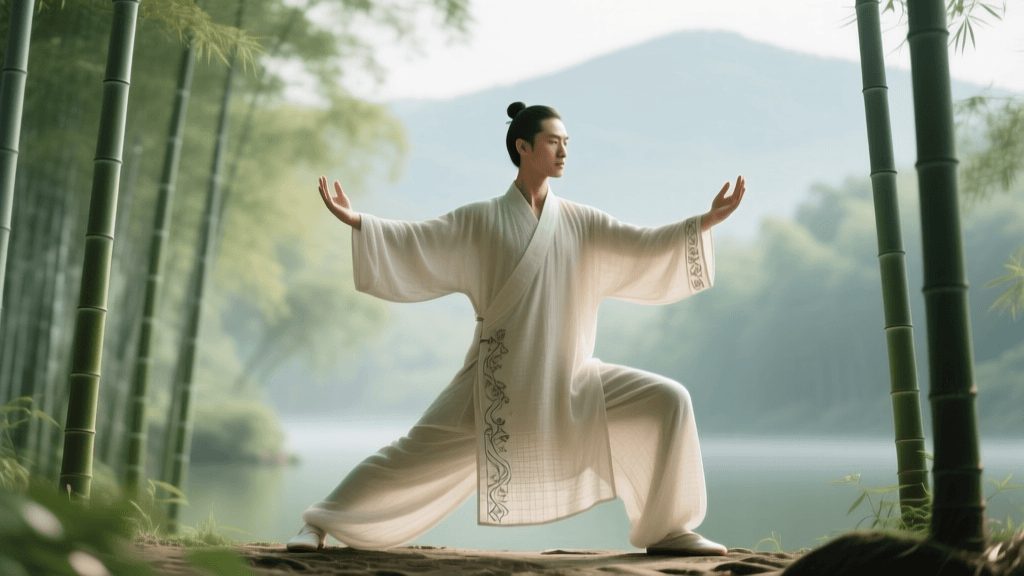
Internal martial arts focus on grounding, slow continuous movement, and structural alignment. Uniforms for these arts favor heavier, natural fabrics with a matte finish and a fluid drape. The weight of the fabric helps the practitioner feel their center of gravity and emphasizes the sweeping, circular nature of the forms. Traditional frog buttons (Pankou) and Mandarin collars are standard, reflecting a deep respect for historical Chinese attire.
External Arts (Changquan, Nanquan, Daoshu)
Modern Wushu is characterized by explosive speed, high jumps, and deep acrobatic stances. Uniforms here are crafted from lightweight, stretchy, and often glossy materials like stretch satin or ice silk. They are tailored much closer to the body to prevent the fabric from catching during aerial maneuvers and to allow judges to clearly see the athlete's joint extension and muscular engagement.
Fabric Selection: Breathability, Drape, and Durability
Choosing the right fabric is perhaps the most critical decision when purchasing martial arts clothing. Below is a comprehensive comparison of the most common materials used in Tai Chi and Wushu practice wear.
| Fabric Type | Weight and Drape | Breathability | Best Application | Average Cost (USD) |
|---|---|---|---|---|
| Mulberry Silk (16mm-19mm) | Medium, luxurious drape | Excellent | Traditional Tai Chi, formal demonstrations | $120 - $250 |
| Ice Silk (Viscose/Nylon Blend) | Lightweight, fluid | High | Summer practice, outdoor morning forms | $30 - $60 |
| Cotton-Linen Blend | Medium-Heavy, structured | Moderate | Winter practice, rugged outdoor training | $45 - $85 |
| Stretch Satin (Polyester/Spandex) | Lightweight, glossy, clingy | Low | Competitive Wushu, acrobatic forms | $50 - $100 |
For daily Tai Chi practice, an Ice Silk or Cotton-Linen blend offers the best balance of durability, ease of care, and comfort. Mulberry silk is breathtakingly beautiful and feels incredible against the skin, but it requires meticulous care and is easily damaged by snags or excessive sweat. Stretch satin should be reserved strictly for Wushu competitions or stage performances, as it lacks the breathability required for long, meditative internal arts sessions.
Sizing and Fit: The Mechanics of Martial Arts Tailoring
A standard Western clothing size chart will not suffice for martial arts uniforms. The biomechanics of forms require specific allowances in the tailoring. When measuring yourself or ordering a custom suit, pay close attention to the following actionable guidelines:
- The Shoulder and Chest Seam: When performing movements like 'Single Whip' or 'Cloud Hands,' your arms extend fully while your torso rotates. The jacket must have a dropped shoulder seam or a raglan sleeve design to prevent the fabric from pulling across the chest. Allow 2 to 3 inches of ease in the chest measurement beyond your resting size.
- Sleeve Length and the Laogong Acupoint: In traditional Tai Chi, the sleeve should end exactly at the base of the thumb (the carpometacarpal joint). This ensures that the Laogong acupoint in the center of the palm remains exposed and unencumbered, which is vital for energy projection and sensitivity during Pushing Hands.
- The Inseam and the Drop Stance (Pu Bu): Wushu and traditional forms frequently feature the Pu Bu (drop stance), where one leg is fully extended while the other is deeply bent. Standard trousers will tear at the crotch seam during this movement. Ensure your martial arts pants feature a diamond-shaped gusset in the crotch and a high, elasticized waistband that can be folded down to accommodate deep hip flexion.
- Pant Length and the Taixi Acupoint: TCM dictates that the ankles must be protected from wind. The trouser leg should be long enough to graze the top of the foot, fully covering the ankle bone (Taixi acupoint) when standing upright.
Footwear: Grounding Your Practice and Proprioception
Your connection to the earth is the foundation of all martial arts. Thick, cushioned running shoes destroy proprioception (your body's ability to sense its position in space) and elevate your center of gravity, making you unstable during single-leg stances like 'Golden Rooster Stands on One Leg.'
The gold standard for Tai Chi and Wushu footwear is the traditional Chinese Kung Fu shoe, most notably the Feiyue or Warrior brands. Originally designed in the 1920s in Shanghai, these shoes feature a thin, flat rubber sole (typically 2mm to 3mm thick) that allows the practitioner to feel the texture of the ground, grip the floor during pivots, and spread the toes for maximum balance. They are constructed with a flexible canvas upper that moves seamlessly with the foot during extreme dorsiflexion. Priced between $15 and $25, they are an affordable and essential investment for any serious practitioner. For outdoor practice on rough concrete or gravel, you may opt for modern minimalist shoes with a zero-drop sole and a slightly thicker, more abrasion-resistant rubber outsole to protect the feet while maintaining ground feel.
Caring for Your Martial Arts Wardrobe
Proper maintenance of your practice wear ensures longevity and preserves the integrity of the fabrics. Natural fibers like silk and linen require gentle handling. Always hand-wash silk uniforms in cold water using a pH-neutral detergent specifically formulated for delicates. Never wring or twist the fabric; instead, press the water out gently between two clean towels and lay the garment flat to dry in the shade. Direct sunlight will rapidly degrade natural silk fibers and cause the rich, traditional colors to fade.
Cotton-linen blends and ice silk can generally be machine-washed on a gentle cycle inside a mesh laundry bag. However, you must pay special attention to the traditional Pankou (frog buttons). These knotted buttons can easily become misshapen or frayed in a washing machine. Fasten all buttons before washing, or better yet, turn the jacket inside out to protect the knotwork. Ironing should be done on a low heat setting, preferably with a pressing cloth between the iron and the garment to prevent scorching.
Conclusion
Selecting the right Tai Chi and Wushu practice wear is a deeply personal journey that bridges the gap between historical Asian traditions and modern physical wellness. By understanding the philosophy of Qi flow, choosing the appropriate fabrics for your specific discipline, and adhering to the precise tailoring mechanics required for martial arts stances, you equip yourself with a uniform that enhances rather than hinders your practice. Whether you are flowing through a Tai Chi form at sunrise or executing a soaring Wushu aerial, the right garment will move with you, honoring the rich cultural legacy of the martial arts.