Preserving China's Intangible Textile Heritage: Silk Artisans
The Living Threads of China: Intangible Cultural Heritage
China’s textile history is a tapestry woven with millennia of innovation, artistry, and cultural significance. Beyond the garments themselves, the techniques used to create these fabrics represent a profound cultural legacy. Today, the preservation of these methods falls under the umbrella of Intangible Cultural Heritage (ICH). According to UNESCO's Intangible Cultural Heritage list, sericulture and silk craftsmanship in China encompass not just the rearing of silkworms, but the intricate weaving, dyeing, and embroidery techniques passed down through generations. For collectors, historians, and enthusiasts of Asian traditions, understanding the artisans behind these crafts is essential to appreciating the true value of traditional Chinese garments.
The Chinese Ministry of Culture and Tourism has established a rigorous tiered system to recognize master artisans, ranging from county-level inheritors to national-level masters. These individuals are not merely craftspeople; they are living repositories of ancestral knowledge. In this guide, we explore two of the most prestigious textile crafts in China—Su Embroidery and Nanjing Yunjin Brocade—and provide actionable advice on how to identify, evaluate, and support authentic artisan work.
Su Embroidery (Su Xiu): The Pinnacle of Needlework
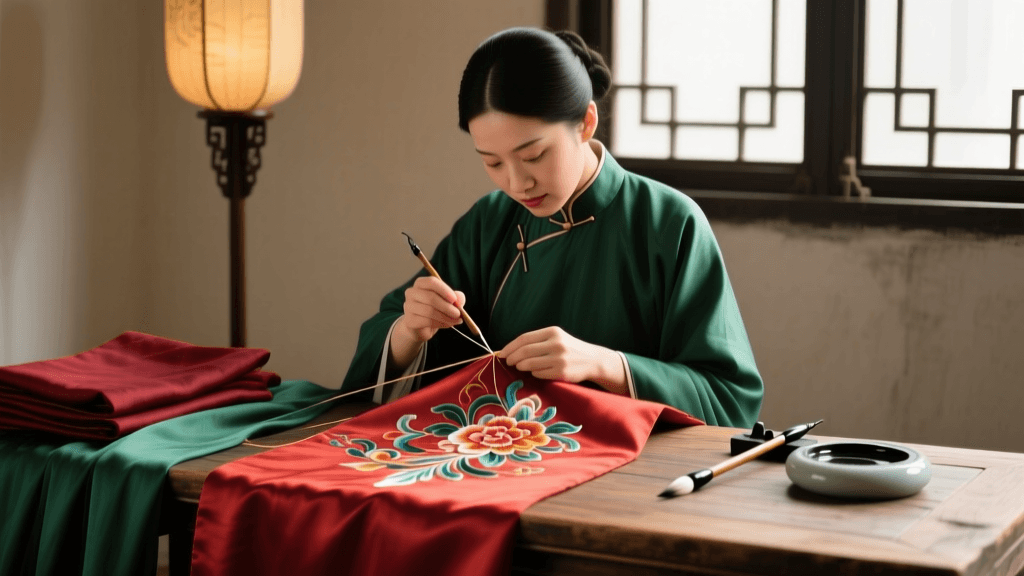
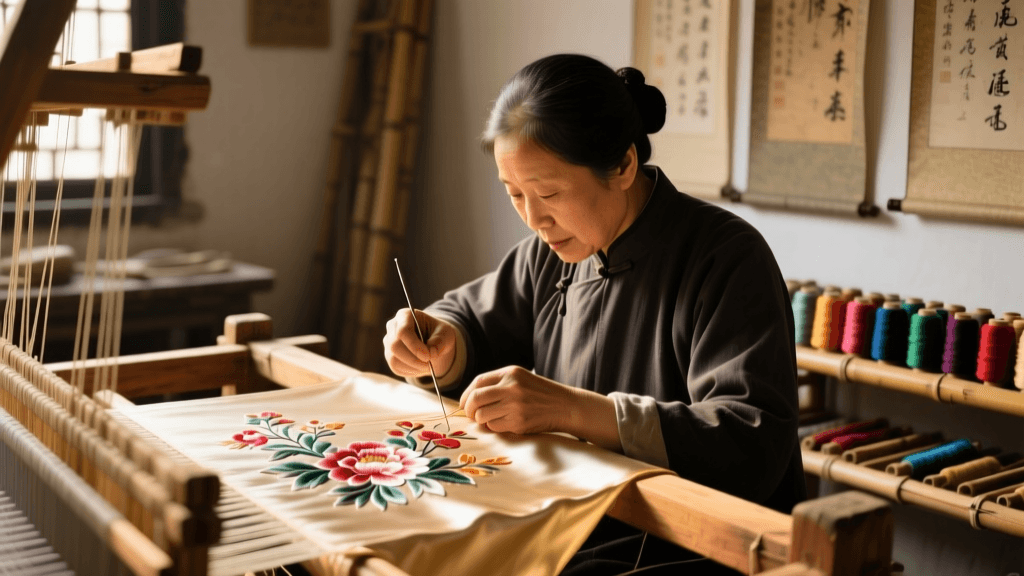
Originating in the Suzhou region of Jiangsu province over 2,000 years ago, Su Embroidery (Su Xiu) is celebrated for its delicate patterns, elegant colors, and astonishingly fine needlework. It is one of the Four Major Embroideries of China. The hallmark of a true Su Xiu master is the 'split-thread' technique. A single strand of silk thread can be split by hand into two, four, eight, sixteen, thirty-two, or even sixty-four microscopic filaments. This allows artisans to create gradients and textures so realistic that the embroidery mimics the brushstrokes of a traditional ink painting.
The Marvel of Double-Sided Embroidery
The most technically demanding iteration of this craft is double-sided embroidery (Shuang Mian Xiu). In this technique, the artisan hides all knots and thread ends within the stitches, resulting in an identical image on both the front and back of a translucent silk canvas. A master artisan working on a standard 30x30 cm piece of double-sided embroidery will typically work eight hours a day for six to eight months to complete a single side, with complex pieces featuring different images on each side (e.g., a tiger on the front, a leopard on the back) taking over a year.
'The needle is an extension of the breath. To split the silk into sixty-four strands, your hands must be as still as a frozen lake, and your mind must be entirely empty of the outside world.' — Master Wang, Suzhou Embroidery Institute.
Nanjing Yunjin Brocade: Cloud-Like Silk Weaving
While Su Embroidery is defined by the needle, Nanjing Yunjin brocade is defined by the loom. Translating to 'cloud-like brocade,' Yunjin was the exclusive fabric of the imperial court during the Ming and Qing dynasties, used primarily for dragon robes and imperial decrees. As noted in the documentation for Nanjing Yunjin brocade craftsmanship, the creation of this fabric requires a massive, traditional wooden drawloom that measures 5.6 meters long, 4 meters high, and 1.4 meters wide.
Operating a Yunjin loom is a physically demanding, two-person endeavor. The 'puller' sits at the top of the 4-meter-high loom, manually pulling the warp threads according to a complex, memorized sequence of knots (acting as a human Jacquard punch card). The 'weaver' sits at the base, passing the shuttle and beating the weft threads into place. Because the weft incorporates precious materials like real gold foil threads, silver, and even peacock feathers, the weaver must carefully interlock the colors using a 'digging' technique rather than passing the shuttle all the way across.
The result is a painstakingly slow production rate. A master team can produce only 5 to 6 centimeters of Yunjin brocade per day. This extreme scarcity and the sheer physical toll of the work make authentic Yunjin one of the most expensive and revered textiles in the world.
Comparison of Major Chinese Intangible Textile Crafts
For collectors and cultural institutions looking to acquire authentic pieces, understanding the baseline metrics of production is crucial for verifying authenticity and pricing. Below is a comparative overview of three major intangible textile crafts.
| Craft Name | Origin Region | Key Technique & Materials | Production Time (per sq meter) | Average Authentic Cost (USD) |
|---|---|---|---|---|
| Su Embroidery (Su Xiu) | Suzhou, Jiangsu | Split-silk threading, double-sided stitching on organza or satin. | 6 to 12 months (hand-stitched) | $3,000 - $15,000+ |
| Nanjing Yunjin Brocade | Nanjing, Jiangsu | Drawloom weaving with gold/silver threads and peacock feathers. | 2 to 3 months (5-6 cm per day) | $1,500 - $3,000 per meter |
| Shu Embroidery (Shu Xiu) | Chengdu, Sichuan | Thick silk threads, satin stitch, often featuring carp and pandas. | 2 to 4 months | $800 - $4,000 |
How to Identify and Support Authentic Artisans
The commercialization of traditional Chinese garments has led to a flood of machine-made imitations in the market. Machine embroidery and digital jacquard weaving can mimic the look of Su Xiu and Yunjin from a distance, but they lack the structural integrity, material purity, and soul of handcrafted heritage pieces. Here is practical, actionable advice for identifying and purchasing authentic intangible heritage textiles.
1. Inspect the Reverse Side
When evaluating Su Embroidery, always ask to see the back of the piece. Machine embroidery will show a messy web of connecting threads, jump stitches, and a stiff paper or mesh backing. Authentic hand-embroidery will have a remarkably clean back. In the case of double-sided embroidery, the reverse should be a perfect, seamless mirror of the front, with absolutely no visible knots or thread tails.
2. Verify the Materials and Weight
Authentic Yunjin brocade incorporates genuine gold thread, which is made by sandwiching gold foil between layers of animal glue and paper, then cutting it into microscopic strips. This gives the fabric a distinct, heavy drape and a subdued, warm metallic luster. Machine-made 'Yunjin' often uses synthetic metallic yarns (Lurex), which are overly shiny, lightweight, and prone to tarnishing. A true Yunjin fabric will feel substantial, weighing significantly more than standard silk brocade.
3. Request Certification and Provenance
When purchasing high-value pieces (typically those exceeding $1,000), always request a Certificate of Authenticity issued by the artisan's studio or the local Intangible Cultural Heritage Protection Center. These certificates should include the artisan's name, their recognized ICH tier (e.g., Provincial-Level Inheritor), the exact dimensions of the piece, and the number of hours or months spent on its creation. Reputable galleries, such as those affiliated with The Metropolitan Museum of Art or specialized Asian textile dealers, will always provide this provenance.
4. Commissioning Custom Hanfu and Textiles
If you are commissioning a custom Hanfu garment using heritage fabrics, timing is everything. Master artisans often have waitlists ranging from six months to two years. When placing a commission:
- Provide Exact Measurements: Include shoulder width, sleeve length (from the center back neck to the wrist for traditional Hanfu cuts), and garment length in centimeters.
- Discuss Motif Alignment: In traditional Chinese tailoring, motifs like dragons, phoenixes, or peonies must not be severed by seams. Ensure the artisan maps the pattern to your specific measurements before weaving or embroidering begins.
- Factor in Climate: If commissioning Yunjin for a winter festival, request a heavier silk satin base. For summer wear, ask the artisan to weave the brocade patterns onto a lightweight silk gauze (Luo) base, a highly specialized technique that takes even longer to execute.
Conclusion: Investing in Living History
The artisans preserving China's intangible textile heritage are fighting a battle against time and industrialization. The physical toll of the craft—particularly the severe strain on the eyesight and cervical spine of embroiderers, and the joint stress experienced by loom weavers—means that many masters are aging out of the profession without enough apprentices to take their place. By learning to distinguish authentic handcraft from mass-produced imitation, and by fairly compensating these master artisans for their time and skill, collectors and enthusiasts play a vital role in ensuring that the living threads of China's textile history are not severed. When you drape yourself in authentic Su Xiu or Yunjin, you are not merely wearing a garment; you are wearing a masterpiece of human endurance and cultural pride.