Decoding Imperial Chinese Court Robes: Rank Colors & Symbols
The Sartorial Hierarchy of Imperial China
For over two millennia, clothing in China was not merely a matter of personal expression or practical necessity; it was a strictly regulated visual language. In the imperial courts of the Ming (1368–1644) and Qing (1644–1911) dynasties, sumptuary laws dictated every thread, hue, and motif worn by the emperor, his officials, and the common populace. To wear a color or motif above one's station was not merely a fashion faux pas—it was considered an act of treason. Today, as the Hanfu revival movement and historical reenactment communities grow globally, understanding these intricate rank codes is essential for collectors, designers, and enthusiasts who wish to honor the profound symbolism of traditional Chinese garments.
'The dress of the Chinese empire was a canvas of cosmic order and political hierarchy, where every stitch reinforced the mandate of heaven and the rigid stratification of society.'
Decoding the Imperial Color Codes
Color was the first and most immediate indicator of social standing in imperial China. However, the specific rules shifted dramatically between the Han-led Ming Dynasty and the Manchu-led Qing Dynasty.
Ming Dynasty Color Hierarchy
The Ming Dynasty favored red as the supreme color of the imperial family and high-ranking officials, reflecting the Han Chinese association of red with fire, the south, and prosperity. According to The Metropolitan Museum of Art's Heilbrunn Timeline on the Ming Dynasty, court officials wore round-collar robes (Yuanlingpao) colored strictly by rank:
- 1st to 4th Rank: Crimson or Scarlet Red
- 5th to 7th Rank: Cyan or Teal
- 8th to 9th Rank: Green
Commoners were largely restricted to undyed hemp, muted cottons, and pale yellows or whites, forbidden from wearing the vibrant dyes reserved for the court.
Qing Dynasty Color Hierarchy
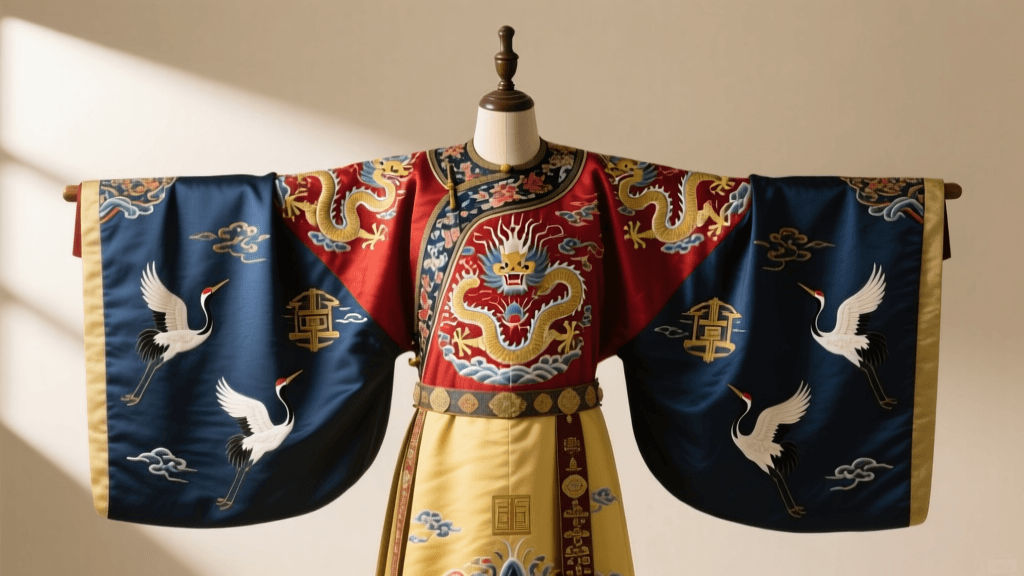
The Manchu rulers of the Qing Dynasty overhauled the sartorial system. Bright yellow (Minghuang) became the exclusive domain of the Emperor, representing the center of the universe and the earth element. The Crown Prince wore apricot yellow, while imperial princes were restricted to golden yellow or blue. For court officials, the outer surcoat (Bufu) was almost universally dark blue or black, serving as a somber canvas for the rank badges. The underlying robes, however, could feature subtle color variations based on the specific court function and the official's exact tier.
The Buzi (Mandarin Squares): Reading the Rank Badges
While color provided a general hierarchy, the exact rank of an official was denoted by the buzi, or Mandarin square. As detailed in Britannica's guide to the buzi, these intricately embroidered squares were affixed to the front and back of the outer surcoat. Civil officials wore birds, symbolizing elegance and literary prowess, while military officials wore beasts, representing courage and martial strength.
| Rank | Civil Official (Bird) | Military Official (Beast - Ming/Qing Variations) |
|---|---|---|
| 1st Rank | Crane (Immortality & Longevity) | Lion / Qilin (Supreme Power) |
| 2nd Rank | Golden Pheasant (Duty & Loyalty) | Lion / Lioness |
| 3rd Rank | Peacock (Beauty & Dignity) | Tiger (Bravery) |
| 4th Rank | Wild Goose (Teamwork & Order) | Leopard / Tiger |
| 5th Rank | Silver Pheasant (Refinement) | Bear (Strength) |
Note: The Emperor and his immediate family bypassed the Buzi system entirely, wearing the iconic Longpao (Dragon Robe) featuring five-clawed dragons, a motif strictly forbidden to anyone else. Smithsonian Magazine's analysis of imperial dragon robes highlights how the five claws represented the emperor's absolute dominion over the five elements and the four corners of the earth.
Actionable Guide: Sourcing Historical Reproductions Today
For modern Hanfu enthusiasts, theater costumers, and historical reenactors, purchasing an authentic reproduction requires navigating a market filled with both high-quality artisanal weaves and cheap, historically inaccurate costumes. Here is a practical guide to sourcing Ming and Qing court-style garments.
1. Fabric Selection and Costs
Authentic court robes were woven from silk brocade, often incorporating gold-wrapped threads. When commissioning or buying a reproduction, look for specific traditional weaves:
- Song Brocade (Songjin): Features subtle, geometric background patterns with raised motifs. Ideal for Ming Dynasty Yuanlingpao. Cost: $80–$150 per yard.
- Zhuanghua Brocade: A complex technique where motifs are woven directly into the fabric as distinct, unconnected medallions. Essential for accurate Qing Dragon robes. Cost: $200–$400+ per yard.
- Budget Alternative: High-grade polyester jacquard. While lacking the breathability of silk, it mimics the drape and sheen for photography. Cost: $15–$30 per yard.
Total Garment Cost Expectation: A custom-tailored, historically accurate silk Bufu (Qing surcoat) with hand-embroidered Buzi will cost between $600 and $1,500. Mass-produced polyester alternatives on e-commerce sites range from $80 to $150.
2. Crucial Measurements and Silhouettes
Do not rely on standard modern sizing. Imperial garments were cut to create specific architectural silhouettes:
- Ming Sleeves: The Daopao and Yuanlingpao feature 'Pipa' or wide sleeves. The cuff should measure at least 45cm to 60cm in circumference, tapering sharply at the wrist or armpit to hold items.
- Qing Sleeves: The Manchu style requires the 'Matixiu' (horse-hoof cuff). The sleeve is narrow (approx. 15cm at the wrist) but features a curved, extended cuff that covers the back of the hand, meant to be folded back during formal greetings.
- Hem Length: Court robes were designed to skim the floor. When ordering, measure from the C7 vertebra (base of the neck) to the floor while wearing your traditional court boots (which add 3–5cm of height). A standard hem should end exactly 2cm above the ground to prevent soiling while maintaining the illusion of floating.
3. Timing for Custom Orders
If you are commissioning a hand-embroidered Buzi or a custom-woven Zhuanghua silk robe from artisans in Suzhou or Hangzhou, expect a lead time of 45 to 90 days. Hand-embroidering a single, high-quality Mandarin square using traditional silk floss and metallic threads takes an artisan approximately 120 to 200 hours.
Modern Etiquette: Respecting the Tradition
When wearing these garments today at cultural festivals, weddings, or academic symposiums, it is important to understand the historical weight they carry. While modern society is thankfully free of imperial sumptuary laws, historical purists recommend avoiding the five-clawed dragon motif and the bright Minghuang yellow unless you are participating in a specific theatrical portrayal of the Emperor. Opting for the four-clawed dragon (Mang) or the elegant civil official bird motifs allows you to celebrate the breathtaking craftsmanship and profound symbolism of traditional Chinese sartorial arts while maintaining historical respect and accuracy.