Scandinavian Skjorte Zero-Waste Pattern Drafting Guide for 2026
The Enduring Legacy of the Square-Cut Skjorte
In the realm of European folk dress, few garments exemplify the perfect marriage of geometric efficiency and functional elegance quite like the traditional Scandinavian skjorte (shirt). Worn as the foundational layer beneath the heavily embroidered bodices (liv) and wool skirts of the Swedish folkdräkt and Norwegian bunad, the skjorte is a masterclass in zero-waste pattern drafting. As the global fashion industry grapples with textile waste in 2026, historical European construction techniques offer profound, actionable solutions for modern makers and designers.
Historically, the width of the handwoven linen loom dictated the pattern. Because fabric was incredibly labor-intensive to produce, wasting even a few inches of cloth was unthinkable. The resulting garment was constructed entirely from rectangles, squares, and straight lines, relying on strategic gathering and gussets to fit the human form. Today, we explore how to draft and construct an authentic, zero-waste Swedish Folkdräkt skjorte, blending historical integrity with 2026 digital drafting workflows.
Core Principles of Zero-Waste Folk Pattern Drafting
The foundational rule of the traditional Scandinavian shirt is the absence of curved seams. Modern tailored shirts rely on curved armscyes (armholes) and shaped side seams to contour the body. The folk skjorte, however, uses a T-tunic or modified rectangular block approach. The body is formed from one or two large rectangles, the sleeves are simple tubes, and the critical element that provides mobility—the underarm gusset (kil)—is a perfect square or diamond.
'The geometry of the peasant shirt is not born of a lack of tailoring skill, but of a profound respect for the material. Every thread spun and woven represented hours of human labor; the pattern was merely the mathematics of preservation.' — Nordic Textile Historians
For contemporary sewists exploring the Nordiska Museet archives, the brilliance of this system becomes apparent. By utilizing the full width of standard linen bolts, the pattern pieces interlock like a jigsaw puzzle, leaving the cutting room floor entirely bare.
The Geometry of the Scandinavian Shirt
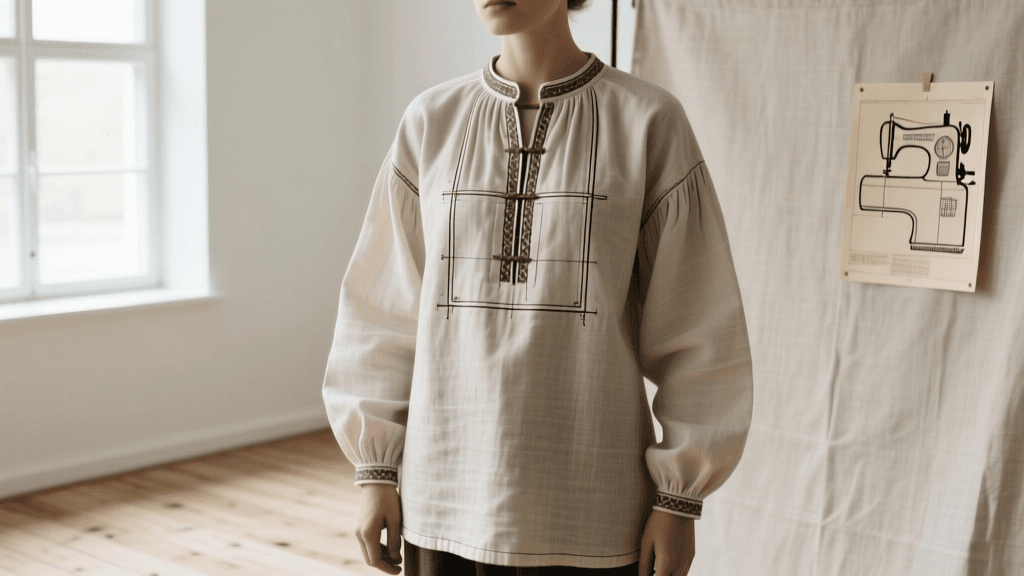
To draft a zero-waste skjorte, you must abandon the standard curved block. The front and back are identical rectangles. The sleeves are tapered or straight rectangles. The neckline is a simple horizontal slit or a small circular cutout, finished with a gathered standing collar or a drawstring casing. The underarm gusset bridges the gap between the sleeve tube and the body rectangle, allowing the arm to lift without pulling the entire shirt upward.
Step-by-Step: Drafting the 2026 Adapted Skjorte Pattern
In 2026, modern makers frequently utilize parametric pattern drafting software to perfect zero-waste markers before cutting into expensive, sustainably grown European flax linens. Open-source platforms like Seamly2D allow designers to input exact loom widths and automatically generate interlocking rectangular markers, ensuring mathematical zero-waste.
Measurements and Fabric Widths
Historically, handwoven linen was narrow, often around 60 cm (24 inches) wide. Modern linen is typically 140 cm (55 inches) wide. To maintain the historical zero-waste ethos, you must either restrict your layout to a 60 cm virtual loom width or adapt the rectangles to utilize the full 140 cm width without offcuts. Below is a standard measurement chart for a modern medium skjorte, adapted for a 140 cm wide linen layout.
| Pattern Piece | Dimensions (cm) | Quantity | Function |
|---|---|---|---|
| Main Body Panel | 140 (W) x 85 (L) | 1 (cut on fold) | Forms front, back, and shoulder drape |
| Sleeve Rectangle | 45 (W) x 60 (L) | 2 | Forms the tubular sleeve |
| Underarm Gusset (Kil) | 15 x 15 | 2 | Provides underarm mobility |
| Neckline Slit/Collar | 45 (W) x 10 (L) | 1 | Standing collar with front slit |
| Cuff Bands | 25 (W) x 8 (L) | 2 | Wrist gathering and closure |
The Underarm Gusset (Kil) and Mobility
The gusset is the engineering marvel of the folk skjorte. Without it, a square-cut shirt would bind tightly across the chest when the wearer raised their arms. To insert the gusset using historical methods:
- Prepare the Slit: Instead of cutting a curved armhole, cut a straight vertical slit into the side seam of the body panel, exactly the length of one side of your gusset square (e.g., 15 cm).
- Pivot Stitching: Sew one edge of the gusset to the sleeve tube. Then, sew the adjacent edge to the body slit. The critical step is the pivot point at the inner corner. You must stitch exactly to the corner, leave the needle down, clip the seam allowance of the body slit to within 2mm of the stitch line, pivot the fabric, and continue sewing. In 2026, applying a tiny drop of modern fray-preventative liquid to this clip point ensures the linen will not unravel over decades of wear.
- Reinforcement: Historically, a small embroidered star or blanket stitch was applied to the inside of the gusset pivot to reinforce the stress point, often seen in the intricate svartsöm (blackwork) of Swedish shirts.
Historical Seaming Techniques vs. Modern 2026 Workflows
The construction of the skjorte relies heavily on flat-felled seams and rolled hems. Because the shirt was worn against the skin and washed vigorously by boiling in lye or ash water, all raw edges had to be completely enclosed.
- Flat-Felled Seams (Fällsöm): Used for the side seams, sleeve seams, and gusset insertions. The fabric is stitched wrong sides together, one seam allowance is trimmed close to the stitch line, the longer allowance is folded over the trimmed edge, and then topstitched down. This creates a highly durable, fray-proof seam that lies flat against the skin.
- Whip-Gathering: The voluminous body and sleeves are gathered into the narrow collar and cuffs using a whipstitch technique. Rather than running a basting thread and pulling, the maker uses a tight overcast stitch along the raw edge, pulling the thread taut with every stitch. This creates incredibly strong, permanent gathers that will not snap during washing.
- Drawn Thread Work (Hardanger/Uttagssöm): Many regional Swedish shirts feature hemstitching near the cuffs and collar, where warp or weft threads are carefully withdrawn from the linen and the remaining threads are bundled and wrapped, creating a delicate, lace-like openwork pattern.
Sourcing Authentic European Flax Linens in 2026
The soul of the folkdräkt skjorte lies in its textile. Synthetic blends or heavily processed, chemically softened linens lack the structural integrity required for flat-felled seams and drawn thread work. In 2026, the gold standard for authentic folk dress construction is certified European Flax. Organizations like the European Confederation of Flax and Hemp (CELC) guarantee that the linen is grown in Western Europe (primarily Normandy and Belgium) without artificial irrigation or defoliants, and scutched using traditional mechanical methods.
For a traditional skjorte, look for a medium-weight linen (approx. 190-210 g/m²) with a slightly slubby texture. The fabric should be 'loomstate' or 'greige' (unbleached) if you plan to dye it naturally using madder or woad, or opt for a peroxide-free, naturally sun-bleached white for the classic Dalarna or Hälsingland regional styles. Always pre-wash and boil your linen before cutting; traditional linens can shrink up to 10% on the first hot wash, and pre-shrinking ensures your zero-waste geometry remains mathematically sound post-construction.
Conclusion
The Swedish Folkdräkt skjorte is far more than a historical undergarment; it is a blueprint for sustainable, zero-waste fashion design. By embracing the geometric constraints of the loom, mastering the structural brilliance of the underarm gusset, and utilizing robust historical seam finishes, modern makers can create garments that are not only culturally resonant but built to last generations. As we navigate the textile challenges of 2026, looking back to the resourceful, waste-free patterns of European folk traditions provides a clear, elegant path forward for the conscious creator.