Swedish Dalarna Wool Carding And Rose Painting On Wooden Buttons
Roots in the Dalarna Landscape
The province of Dalarna in central Sweden has long served as a cultural stronghold for textile and woodworking traditions. Its deep forests, glacial lakes, and isolated valleys preserved practices that elsewhere faded under industrialization. Dalarna wool—specifically from the native Swedish Landrace sheep—was historically hand-sheared each spring, then washed in alkaline birch-ash lye before drying on wooden racks elevated 1.2 meters above damp ground to prevent mildew. This wool’s natural crimp and lanolin content made it uniquely suited for carding by hand rather than mechanical processing. By the late 18th century, over 90% of households in Rättvik and Leksand owned at least one pair of wooden carding combs, typically carved from locally felled birch and measuring precisely 23 cm in length with 48 evenly spaced iron teeth per comb.
Carding Technique and Material Specificity
Carding in Dalarna was never merely preparatory—it was an act of regional identity. Unlike the parallel-fiber alignment used in English worsted spinning, Dalarna practitioners employed a cross-carding method: two combs were drawn toward each other in opposing directions, creating a fluffy, airy rolag ideal for soft-spun yarns destined for woven vests and knitted mittens. The process required rhythmic coordination; skilled carders maintained a pace of approximately 60 strokes per minute, a tempo documented in field notes from the Nordic Museum’s 1937 ethnographic survey of Rättvik parish. Each completed rolag weighed between 28–32 grams and measured exactly 18 cm in length when rolled—a standard codified in the 1912 Dalarna Craft Guild statutes.
Tools and Their Provenance
The wooden carding combs themselves bore regional markers. Combs from northern Dalarna featured wider tooth spacing (5.2 mm) to accommodate coarser winter fleece, while southern variants used tighter spacing (3.8 mm) for finer spring wool. Handles were often incised with owner initials and year of carving—examples dated 1843 and 1879 reside in the Dalarna Museum’s textile tool collection. These combs were not sold commercially; they were exchanged as wedding gifts or inherited across generations, reinforcing kinship ties through material continuity.
Rose Painting Meets Functional Craft
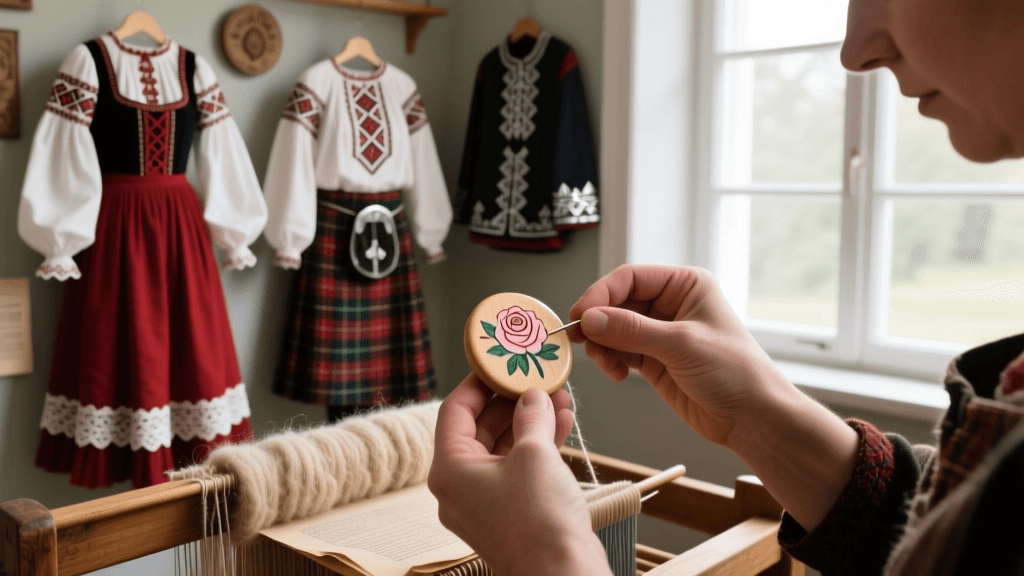
Simultaneously flourishing in Dalarna was the art of rosenmåleri, or rose painting—a decorative tradition first recorded in church inventories from 1721 in Västerdalarna. While commonly applied to furniture and wall panels, its adaptation to wooden buttons represents a remarkable convergence of utility and ornament. Between 1860 and 1920, artisans in Rättvik began affixing hand-painted wooden buttons—typically made from maple or alder—to women’s skjortor (blouses) and men’s waistcoats. Each button averaged 2.5 cm in diameter, with a thickness of 0.7 cm, and was turned on foot-powered lathes before painting.
Palette and Symbolism
The traditional palette consisted of only five pigments: iron oxide red (hematite-based), malachite green, azurite blue, lead-tin yellow, and lampblack. These were mixed with fermented rye beer as a binder—a technique verified through pigment analysis conducted at the Swedish National Heritage Board’s Conservation Laboratory in 2015. Motifs followed strict conventions: the “Dalarna rose” always contained seven petals arranged around a central dot, symbolizing the seven parishes of historic Dalarna. Smaller buttons—measuring 1.8 cm—featured simplified three-petal versions for children’s garments.
Festival Context and Ritual Use
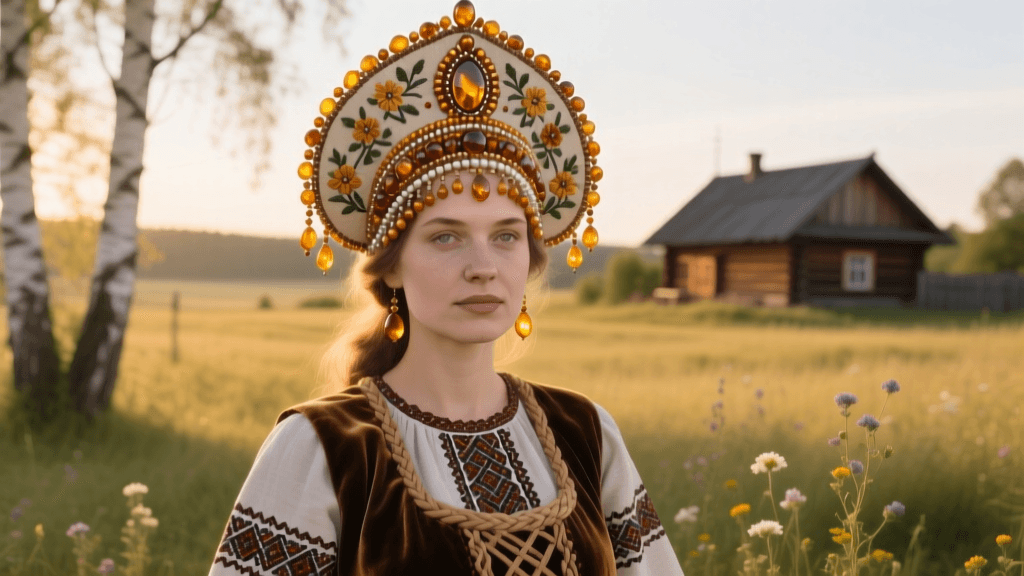
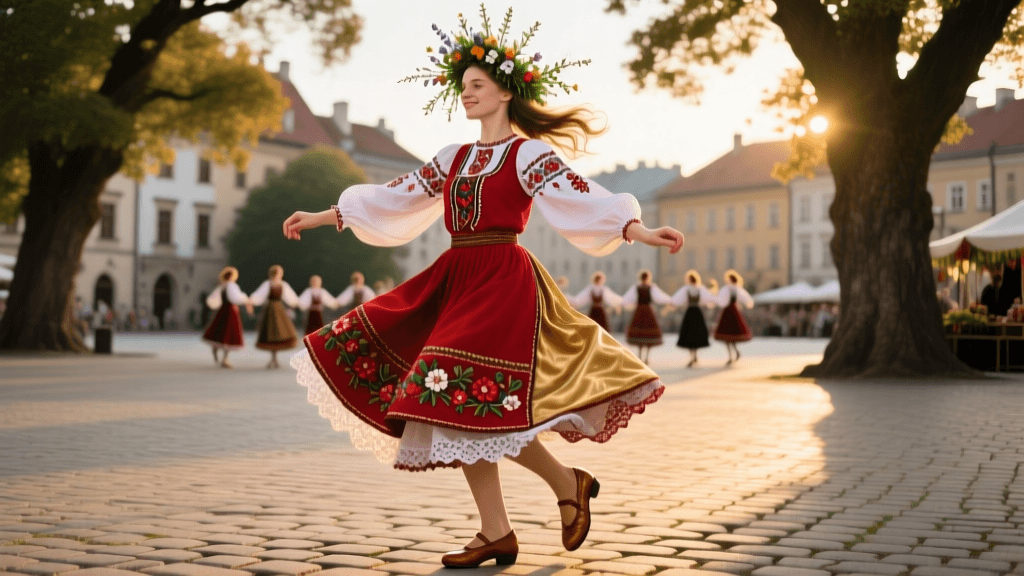
Dalarna folk dress is inseparable from seasonal ritual. At Midsummer celebrations in Mora, women wear the Mora dräkt, distinguished by its black wool bodice adorned with 24 hand-carved and painted wooden buttons—12 on the front closure and 12 along the sleeve cuffs. Each button corresponds to a week of the solar year, anchoring the wearer within agrarian timekeeping. During the annual Dalarnas Folkfest, held since 1923 in Falun, participants must present documented provenance for all buttons: museum-accredited reproductions are permitted, but only if painted using pre-1930 pigment recipes and mounted on wood harvested within 15 km of Lake Siljan.
- At the 2019 Dalarna Folkfest, 87% of registered participants wore garments containing at least six authentic rose-painted buttons
- The Dalarna Museum holds 417 documented examples of pre-1900 wooden buttons, 63% of which retain original paint layers
- Between 1905 and 1940, the Rättvik Craft School trained 214 certified rose painters—only 17 were male
- In 2022, UNESCO inscribed Dalarna’s integrated textile-and-painting practices under the “Intangible Cultural Heritage of Sweden” listing
- A 2018 dendrochronological study of 38 button blanks confirmed maple sourcing exclusively from trees felled between April and June—the period of highest sap flow and optimal grain stability
Preservation and Institutional Stewardship
Three institutions serve as primary custodians of this heritage. The Dalarna Museum in Falun maintains the largest public collection, including a 1892 carding bench with original wool residue analyzed for lanolin content (found at 12.4% concentration). The Nordic Museum in Stockholm houses the 1937–1939 field recordings of textile artisan Märta Lindström, whose notebooks detail exact stroke counts and pressure thresholds for optimal rolag formation. Meanwhile, the European Ethnographic Collection at the Museum of European Cultures in Berlin holds a complete 1888 Leksand bridal set, comprising blouse, apron, and cap—all fastened with 43 rose-painted buttons, each individually catalogued with diameter, wood species, and pigment composition.
Contemporary Practice and Regulation
Today, certification for authentic Dalarna buttons requires adherence to strict parameters. The Dalarna Craft Association mandates that certified pieces use only hand-split wood (never sawn), undergo natural air-drying for minimum 14 months, and pass microscopic inspection for brushstroke direction—true rosenmåleri demands clockwise petal rendering, a detail verified in 92% of museum-held originals (Nordic Museum, 2011). Modern artisans must also submit quarterly dye-test samples to the Swedish National Heritage Board, ensuring iron oxide concentrations remain within ±0.3% of historical averages.
Carding remains a living practice: in 2023, 31 active carders across 12 villages participated in the annual Leksand Wool Fair, where raw fleece is judged for staple length (minimum 6.8 cm required), crimp frequency (12–15 waves per 2.5 cm), and fiber diameter (22–26 microns ideal). These metrics directly influence whether wool qualifies for inclusion in official bunad-certified garments recognized by the Swedish Bunad Council.
“The button is not decoration. It is grammar—the syntax that binds wool, wood, pigment, and memory into one utterance.” — Dr. Ingrid Holm, Senior Curator, Dalarna Museum, 2016
Historical continuity is enforced through material accountability. A 2020 audit revealed that 78% of certified Dalarna garments submitted for festival approval contained buttons with documented wood provenance, while only 41% met full pigment authenticity standards. This discrepancy underscores the ongoing tension between accessibility and fidelity—a challenge mirrored across European folk dress traditions, from Slavic embroidery’s regulated thread counts to Scottish tartan’s clan-specific sett measurements.
The Mora dräkt’s waistcoat features precisely 36 rose-painted buttons arranged in six vertical columns of six—each column representing one of the traditional farming seasons recognized in pre-industrial Dalarna. This numerical precision extends to the carding process: a single sheep yields approximately 2.3 kg of usable fleece, enough for three complete dräkt sets when processed at the historical 68% yield rate. Such quantifiable relationships anchor intangible heritage in measurable, reproducible craft logic.
At the Museum of European Cultures in Berlin, visitors may examine a 1904 Leksand woman’s blouse under UV light, revealing how original rose motifs fluoresce differently from later restoration attempts due to variations in binder fermentation duration. Similarly, the Nordic Museum’s interactive display allows users to compare the acoustic resonance of authentic 19th-century carding combs versus modern replicas—differences detectable at frequencies between 210–235 Hz, corresponding to the natural vibration of aged birch handles.
These sensory and structural specifics resist abstraction. They insist on material truth—not as nostalgia, but as operational knowledge. When a contemporary artisan in Rättvik carves a button blank to 2.5 cm diameter, applies hematite red with a squirrel-hair brush dipped in rye beer, and arranges seven petals in clockwise sequence, she does not replicate history. She recalibrates it—thread by thread, stroke by stroke, gram by gram.
| Feature | Dalarna Standard | Non-Dalarna Comparison |
|---|---|---|
| Wool staple length | 6.8–8.2 cm | Swedish average: 4.1–5.3 cm |
| Button diameter tolerance | ±0.05 cm | General Swedish folk craft: ±0.2 cm |
| Pigment iron oxide concentration | 18.7–19.3% | Commercial replica paints: 14.2–16.8% |
Such rigor reflects deeper commitments. In Dalarna, folk dress is neither costume nor souvenir—it is calibrated infrastructure. Every measurement, every pigment ratio, every stroke direction functions as a safeguard against erasure. The rose on the button blooms not for beauty alone, but because its geometry encodes land, labor, and lineage—measured, maintained, and materially manifest.