Scottish Kilt Pleating Techniques & Tartan Alignment Guide 2026
The Renaissance of Bespoke Highland Tailoring in 2026
The construction of the traditional Scottish Highland kilt is widely considered one of the most complex feats of bespoke garment engineering in European folk dress. Unlike standard trousers or skirts that rely on darts and seams to shape the fabric, the kilt is a masterclass in geometric folding, tension management, and precise pattern alignment. As of 2026, there has been a massive resurgence in heritage tailoring, with a new generation of artisans and enthusiasts embracing sustainable, hand-stitched Highland wear over mass-produced alternatives. Understanding the foundational construction patterns and pleating techniques is essential for anyone looking to craft an authentic, structurally sound kilt that will last a lifetime.
Decoding the Tartan Sett: The Blueprint of the Kilt
Before a single cut is made, the kiltmaker must understand the 'sett'—the repeating geometric pattern that makes up a specific tartan. According to the Victoria and Albert Museum's comprehensive guide to tartan, the sett is historically rooted in the natural dyes and weaving capabilities of specific Scottish regions, but today it serves as the mathematical blueprint for kilt pleating. The sett dictates the width of each pleat, the placement of the hidden stitches, and the overall yardage required.
A standard bespoke kilt requires approximately 8 yards (7.3 meters) of double-width (54-60 inches) tartan wool. The pattern must be perfectly aligned across the aprons and the pleats so that the tartan appears as a continuous, unbroken wrap around the wearer's body. This optical illusion is the hallmark of true Highland tailoring.
Material Requirements and 2026 Sourcing
Authentic kilt construction demands heavy, durable textiles. In 2026, the industry standard remains 16oz to 18oz worsted wool, which provides the necessary weight to ensure the pleats swing properly and hold their shape without excessive wrinkling. Premium heritage mills, such as Lochcarron of Scotland and Andrew Elliot Ltd, continue to dominate the market, with 16oz wool averaging between £45 and £65 per meter in early 2026.
- Wool: 8 yards of 54-inch wide, 16oz worsted wool tartan.
- Thread: Waxed 3-cord linen thread (color-matched to the darkest stripe in the sett).
- Interlining: 100% cotton or linen canvas (hair canvas is preferred for the fell).
- Lining: Cotton sateen or breathable linen for the interior apron.
- Hardware: Solid brass or sterling silver buckles, leather straps, and heavy-duty kilt pins.
Construction Table: Yardage and Sett Repeats
The size of the sett directly impacts how the kilt is pleated and how much fabric is consumed. Below is a comparison of popular tartans and their construction metrics for a standard 34-inch waist kilt in 2026:
| Tartan Name | Sett Size (Inches) | Pleating Style | Approx. Pleat Count | 2026 Wool Cost (8 Yards) |
|---|---|---|---|---|
| Royal Stewart | 6.5" | Pleated to the Sett | 28 - 32 | £420 - £480 |
| Black Watch | 5.5" | Pleated to the Stripe | 30 - 34 | £380 - £440 |
| Dress Gordon | 7.0" | Pleated to the Sett | 26 - 29 | £450 - £520 |
| MacDonald Modern | 6.0" | Box Pleated | 24 - 28 | £410 - £470 |
Step-by-Step Pleating Techniques
The pleating process is where the mathematical precision of kiltmaking truly shines. There are two primary methods of knife pleating used in Highland dress, each requiring a different approach to pattern alignment.
1. Knife Pleating to the Sett
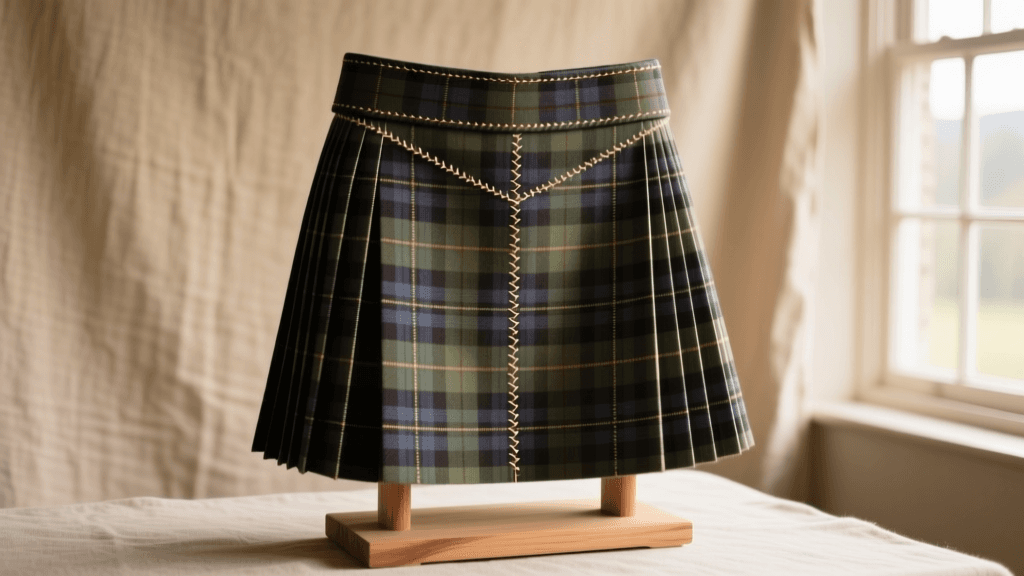
Pleating to the sett is the most common and visually striking technique. The goal is to fold the fabric so that the pattern on the visible face of each pleat perfectly matches the pattern on the apron. The kiltmaker selects a dominant pivot line within the sett—usually a prominent stripe or the exact center of a symmetrical pattern block. Each pleat is folded back on itself so that the chosen line sits precisely on the edge of the fold. This creates a continuous, unbroken tartan pattern across the back of the kilt when the wearer is standing still, while allowing the hidden colors to flash during movement.
2. Knife Pleating to the Stripe
Often favored by military regiments, pleating to the stripe (or 'to the line') ignores the overall symmetrical pattern and instead focuses on a single, bold vertical stripe within the sett. This stripe is placed at the edge of every single pleat. The result is a striking, vertical striped effect across the back of the kilt, which looks dramatically different from the front apron. This technique requires intense calculation to ensure the stripe remains perfectly vertical and does not drift due to the bias of the fabric.
Mastering the Fell and the Hidden Stitch
The 'fell' is the upper portion of the kilt, spanning from the waistline down to the hipline (typically about 7 to 8 inches). This is the most structurally critical area of the garment. Because the human hip is significantly wider than the waist, the pleats cannot simply be folded straight down; they must be tapered and shaped to contour the body.
To achieve this, the kiltmaker calculates the difference between the waist and hip measurements. If a wearer has a 32-inch waist and a 40-inch hip, there is an 8-inch difference. This 8 inches must be distributed evenly across all the pleats in the fell. The fabric is folded and pinned, tapering the depth of each pleat slightly as it moves from the hip up to the waist.
The Hidden Stitch Technique
Once the tapering is calculated and pinned, the fell must be secured. Kiltmakers use a specialized 'hidden stitch' (a variation of the blind hem stitch) to sew the pleats down from the inside. Using a heavy harness needle and waxed linen thread, the artisan catches only one or two threads of the outer wool layer, pulling the thread through the canvas interlining without piercing all the way to the front face of the tartan. This ensures that absolutely no stitching is visible on the outside of the kilt. In 2026, master tailors still insist on 6 to 8 stitches per inch to guarantee the heavy wool will not pull away under the tension of movement.
Interlining and Lining for Structural Integrity
A kilt is not just wool; it is a composite garment. The interior of the fell is heavily reinforced with canvas interlining. This canvas is pad-stitched to the wool, providing a rigid corset-like structure that supports the heavy buckles and straps without sagging. The inner aprons are then lined with cotton sateen or linen. This lining protects the wool from body oils and sweat, while also providing a smooth surface that allows the kilt to be easily slipped on and off. Modern 2026 tailoring often incorporates breathable, moisture-wicking linen blends to increase comfort during long days at Highland games or formal ceilidhs.
Historical Context: From Plaid to Tailored Garment
To truly appreciate the engineering of the modern kilt, one must understand its origins. As detailed by National Museums Scotland, the original Highland garment was the 'feileadh mòr' (the great plaid), an untailored length of wool gathered and belted around the waist. It wasn't until the late 18th and early 19th centuries that the 'feileadh beag' (the little kilt) emerged, featuring pre-sewn pleats and tailored aprons. The evolution from a simple belted blanket to the highly engineered, mathematically precise garment we see today represents a fascinating intersection of Celtic heritage and Victorian-era tailoring innovation.
Final Fitting and Maintenance
Once the pleats are stitched, the fell is bound with a wool or cotton tape, and the leather straps and brass buckles are riveted into place, the kilt undergoes a rigorous pressing process. Using heavy tailor's clappers and copious amounts of steam, the pleats are permanently set into the wool. A properly constructed 2026 bespoke kilt requires minimal maintenance: it should be dry-cleaned only when absolutely necessary, stored flat or on a specialized wide-hanger to prevent the pleats from warping, and brushed regularly with a natural bristle garment brush to remove dust and restore the worsted wool's natural luster.
By mastering these traditional construction patterns and pleating techniques, artisans and enthusiasts alike ensure that the Scottish Highland kilt remains not just a symbol of cultural pride, but a pinnacle of European folk dress engineering for generations to come.