Zero-Waste Geometric Cutting: Drafting the Slavic Rubakha in 2026
Introduction to the Slavic Rubakha and Zero-Waste Heritage
The traditional Slavic rubakha (also known as the sorochka or kosovorotka depending on the specific regional variation) is a masterclass in functional, geometric garment construction. For centuries, Eastern European peasants and artisans crafted these foundational shirts using a strict rectangular cutting system. This was not merely an aesthetic choice, but a vital economic necessity dictated by the narrow widths of handwoven linen produced on traditional looms. Every single inch of fabric was utilized, resulting in a garment that produced zero textile waste.
As we navigate the fashion landscape of 2026, the zero-waste movement has transitioned from a niche environmental protest to a core pillar of global textile sustainability. According to the Fashion Revolution initiative, modern pattern drafting is increasingly looking backward to historical methodologies to solve contemporary waste crises. By studying the Slavic rubakha, modern sewists and designers can master a completely zero-waste pattern drafting technique that yields a highly mobile, durable, and historically authentic garment without generating a single scrap of landfill-bound fabric.
Core Geometry: The Rectangular Cutting System
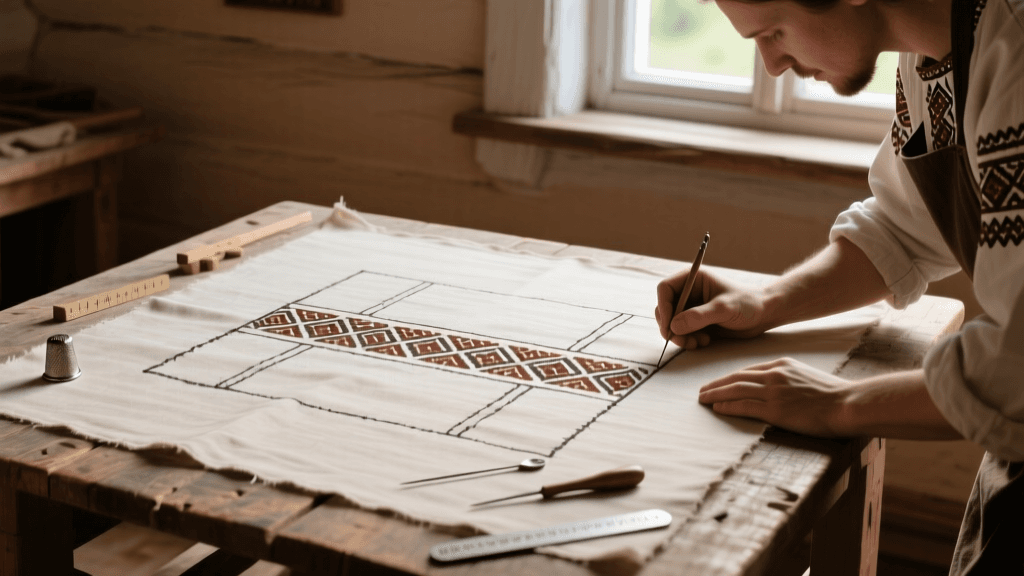
Unlike modern Western tailoring, which relies heavily on curved armholes, princess seams, and complex darts to contour the body, the rubakha relies entirely on straight lines, rectangles, and squares. The fundamental philosophy is that the fabric should drape and fold around the body, with mobility provided by strategic gussets rather than shaped seams.
Historically, handwoven linen was typically 36 to 40 inches (90-100 cm) wide. In 2026, most commercially available European Flax-certified linens come in standard widths of 60 inches (150 cm). To draft an authentic rubakha today, you must adapt the historical layout. You can either fold your modern 150cm fabric to simulate a narrower loom width, or you can use digital pattern drafting software like CLO 3D to optimize the zero-waste marker for wider fabric, ensuring that the offcuts are repurposed into smaller accessories like onuchi (leg wrappings) or drawstring bags, maintaining the 100% utilization rate.
Drafting the Patterns: Step-by-Step Measurements
The rubakha is composed of four primary geometric components: the stan (main body panels), the rukava (sleeves), the lastovitsa (underarm gussets), and the voron (collar or neckline binding). Below is a comprehensive cutting guide based on a standard adult medium, utilizing 100% heavyweight linen (approx. 200-250 gsm).
| Garment Component | Traditional Term | Geometric Shape | Standard 2026 Measurements (cm) | Quantity Required |
|---|---|---|---|---|
| Main Body Panel | Stan | Rectangle | Width: 60cm x Length: 160cm (folded) | 2 |
| Sleeve Panel | Rukava | Rectangle | Width: 45cm x Length: 65cm | 2 |
| Underarm Gusset | Lastovitsa | Square | 15cm x 15cm | 2 |
| Collar Binding | Voron | Rectangle | Width: 8cm x Length: 45cm | 1 |
| Cuff Binding | Manzheta | Rectangle | Width: 6cm x Length: 25cm | 2 |
Calculating the Body Panels (Stan)
The main body of the rubakha is formed by two large rectangles. To calculate the width, take the wearer's full chest circumference, add 15-20 cm for ease and historical drape, and divide by two. For a 100 cm chest, the finished width per panel should be roughly 60 cm. The length is traditionally cut to reach mid-calf or the ankles for women, and just below the knee for men. A 160 cm length allows for a deep hem and slight blousing over a belt (poyas), which is essential for the traditional silhouette.
The Crucial Underarm Gusset (Lastovitsa)
The lastovitsa is the engineering marvel of Eastern European folk dress. Because the sleeve is attached to the body panel at a strict 90-degree angle (forming a T-shape or cross-shape when laid flat), raising the arms would pull the entire side seam upward, restricting movement and tearing the fabric. The 15x15 cm square gusset is inserted at the intersection of the sleeve, front body, and back body. This diamond-shaped insertion when worn acts as a pivot point, granting the wearer complete overhead mobility without the need for modern curved armholes.
Authentic Construction and Seam Techniques
Constructing a rubakha requires specific seam finishes that honor the garment's utilitarian roots while ensuring longevity. In 2026, while sergers and overlockers are the industry standard for preventing fraying, traditional Slavic garments relied on enclosed seams that are both incredibly durable and aesthetically clean on the inside.
Flat-Felled Seams (Zaposhivnoy Shov)
All structural seams of the rubakha—the side seams, sleeve seams, and gusset insertions—should be finished using flat-felled seams. To execute this:
- Place your fabric pieces wrong sides together and sew a standard seam at 1 cm.
- Trim one side of the seam allowance down to 3 mm.
- Fold the longer seam allowance over the trimmed edge, encasing the raw edge completely.
- Press flat and topstitch close to the folded edge.
Gathering and Smocking the Neckline
Unlike modern shirts with shaped collar stands, the rubakha neckline is created by gathering a wide rectangular slit. The center front slit is typically 15-20 cm deep. The raw edges are finished with a narrow rolled hem. The entire neckline circumference is then gathered tightly using a heavy linen thread. According to the Victoria and Albert Museum's textile archives, traditional Eastern European smocking and gathering techniques often involved intricate surface embroidery that not only decorated the garment but also reinforced the high-stress gathered areas. In 2026, you can replicate this using a drawstring casing for a simple, adjustable fit, or employ traditional honeycomb smocking stitches to permanently secure the gathers while adding a touch of regional authenticity.
Sourcing Authentic Materials in 2026
The success of a historical reproduction relies heavily on the textile. Modern cotton poplins or synthetic blends will completely ruin the drape and structural integrity of a rectangular-cut garment. You must source 100% European Flax-certified linen. The weight should be medium to heavy (180 to 250 gsm) to provide the necessary body for the geometric folds.
When sourcing linen in 2026, look for suppliers who provide transparency regarding their retting and weaving processes. Naturally retted (dew-retted) linen offers a beautiful, slightly slubbed texture that closely mimics historical handwoven fabrics. For the embroidery thread, avoid modern mercerized cotton, which is too shiny and synthetic-looking. Instead, opt for matte wool yarns or unmercerized linen threads for the traditional red and black cross-stitch motifs that often adorn the collar, cuffs, and hem of the rubakha. The Metropolitan Museum of Art's Heilbrunn Timeline of Art History provides excellent visual references for the specific geometric embroidery motifs native to various Eastern European regions, ensuring your surface decoration is as historically accurate as your pattern draft.
Conclusion
Drafting and constructing a traditional Slavic rubakha is a profound exercise in sustainable pattern making. By embracing the zero-waste rectangular cutting system, sewists can create garments that are deeply rooted in Eastern European heritage while actively participating in the 2026 sustainable fashion movement. The integration of the lastovitsa gusset and flat-felled seams proves that historical construction techniques were not primitive, but rather highly advanced solutions to the problems of mobility, durability, and material conservation. Whether you are a historical reenactor, a sustainable fashion designer, or a dedicated home sewist, mastering the geometry of the rubakha will fundamentally change the way you approach pattern drafting and textile waste.