Preserving Su Xiu: China's Intangible Silk Embroidery Heritage
The Living Heritage of Suzhou Silk Embroidery (Su Xiu)
When exploring the rich tapestry of Asian traditions, few elements are as visually stunning and culturally significant as the textiles used in traditional Chinese garments. At the very pinnacle of this sartorial hierarchy sits Su Xiu, or Suzhou embroidery. Originating from the silk-rich region of Suzhou in Jiangsu province, this intricate needlework has been a cornerstone of Chinese fashion and cultural expression for over two millennia. Today, it is recognized not merely as a decorative art, but as a vital component of China's Intangible Cultural Heritage (ICH).
For enthusiasts and collectors of Hanfu (traditional Han Chinese clothing), understanding Su Xiu is essential. The delicate motifs of cranes, peonies, and mythical dragons that adorn high-end Ming and Song dynasty-style garments are often brought to life through this painstaking technique. In 2009, the broader category of sericulture and silk craftsmanship of China was officially inscribed on the UNESCO Representative List of the Intangible Cultural Heritage of Humanity, cementing its global importance and the urgent need to protect the artisans who keep the craft alive.
The Artisans: Masters of the Split Silk Thread
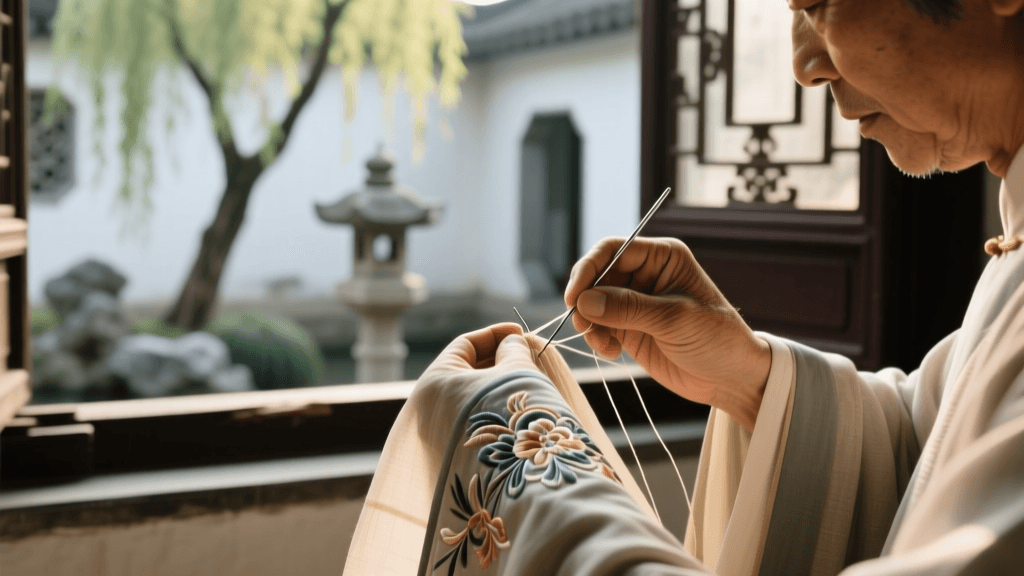
The creation of authentic Su Xiu is not a skill that can be mastered in a few months or even a few years. Traditional artisans, predominantly women who have passed down the craft through matrilineal lines for generations, undergo rigorous apprenticeships. It typically takes a minimum of ten years of dedicated, daily practice to achieve the status of a master embroiderer.
The physical toll on these artisans is immense. The work requires extraordinary visual acuity, steady hands, and immense patience. Many master embroiderers experience significant eyesight deterioration due to the microscopic precision required for their finest pieces. Despite these challenges, the dedication of these inheritors ensures that the soul of traditional Chinese clothing remains intact in an era increasingly dominated by fast fashion and machine-made textiles.
The Technique: Splitting Silk to 1/48th of a Strand
The true magic of Su Xiu lies in a technique known as pi xian, or silk splitting. A standard strand of silk thread is composed of multiple finer filaments. To achieve the photorealistic gradients and ethereal softness required for high-end Hanfu embellishments, artisans manually split a single silk thread into fractions of its original thickness.
- 1/2 and 1/4 splits: Used for bold outlines, structural elements, and heavier botanical motifs like tree branches.
- 1/8 and 1/16 splits: Employed for shading, delicate flower petals, and the intricate scales of traditional dragon or carp motifs.
- 1/32 and 1/48 splits: The absolute pinnacle of the craft. Threads split to 1/48th of their original width are practically invisible to the naked eye and are used for the finest details, such as the subtle highlights in a bird's eye or the misty edges of a landscape. At this thickness, the silk thread is thinner than a human hair.
This meticulous splitting allows for the use of over a thousand different color shades in a single, relatively small embroidery panel, creating a seamless blend that mimics traditional ink wash paintings.
Kesi (Silk Tapestry): The Pinnacle of Woven Heritage
While Su Xiu involves stitching threads onto an existing base fabric, Kesi (translated as 'cut silk') is a weaving technique that creates the fabric and the image simultaneously. Using a specialized wooden loom, artisans weave colored silk weft threads only where a specific color is needed in the pattern, leaving tiny, intentional slits between color boundaries. This gives the textile a carved, three-dimensional appearance.
Historically reserved for imperial dragon robes and the highest echelons of court dress, Kesi is incredibly time-consuming. There is a famous Chinese proverb regarding this textile: 'One inch of Kesi, one ounce of gold.' The Metropolitan Museum of Art's Heilbrunn Timeline of Art History notes that Chinese silk tapestries were highly prized not only domestically but also along the Silk Road, influencing textile arts across Eurasia. Today, authentic Kesi is used sparingly in luxury Hanfu, often for statement collars, cuffs, or the central panels of a bijia (vest).
Identifying Authentic Intangible Heritage Hanfu Textiles
As the Hanfu movement has surged in popularity, the market has been flooded with machine-embroidered imitations. While machine embroidery is excellent for affordable, everyday wear, it lacks the cultural and monetary value of ICH-certified handmade textiles. Use the comparison chart below to distinguish between mass-produced garments and authentic artisan work.
| Feature | Machine Embroidery | Authentic Handmade Su Xiu | Authentic Kesi Tapestry |
|---|---|---|---|
| Thread Texture | Uniform, thick, synthetic or blended shine | Variable thickness, deep natural silk luster | Woven into the fabric, slight slit gaps between colors |
| Reverse Side | Messy bobbin threads, visible backing paper | Neat, or identical to the front (double-sided) | Pattern visible in reverse, no loose threads |
| Color Blending | Block colors, obvious digital stepping | Seamless gradients using split threads | Geometric or stepped color transitions |
| Time to Produce | Minutes to a few hours | Weeks to several months | Months to over a year |
| Approx. Cost (USD) | $50 - $200 (Full Garment) | $800 - $5,000+ (Embellished Garment) | $2,000 - $15,000+ (Panel or Garment) |
Practical Guide: Sourcing, Cost, and Care
For those looking to invest in authentic heritage garments, knowing where and how to buy is crucial. The epicenter of Su Xiu is Zhenhu Town in Suzhou, where hundreds of embroidery studios and family-run workshops operate. When commissioning or purchasing a piece, always ask for a certificate of authenticity from a recognized ICH inheritor or a certified studio.
Cost and Investment Breakdown
Investing in handmade heritage textiles is akin to purchasing fine art. Prices are dictated by the complexity of the design, the fineness of the silk split, and the reputation of the artisan.
- Entry-Level Artisan (Apprentice/Junior): $300 - $800 for small accessories like embroidered cloud shoulders or pouches. These pieces usually utilize 1/4 or 1/8 silk splits.
- Mid-Tier Master: $1,500 - $4,000 for heavily embroidered Hanfu components, such as a Ming dynasty-style mamianqun (horse-face skirt) hem. These feature 1/16 splits and complex shading.
- National Treasure Level: $10,000 and above. These are museum-quality pieces featuring double-sided embroidery (where the front and back are identical but feature different colors) or ultra-fine 1/48 splits.
Preservation and Care Protocols
Silk is a natural protein fiber that is highly susceptible to environmental damage. Proper care is non-negotiable for heritage textiles.
- Cleaning: Never machine wash or aggressively hand-wash authentic Su Xiu or Kesi. The tension and moisture can cause the silk threads to bleed, shrink, or lose their structural integrity. Always seek a professional dry cleaner who specializes in antique or heritage textiles.
- Storage: Do not hang heavily embroidered garments on standard hangers, as the weight of the embroidery will distort the base silk over time. Store garments flat in a cool, dark environment.
- Archival Materials: Wrap the garment in acid-free, unbuffered tissue paper. Avoid plastic garment bags, which can trap moisture and emit off-gassing chemicals that yellow the silk.
- Handling: Always handle heritage silk with clean, dry hands. The natural oils and acids from human skin can degrade the silk proteins and tarnish metallic threads over time.
Supporting the Future of the Craft
The survival of Su Xiu and Kesi relies heavily on conscious consumerism. By choosing to invest in authentic, artisan-crafted Hanfu textiles, collectors and enthusiasts provide the financial ecosystem necessary for master embroiderers to take on new apprentices. As we continue to celebrate and revive Asian traditions, recognizing the profound human effort woven into every fraction of a silk thread ensures that China's intangible heritage will continue to drape future generations in living history.