Suzhou Silk Embroidery: Techniques, Care, and Buying Guide
The Legacy of Su Xiu: China's Premier Silk Embroidery
Suzhou embroidery, known locally as Su Xiu, is widely considered the crown jewel of Chinese textile arts. Originating in the Jiangsu province over 2,000 years ago, this meticulous craft is celebrated for its delicate patterns, elegant colors, and photorealistic depth. As one of the Four Major Embroideries of China (alongside Xiang, Shu, and Yue), Su Xiu represents the pinnacle of silk manipulation, transforming raw mulberry silk threads into breathtaking works of art that have adorned imperial robes, luxury home decor, and high-end traditional garments like the qipao.
According to the Victoria and Albert Museum, Chinese embroidery has long been a vital medium for cultural expression, with regional styles reflecting local aesthetics and resources. Suzhou, historically a wealthy center of the silk trade, provided artisans with the finest materials, allowing them to develop techniques that remain unmatched in their intricacy today.
The Magic of Thread Splitting (Pisi)
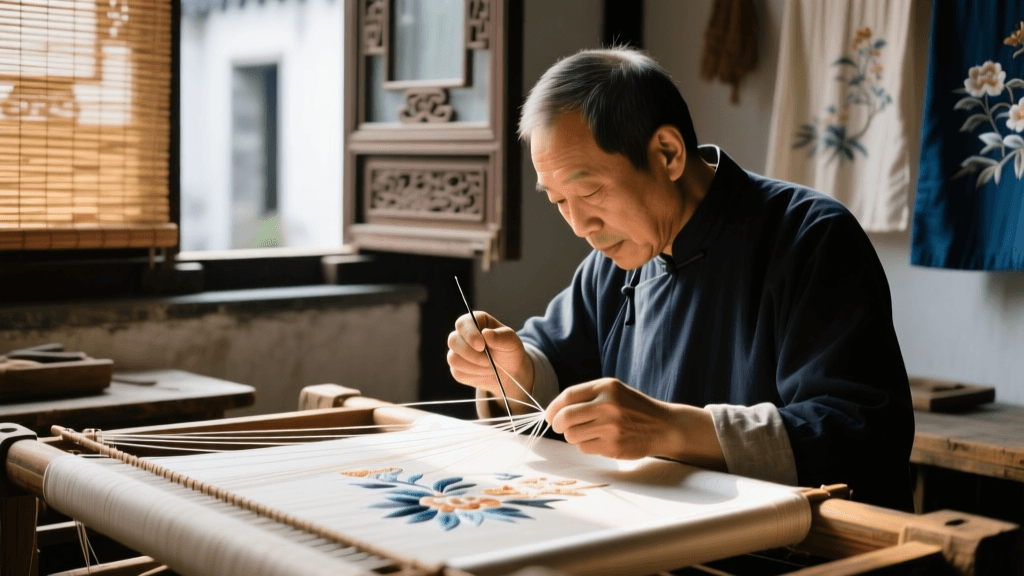
The defining characteristic of authentic Su embroidery is the artisan's ability to split silk threads into microscopic fractions. A standard strand of mulberry silk thread measures approximately 0.1 millimeters in diameter. However, to achieve the subtle color gradients required for realistic depictions of koi fish, peonies, or feline fur, master embroiderers employ a technique called Pisi (thread splitting).
- 1/2 Split: Used for bold outlines and structural elements of the design.
- 1/4 to 1/8 Split: Utilized for filling in base colors and creating mid-tone shading.
- 1/16 to 1/32 Split: Applied to delicate details like the translucent fins of a goldfish or the subtle blush on a portrait's cheek.
- 1/48 Split: The absolute limit of human dexterity, measuring roughly 0.002 millimeters. This is reserved for the finest highlights, such as the reflection of light in an animal's eye or the morning dew on a lotus petal.
This painstaking process requires immense patience, steady hands, and optimal humidity levels to prevent the ultra-fine silk fibers from snapping or tangling.
Core Stitching Techniques
Su Xiu encompasses over 40 distinct stitching techniques, but three are fundamental to the craft:
1. Ping Xiu (Flat Stitch)
The most common technique, where stitches are laid flat and parallel to one another. The edges of the stitches interlock seamlessly, creating a smooth, satin-like surface that catches the light beautifully. This is heavily used in traditional Hanfu and Changshan garment trims.
2. Da Zi Xiu (Seed Stitch)
Consisting of tiny, knotted stitches that resemble seeds. This technique is used to create texture, often forming the centers of flowers, the scales of dragons, or the rough bark of ancient pine trees.
3. Shuang Mian Xiu (Double-Sided Embroidery)
The most astonishing feat of Su embroidery. In double-sided embroidery, the artisan stitches on a translucent silk organza base, hiding all knots and thread ends within the microscopic stitches themselves. The result is a piece that displays identical, flawless images on both the front and the back. Advanced variations even feature different colors or entirely different images on each side (e.g., a white tiger on the front, a black tiger on the back).
"The essence of Su embroidery lies not in the density of the stitches, but in the invisible transition of colors and the breath of life given to the silk." — Master Artisan of the Suzhou Embroidery Research Institute.
Comparison Chart: Authentic Handmade Su Xiu vs. Machine Embroidery
When shopping for traditional textiles, it is crucial to distinguish between genuine handcrafted Su Xiu and mass-produced machine alternatives. Use this comparison chart to guide your inspection:
| Feature | Authentic Handmade Su Xiu | Machine Embroidery |
|---|---|---|
| Thread Material | 100% natural mulberry silk (high sheen, soft drape) | Polyester or rayon blends (harsh shine, stiff) |
| Stitch Uniformity | Slight, organic variations; visible overlapping for gradients | Perfectly uniform, rigid, and flat |
| Backing / Reverse Side | Clean, nearly identical to front (in double-sided); minimal knots | Covered in white bobbin thread, messy jump stitches |
| Production Time | 3 to 12+ months for a standard 12-inch piece | Less than 2 hours |
| Color Blending | Seamless, achieved by threading multiple micro-strands | Blocky, relying on digital thread color changes |
Practical Guide to Buying Authentic Su Embroidery
Purchasing authentic Su embroidery is an investment in cultural heritage. The vast majority of genuine pieces are produced in Zhenhu Embroidery Street in Suzhou, a town dedicated entirely to this craft. As noted by China Daily, Zhenhu is home to thousands of embroiderers and remains the epicenter of the Su Xiu industry.
Pricing and Dimensions
- Entry-Level Accessories (Scarves, Handkerchiefs): $80 - $250. These usually feature single-sided embroidery on pre-woven silk bases. Expect dimensions around 10x70 inches.
- Mid-Range Table Screens (Tai Ping): $500 - $2,500. Typically 10x10 inches to 15x15 inches, mounted on rosewood stands. These showcase advanced flat stitching and basic double-sided techniques.
- Master-Level Floor Screens & Garments: $10,000 - $50,000+. Large double-sided floor screens (e.g., 36x48 inches) or bespoke Qipao dresses featuring master-level Pisi thread splitting and complex shading.
Timing and Commissioning
If you are commissioning a custom piece, be prepared for a significant wait. A skilled artisan works roughly 6 to 8 hours a day. A standard 12-inch double-sided table screen requires approximately 800 to 1,200 hours of labor, meaning a realistic delivery timeline is 6 to 9 months. Always request a detailed contract outlining the silk grade, thread split level, and monthly progress photos.
Care and Maintenance of Silk Textiles
Silk is a protein fiber, making it highly susceptible to environmental damage. Proper preservation is essential to maintain the structural integrity and vibrancy of your Su embroidery.
- Climate Control: Maintain a relative humidity of 45% to 55%. High humidity promotes mold growth on the silk and wooden frames, while low humidity makes the threads brittle and prone to snapping.
- UV Protection: Never display Su embroidery in direct sunlight. Ultraviolet rays will rapidly degrade the silk proteins and fade the natural dyes. Use UV-filtering glass if framing the piece, and rely on indirect, ambient LED lighting.
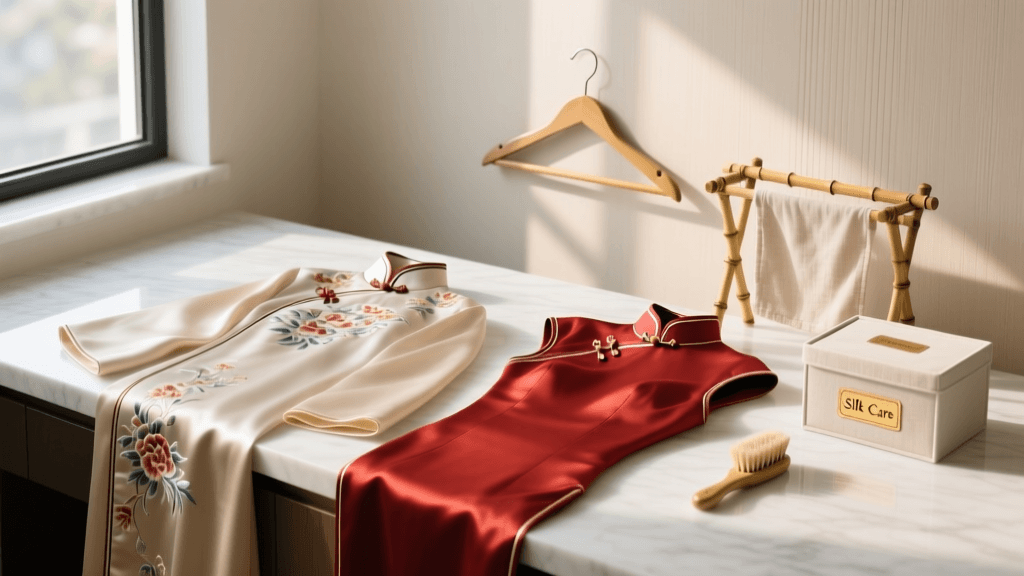
- Cleaning Protocol: Never wash or dry-clean authentic Su embroidery. Water will cause the silk threads to bleed and lose their tension. To remove dust, gently sweep the surface with a dry, ultra-soft camel-hair brush, moving strictly in the direction of the stitches.
- Storage: If storing a garment like an embroidered Tangzhuang or Hanfu, roll it loosely around an acid-free cardboard tube. Never fold embroidered silk, as the creases will permanently break the microscopic embroidery threads over time.
Modern Revival and Haute Couture
While Su Xiu is deeply rooted in history, it is currently experiencing a renaissance in modern fashion. Contemporary designers are integrating Suzhou embroidery into modern silhouettes, blending ancient thread-splitting techniques with minimalist aesthetics. Institutions like the Metropolitan Museum of Art have highlighted the enduring influence of Chinese silk arts on global fashion, noting how traditional motifs are continuously reinterpreted for the modern wardrobe.
Whether you are a collector seeking a museum-quality double-sided screen, a fashion enthusiast looking for an intricately embroidered qipao, or a textile student studying the limits of human craftsmanship, Suzhou silk embroidery offers a profound connection to the artistic soul of Asia. By understanding the techniques, costs, and care requirements, you can confidently acquire and preserve these magnificent textile masterpieces for generations to come.
References
- Victoria and Albert Museum. "Chinese Embroidery." vam.ac.uk
- China Daily. "Embroidery town stitches a path to prosperity." chinadaily.com.cn
- The Metropolitan Museum of Art. "Chinese Silk and Embroidery." metmuseum.org