Mastering Kesi Silk Tapestry Looms: 2026 Artisan Guide
The Enduring Legacy of Kesi: "Cut Silk" Tapestry in 2026
Among the most revered and technically demanding textile arts in Asian history is Kesi (刻丝), which translates literally to "cut silk." Originating during the Song Dynasty, this ancient tapestry weaving technique creates intricate, painterly designs that appear to be carved or cut into the fabric. As we navigate the global textile renaissance of 2026, the demand for authentic, hand-woven Kesi has surged, driven by a renewed appreciation for slow fashion, heritage craftsmanship, and the Xin Zhongshi (new Chinese style) movement. Unlike standard brocades or embroidered textiles, Kesi is woven on a highly specialized plain-weave loom where the pattern is created entirely by the weft threads, resulting in a reversible fabric with identical designs on both sides.
In 2026, master weavers in Suzhou's Zhenhu district and heritage workshops across Jiangsu province are not only preserving this ancient art but also adapting it for contemporary haute couture and interior design. According to UNESCO's Intangible Cultural Heritage archives, the sericulture and silk craftsmanship of China remain a vital living tradition, with Kesi representing the pinnacle of weft-faced weaving. This comprehensive guide explores the anatomy of the traditional Kesi loom, the precise mechanics of the "cut silk" technique, and how modern artisans are sourcing materials and preserving these methods today.
Anatomy of the Traditional Kesi Loom
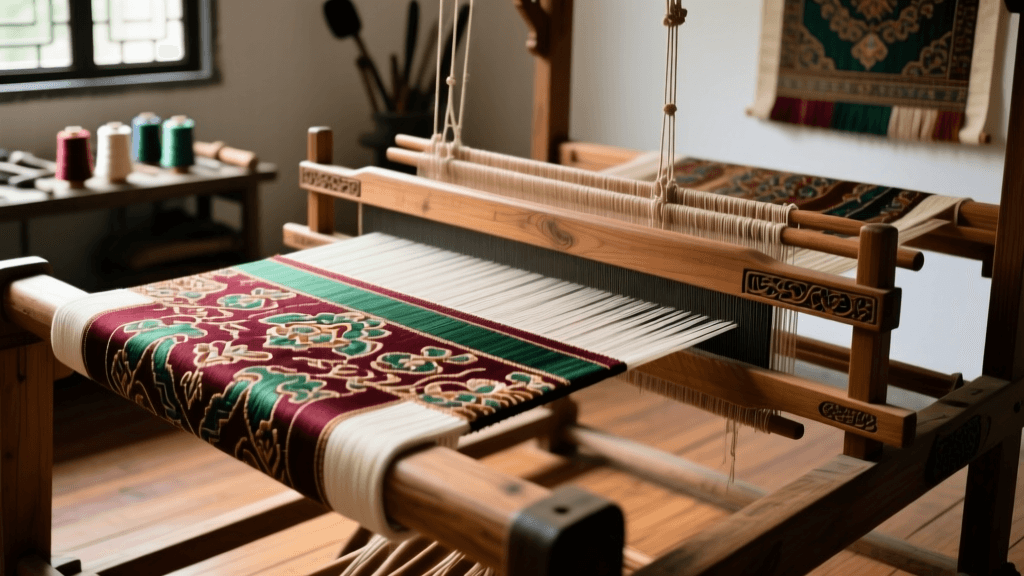
To understand Kesi, one must first understand the loom itself. The traditional Suzhou Kesi loom is remarkably minimalist compared to the massive, multi-story drawlooms used for Nanjing Yunjin (cloud brocade). The Kesi loom is essentially a plain-weave frame, typically constructed from aged elm or mahogany, designed to hold the warp threads under extreme, uniform tension.
Key Components of the Loom
- The Jing (Warp Beam) and Buzhou (Cloth Beam): These wooden rollers anchor the vertical silk threads. In 2026, many heritage workshops have integrated digital tension meters onto the warp beam to help apprentices maintain the exact 28-to-32-gram tension required for ultra-fine 20/22 denier mulberry silk.
- The Zong (Heddles): Unlike jacquard looms that use thousands of heddles to create complex pattern sheds, the Kesi loom uses only two sets of heddles. This creates a simple alternating shed (up and down) for the plain weave foundation.
- The Suoyu (Bamboo Bobbins): Instead of a single shuttle that travels across the entire width of the fabric, Kesi weavers use dozens of small, boat-shaped bamboo bobbins. Each bobbin holds a specific color of weft thread and is only woven back and forth within its designated color block.
- The Zhu (Wooden Comb/Beater): A heavy, fine-toothed wooden comb used to beat the weft threads tightly against the previous row, completely hiding the warp threads and creating the tapestry effect.
Comparative Analysis: Kesi Loom vs. Yunjin Drawloom
While both are celebrated Chinese silk weaving traditions, their mechanical approaches to pattern-making are fundamentally opposed. The table below highlights the structural and functional differences between the two primary heritage looms utilized by artisans in 2026.
| Feature | Suzhou Kesi Loom | Nanjing Yunjin Drawloom |
|---|---|---|
| Weft Structure | Discontinuous (localized color blocks) | Continuous (shuttle passes fully across) |
| Pattern Mechanism | Hand-manipulated individual bobbins | Drawboy / Jacquard harness system |
| Visual Effect | Slit tapestry ("cut" boundaries) | Brocade (unbroken, shimmering surface) |
| Reversibility | Fully reversible (identical both sides) | Single-faced (floating wefts on back) |
| Primary Historical Use | Art replication, imperial robe panels | Imperial dragon robes, heavy brocade |
| 2026 Production Speed | 1-2 square centimeters per day | 5-6 square centimeters per day |
The "Cut Silk" Mechanics: Tong Jing Duan Wei
The defining characteristic of Kesi is encapsulated in the traditional Chinese weaving maxim: Tong jing duan wei, meaning "through the warp, broken weft." This refers to the discontinuous weft technique that gives the textile its name.
Step-by-Step Weaving Process
The warp threads are typically a fine, unbleached raw mulberry silk, set at a high density of 20 to 30 ends per centimeter. The weft threads, which carry the color and pattern, are slightly thicker and dyed in a vast spectrum of hues. When a weaver transitions from a blue floral petal to a green leaf, the blue weft thread does not carry over into the green section. Instead, it wraps around the final warp thread of the blue zone and turns back on itself. The green weft thread does the same from the opposite direction.
Because the two colors do not interlock or overlap, a microscopic vertical slit is formed where the two color fields meet. When held up to the light, these tiny slits look as though the silk has been cut with a razor—hence the name "cut silk." According to The Metropolitan Museum of Art's extensive archives on Kesi, this structural slit is not a flaw but the defining hallmark of authentic tapestry weaving, allowing for sharp, unblurred boundaries between colors that embroidery or continuous-weft brocade cannot achieve.
"The mastery of Kesi lies not in the complexity of the loom, but in the mathematical precision of the weaver's mind. The artisan must essentially paint with silk bobbins, calculating the exact number of warp threads required for a single curved brushstroke of color." — Master Weaver Lin, Suzhou Silk Biennale, 2026.
Advanced Interlocking Techniques
While the "slit" technique is standard, 2026 artisans also utilize advanced variations to prevent structural weakness in larger color blocks. Gou Kesi (interlocking Kesi) involves looping adjacent weft threads around each other where colors meet, eliminating the slit and creating a stronger, albeit slightly more textured, seam. Jie Kesi (long-short interlocking) uses a graduated, zigzag boundary between colors to create a subtle shading effect, mimicking the ink-wash gradients of traditional Song Dynasty landscape paintings.
Sourcing Materials for Traditional Kesi in 2026
For textile artists and designers looking to commission or practice Kesi in 2026, understanding material specifications is critical. The market for heritage silk has evolved, with strict grading systems now in place to ensure authenticity.
Silk Thread Specifications
- Warp Thread: 20/22 denier raw mulberry silk (single ply). It must possess high tensile strength to withstand the aggressive beating of the wooden comb without snapping.
- Weft Thread: 20/22 denier silk, typically plied (2 to 4 strands twisted together) depending on the desired texture. For ultra-fine details, such as the pupils of a bird's eye or the delicate stamen of a lotus, weavers will split a single silk filament into 1/16th of its original thickness.
Natural Dyeing Revival
In 2026, the most prestigious Kesi ateliers have returned to botanical dyeing to achieve the muted, archival color palettes of antiquity. Indigo (from Persicaria tinctoria), madder root, and lotus shell are used to create colors that resist UV fading. The Victoria and Albert Museum's research on Chinese silk weaving notes that historically accurate natural dyes are essential for the light-refractive qualities of the silk fibroin, giving Kesi its characteristic subtle luster that synthetic dyes cannot replicate.
Preservation and Artisan Workshops in 2026
The survival of the Kesi loom relies heavily on institutional support and commercial viability. As of 2026, the Suzhou Silk Museum and the Zhenhu Embroidery and Kesi Heritage Center offer immersive apprenticeships. These programs pair young weavers with octogenarian masters, ensuring that the oral traditions of tension management and bobbin winding are not lost.
Furthermore, the 2026 integration of 3D scanning technology has allowed conservationists to map the exact wear patterns and joint stresses of 19th-century antique Kesi looms. This data is being used to mill replacement parts from sustainably sourced hardwoods, ensuring that historical looms remain functional rather than being relegated to static museum displays.
Practical Guide: Setting Up a Desktop Kesi Frame
For international textile enthusiasts and fashion students wanting to experiment with the Tong jing duan wei technique, setting up a scaled-down desktop Kesi frame is an excellent entry point. Here are the actionable steps and measurements for a beginner's setup:
- Frame Dimensions: Construct a simple rectangular frame from hardwood measuring 40 cm in width and 50 cm in height. Ensure the top and bottom beams are fitted with ratchets to allow for incremental warp advancement.
- Warping: Use a 20/22 denier raw silk. Wind the warp at a density of 12 ends per centimeter. While traditional masterworks use up to 30 ends per cm, 12 is manageable for beginners learning the discontinuous weft mechanics.
- Heddle Setup: Create a simple string heddle system. You only need two sheds. Alternate the warp threads: odd threads through the front heddle, even threads through the back.
- Bobbin Preparation: Cut thin strips of bamboo or use small wooden tapestry bobbins. Wind your colored weft threads onto these bobbins. Prepare at least 10 distinct colors for a basic geometric practice piece.
- The Beating Tool: Source a heavy, fine-toothed wooden weaving comb or a small brass tapestry beater. The weight of the tool is crucial; you must beat the weft down so forcefully that the warp is completely obscured.
Conclusion
The Kesi silk tapestry loom is a testament to the philosophy that true luxury lies in time and human ingenuity. In an era dominated by automated jacquard weaving and digital textile printing, the painstaking, millimeter-by-millimeter creation of Kesi remains a profound act of cultural preservation. Whether you are a historian studying the Song Dynasty, a fashion designer incorporating Xin Zhongshi elements into a 2026 collection, or a weaver mastering the bamboo bobbins, the "cut silk" technique offers an unparalleled connection to the ancient artisans of Suzhou. By understanding the precise mechanics of the loom and respecting the integrity of the materials, we ensure that the legacy of Kesi continues to weave its way into the future.