Sourcing Xiangyunsha & Su Embroidery for Haute Couture
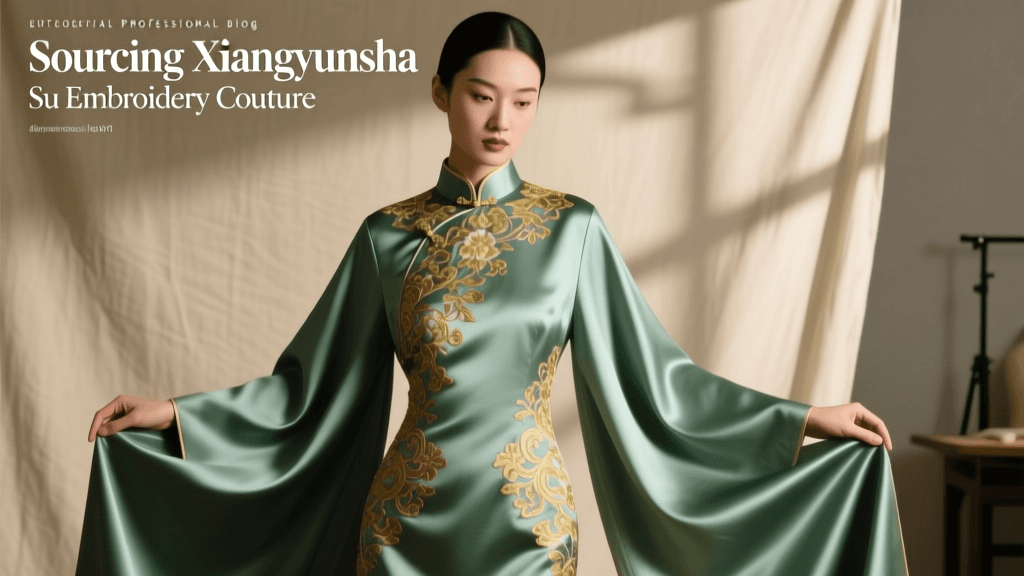
The Global Runway's Fascination with Authentic Chinese Textiles
For decades, international fashion houses relied on superficial 'Chinoiserie' motifs—printing generic dragons or pagodas onto standard European silks. Today, the landscape of global haute couture has shifted dramatically. Modern couturiers and independent designers are now looking directly to the source, integrating authentic, heritage-rich Chinese textiles into their collections. This movement is not merely about aesthetic appropriation; it is a profound appreciation for the structural and material innovation inherent in traditional Chinese craftsmanship.
Designers who study the historical silhouettes preserved by institutions like the Metropolitan Museum of Art's Asian Art department understand that the true luxury of Chinese fashion lies in its textiles. Two materials have emerged as the undisputed darlings of the modern couture atelier: Xiangyunsha (Gambiered Canton Gauze) and Su (Suzhou) Embroidery. Integrating these materials requires more than just a creative eye; it demands a rigorous understanding of sourcing logistics, material behavior, and specialized tailoring techniques.
Understanding Xiangyunsha (Gambiered Canton Gauze)
Xiangyunsha, often translated as 'fragrant cloud silk,' is a highly specialized textile originating from the Foshan region in Guangdong province. It is created through a grueling, weather-dependent process that involves dyeing raw silk with the tannin-rich juice of the shoulang (gambier) yam, followed by repeated applications of iron-rich river mud. This chemical reaction creates a unique, dual-toned fabric: one side is a deep, lustrous black with a leathery texture, while the reverse remains a warm, earthy brown.
The craftsmanship behind this textile is so vital to cultural history that the broader practices of Chinese silk production are safeguarded on the UNESCO Intangible Cultural Heritage list. On the runway, Xiangyunsha is prized for its sculptural qualities. Unlike fluid charmeuse or chiffon, Xiangyunsha holds its shape, making it ideal for architectural draping, structured bodices, and dramatic, gravity-defying capes.
Sourcing Specifications, Costs, and Timelines
For independent couturiers and fashion houses looking to source authentic Xiangyunsha, direct relationships with workshops in Foshan are essential. Here is what you need to know for your production calendar:
- Cost: Authentic, hand-dyed Xiangyunsha typically ranges from $80 to $150 USD per meter, depending on the base silk weight and the complexity of the jacquard weave.
- Minimum Order Quantity (MOQ): Most heritage workshops require an MOQ of one full bolt, which traditionally measures 15 meters in length with a width of 140 cm.
- Lead Times: Because the sun-baking and mud-dyeing process can only occur during specific sunny, dry months (typically from April to October), lead times are extensive. Expect a 6 to 9 month turnaround from commission to delivery.
- Weight: Couture-grade Xiangyunsha usually ranges from 20 to 30 momme, providing a substantial hand-feel without excessive heaviness.
Mastering Su Embroidery for Couture Applications
While Xiangyunsha provides structural drama, Su Embroidery (Suzhou Embroidery) offers unparalleled microscopic detail. Originating from Suzhou in Jiangsu province, this technique is famous for its 'split-thread' method, where a single strand of silk is split into 16, 32, or even 48 finer filaments. This allows artisans to create gradients and textures that mimic brushstrokes or photographic realism.
Historical examples of these meticulous techniques can be studied through the extensive archives of the Victoria and Albert Museum's Asian collections, which highlight the evolution of silk thread manipulation. In modern haute couture, Su embroidery is rarely used to cover an entire garment due to its weight and cost. Instead, it is strategically applied to illusion tulle or silk organza panels, creating 'floating' motifs that wrap around the collarbone, cascade down a sleeve, or frame a bodice.
Commissioning Custom Embroidery Panels
Integrating Su embroidery into a couture collection requires treating the embroidery studio as a co-creator rather than a simple supplier.
- Design Translation: Provide your atelier in Zhenhu (the embroidery hub of Suzhou) with high-contrast vector files or watercolor paintings. Artisans need clear guidance on color gradients and directional flow.
- Cost: Pricing is calculated by stitch density and thread thickness. A standard 30x30 cm panel using medium-density stitching will cost between $400 and $800 USD. Ultra-fine, double-sided embroidery (Shuangmianxiu) can exceed $3,000 USD per panel.
- Lead Times: A single artisan working full-time can complete a moderately complex bodice panel in 3 to 4 months. Plan your sampling phase accordingly.
Material Comparison Chart for Couture Integration
When designing a collection that blends traditional Chinese textiles with Western tailoring, it is crucial to understand how different fabrics behave on the dress form. Below is a comparison of Xiangyunsha against other popular heritage textiles.
| Textile | Weight (momme) | Drape Quality | Cost per Meter (USD) | Best Couture Application |
|---|---|---|---|---|
| Xiangyunsha | 20 - 30 | Sculptural, crisp, leathery | $80 - $150 | Structured gowns, capes, corsetry |
| Song Brocade | 25 - 40 | Heavy, stiff, ornate | $120 - $250 | Outerwear, tailored jackets, trains |
| Su Embroidered Organza | 12 - 16 | Fluid, delicate, sheer | $500+ (per panel) | Overlay skirts, illusion bodices |
| Yun Brocade | 30 - 50 | Rigid, metallic, opulent | $200 - $400 | Statement collars, cuffs, bodices |
Practical Tailoring and Draping Techniques
Working with these heritage materials requires abandoning standard sewing room practices. Xiangyunsha, due to its mud-dyed coating, behaves somewhat like a lightweight leather mixed with crisp taffeta. Standard universal needles will cause puckering and leave permanent holes. Couturiers must use Microtex needles (size 60/8 or 70/10) and a Teflon or roller presser foot to ensure the fabric feeds evenly without sticking to the machine bed. Stitch lengths should be kept short, around 2.0 to 2.5 mm, to maintain seam integrity on bias cuts.
When pressing Xiangyunsha, never apply an iron directly to the black, mud-dyed side, as the heat can dull the lustrous finish or cause the coating to crack. Always use a low-heat setting with a heavy cotton press cloth, and press on the reverse brown side whenever possible. For draping, Xiangyunsha excels in origami-inspired folds and pleated architectures. It will not drape softly over the hip like a bias-cut charmeuse; instead, it should be manipulated into structured cowls or geometric peplums.
Su embroidery panels require a different approach. Because the embroidery process pulls and distorts the base fabric, the embroidered organza or tulle must be block-pressed and stabilized before cutting. In the atelier, it is standard practice to back the embroidered panel with a layer of silk organza using a loose, hand-basted grid. This prevents the intricate stitches from bearing the structural weight of the garment's seams. When finishing the edges of an embroidered panel, avoid standard serging; instead, use a micro-rolled hem or bind the edges with a delicate bias strip of habotai silk to preserve the illusion of the floating motif.
Conclusion
The integration of Xiangyunsha and Su embroidery into international haute couture represents a maturation of global fashion design. It moves beyond pastiche into a realm of deep material respect and technical mastery. By understanding the rigorous sourcing timelines, the precise costs, and the specialized tailoring requirements of these textiles, modern designers can create garments that are not only visually breathtaking but also carry the weight of centuries of unparalleled craftsmanship. As the runway continues to globalize, the designers who succeed will be those who take the time to master the ancient looms and needles of the East.