Su Embroidery: Silk Textile Arts in Hanfu and Qipao
The Pinnacle of Silk Textile Arts: Understanding Su Embroidery
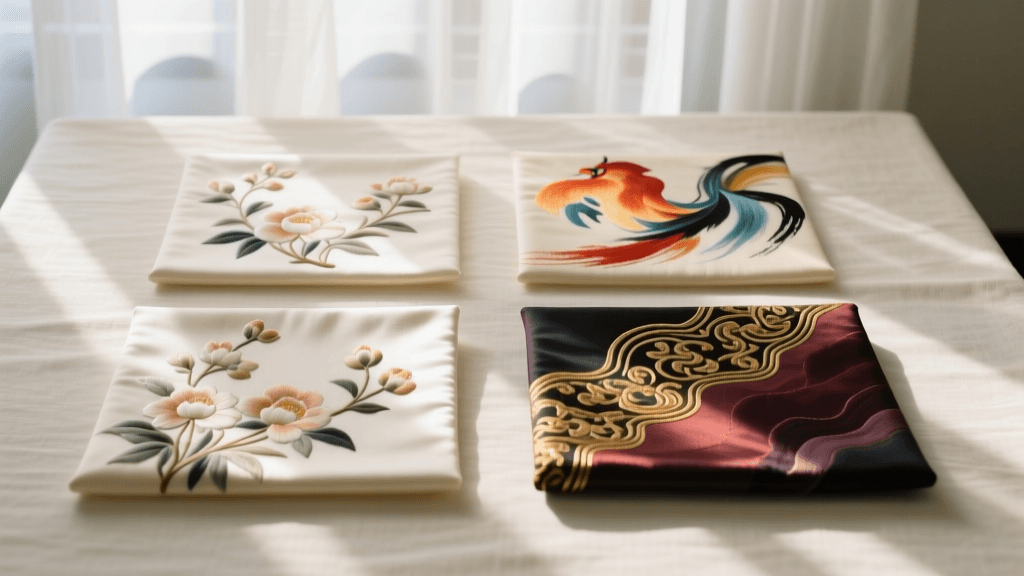
When discussing the zenith of Asian textile traditions, few crafts command as much reverence as Su embroidery (Suzhou embroidery). Originating from the lush, silk-producing region of Suzhou in Jiangsu province, this meticulous art form boasts a history spanning over 2,000 years. Su embroidery is celebrated for its delicate needlework, elegant color palettes, and the astonishing ability to render photorealistic imagery using nothing but silk threads. According to the Victoria and Albert Museum, Chinese silk embroidery represents one of the most sophisticated textile traditions in global history, with Suzhou serving as its undisputed epicenter during the Ming and Qing dynasties.
For modern enthusiasts of traditional Chinese clothing, integrating authentic Su embroidery into Hanfu and Qipao garments elevates a piece from mere apparel to wearable fine art. However, navigating the world of bespoke silk embroidery requires an understanding of thread manipulation, regional variations, and the economics of handcrafted textiles. This guide provides a comprehensive, actionable look at how Su embroidery intersects with traditional garment making, offering practical advice for collectors, designers, and cultural preservationists.
The Technical Mastery: Splitting the Silk Thread
The defining characteristic of Su embroidery is the artisan's ability to split a single strand of mulberry silk thread into multiple, microscopic filaments. A standard silk thread can be split into two, four, eight, sixteen, and in the most masterful cases, up to forty-eight individual strands. This technique, known as Pi Si (splitting silk), allows embroiderers to create imperceptible color gradients and capture the subtle play of light on a bird's feather or a koi fish's scale.
When commissioning a high-end Qipao or a Hanfu cloud shoulder (Yunjian), the density of the stitch and the thickness of the thread dictate both the visual outcome and the cost. A master artisan utilizing 1/48th split silk for a double-sided embroidery piece (Shuang Mian Xiu) might spend six months on a single 40cm panel, resulting in a textile where the front and back display identical, flawless imagery with no visible knots.
The Four Great Embroideries of China
While Su embroidery is the most famous, it is part of a broader tapestry of Chinese textile arts. Understanding how Su compares to other regional styles is crucial when selecting motifs for traditional garments.
| Embroidery Style | Region | Key Characteristics | Best Garment Application |
|---|---|---|---|
| Su (Suzhou) | Jiangsu | Ultra-fine split silk, realistic shading, elegant and subdued color palettes. | Qipao panels, Hanfu cloud shoulders, delicate sleeves. |
| Xiang (Hunan) | Hunan | Strong contrasts, use of black and white, prominent use of lion and tiger motifs. | Statement outerwear, theatrical costumes, bold Tangzhuang. |
| Yue (Guangdong) | Guangdong | Vibrant colors, use of gold and silver threads, highly textured 3D stitching. | Qipao hems, bridal Kwa skirts, ceremonial Hanfu borders. |
| Shu (Sichuan) | Sichuan | Soft satin stitches, floral and nature motifs, often featuring pandas and koi. | Everyday Hanfu skirts, Changshan lapels, silk robes. |
Integrating Su Embroidery into Hanfu and Qipao Design
Hanfu: The Yunjian and Mamian Qun
In the contemporary Hanfu revival movement, the Yunjian (cloud shoulder) and the Mamian Qun (horse-face skirt) are prime canvases for Su embroidery. A traditional Yunjian typically measures 40cm to 50cm in diameter, resting symmetrically over the shoulders. Artisans often employ the Luantan (seed stitch) technique here, using slightly thicker split threads to create a textured, raised effect that mimics the layered feathers of a phoenix or the scales of a dragon. For the Mamian Qun, embroidery is usually concentrated on the flat front and back panels (the 'horse faces'), leaving the pleated sides unembroidered to maintain the skirt's structural drape.
Qipao: Hemlines and the Art of the Border
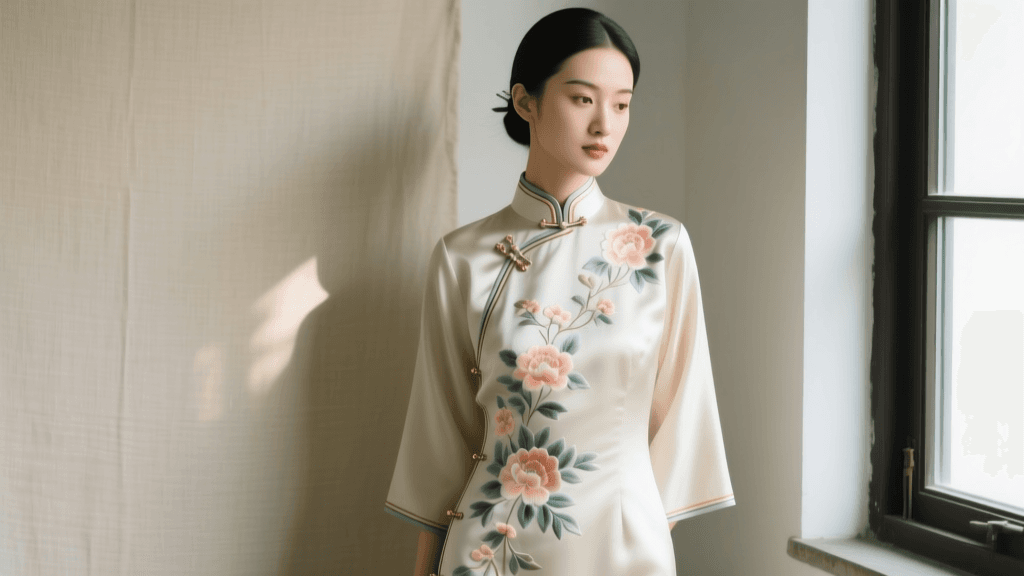
The modern Qipao (Cheongsam) relies heavily on the placement of embroidery to guide the eye and flatter the silhouette. Rather than covering the entire garment, master tailors utilize Su embroidery along the hemline, the side slits, and the Mandarin collar. A popular technique is the Shui Lu (water and land) border, where floral motifs seem to grow organically from the bottom hem upward, fading out via increasingly thinner silk threads. This requires the embroiderer to work directly onto the cut silk charmeuse or brocade before the garment is assembled, ensuring the pattern aligns perfectly across the side seams.
Actionable Guide: Commissioning Custom Silk Embroidery
For designers, collectors, or brides seeking bespoke embroidered traditional garments, understanding the economics and logistics of commissioning is essential. Below is a practical breakdown of what to expect when ordering custom Su embroidery for your garments.
Cost and Timeline Estimates
- Qipao Hem Panel (Approx. 50cm x 70cm): Using standard 1/4 to 1/8 split silk with a floral motif. Timeline: 4 to 8 weeks. Cost: $400 to $800 USD (labor only, excluding base fabric).
- Hanfu Cloud Shoulder (45cm diameter): Intricate double-sided embroidery using 1/16 split silk, featuring a traditional peony and butterfly motif. Timeline: 3 to 5 months. Cost: $1,200 to $2,500 USD.
- Full Mamian Qun Panels (Two 35cm x 90cm panels): Dense satin stitch with metallic thread accents. Timeline: 6 to 9 months. Cost: $3,000 to $6,000+ USD.
Sourcing Authentic Materials
True Su embroidery must be executed on high-grade mulberry silk (Bombyx mori). The sericulture and silk craftsmanship of China is so vital to global heritage that it is officially recognized by the UNESCO Intangible Cultural Heritage list. When commissioning a piece, explicitly request 'Suzhou silk base' and 'mulberry silk threads.' Synthetic rayon or polyester blends, often marketed as 'art silk,' will not accept the microscopic splitting required for high-end Su embroidery and will degrade the historical accuracy of a Hanfu or Qipao.
Preservation and Care for Embroidered Silk Garments
Silk is a protein fiber, making it highly susceptible to environmental damage, UV degradation, and improper cleaning. An embroidered Hanfu or Qipao is an investment that requires meticulous care.
- Cleaning: Never hand-wash or machine-wash heavily embroidered silk. The tension of the embroidery threads can cause the base fabric to pucker when wet. Always seek a dry cleaner who specializes in historical textiles or haute couture. Inform them of the metallic threads, which can tarnish if exposed to harsh chemical solvents.
- Storage: Never hang an embroidered Mamian Qun or heavy Qipao on a wire or thin wooden hanger; the weight of the embroidery will distort the silk grain over time. Store garments flat in archival-quality, acid-free tissue paper. Stuff the embroidered motifs with extra tissue to prevent the threads from being crushed.
- Environment: Maintain a storage environment with a relative humidity of 45-55% and a temperature around 65°F (18°C). Direct sunlight will fade the natural silk dyes within months.
- Ironing: If pressing is necessary, use a low-heat silk setting and always place a clean, undyed cotton pressing cloth between the iron and the garment. Never iron directly over the raised embroidery threads, as this will flatten the Luantan stitches and ruin the three-dimensional texture.
The Philosophical Aesthetic of the Silk Thread
'The needle is the brush, the silk thread is the ink, and the fabric is the paper. In Su embroidery, we do not merely decorate a garment; we capture the breath and spirit of nature, freezing a single, perfect moment in time upon the silk.'
— Traditional Suzhou Embroidery Proverb
The intersection of Su embroidery and traditional Chinese garments is a testament to the patience and philosophical depth of Asian textile arts. As noted by the Metropolitan Museum of Art, the Silk Road was not just a conduit for trade, but a highway for the exchange of aesthetic ideals, with silk serving as the ultimate medium for cultural expression. Today, whether adorning the sweeping pleats of a Ming-dynasty inspired Hanfu or the sleek, modern silhouette of a Shanghai Qipao, Su embroidery remains a living, breathing art form. By understanding its techniques, respecting its economics, and preserving its delicate threads, modern wearers become active participants in a 2,000-year-old legacy of unparalleled craftsmanship.