Su Embroidery: The Silk Art Elevating Hanfu and Qipao
The Legacy of Su Embroidery in Chinese Textile Arts
When exploring the rich tapestry of Asian traditions, few textile arts command as much reverence as Su Embroidery (Suxiu). Originating in the water towns of Suzhou, Jiangsu province, this meticulous craft boasts a history spanning over 2,000 years. As one of the Four Major Embroideries of China—alongside Xiang (Hunan), Shu (Sichuan), and Yue (Guangdong)—Su embroidery is celebrated for its delicate patterns, elegant colors, and astonishingly fine needlework. The cultural significance of this craft is so profound that the broader traditions of Chinese sericulture and silk craftsmanship have been officially recognized by the UNESCO Intangible Cultural Heritage list.
Historically, Su embroidery was reserved for imperial dragon robes and the luxurious garments of the aristocracy. Today, it serves as the ultimate embellishment for traditional Chinese clothing, breathing life into modern revivals of Hanfu and the timeless elegance of the Qipao (Cheongsam). According to historical textile archives at the Metropolitan Museum of Art, the integration of fine silk stitching into daily and ceremonial wear reflects a deep-seated cultural philosophy where clothing is not merely functional, but a canvas for auspicious symbolism and artistic mastery.
Core Techniques: The Science of Split Silk
What separates Su embroidery from other global textile arts is the unparalleled fineness of its needlework. Master artisans utilize a technique known as 'splitting the silk.' A single strand of silk thread is composed of multiple microscopic filaments. Depending on the required detail, an artisan will split this single thread into halves, quarters, eighths, or even 1/48th of its original thickness.
- Pingyao (Even Embroidery): The foundational stitch where threads are laid flat and evenly, creating a smooth, glossy surface that catches the light. Ideal for large floral motifs on Qipaos.
- Luandian (Chaotic Stitch): A complex, intersecting stitch used to create texture. It is heavily utilized to mimic the fur of animals or the rugged bark of pine trees.
- Double-Sided Embroidery (Shuangmian Xiu): A breathtaking technique where the garment or screen displays a perfect, identical image on both the front and back, with all knotting and thread ends hidden within the stitches.
For haute couture Hanfu and Qipao, artisans typically use 1/16th or 1/32nd split threads for delicate elements like the stamen of a peony or the scales of a koi fish, ensuring the embroidery lies flush against the silk base without adding bulky stiffness.
Integrating Su Embroidery into Hanfu
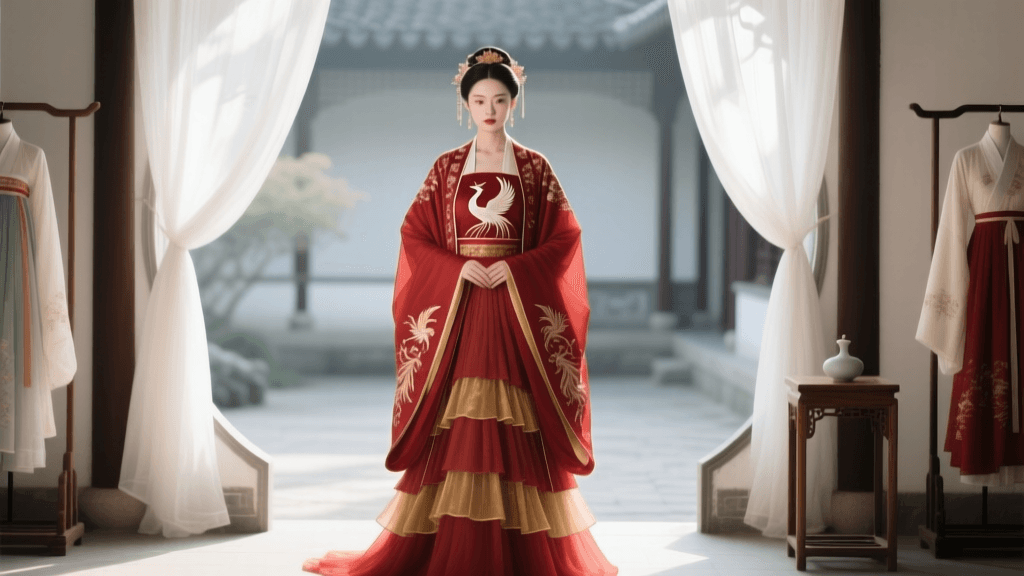
The modern Hanfu movement has sparked a massive resurgence in demand for historically accurate, hand-embroidered garments. The most iconic application of Su embroidery in Hanfu is the Mamianqun (Horse-face skirt).
Sizing and Placement for the Mamianqun
A traditional Mamianqun requires 4 to 6 meters of silk to achieve the proper volume. The skirt features flat panels at the front and back, with deep pleats on the sides. Su embroidery is traditionally applied to the lan (the decorative borders at the hem and waist).
- Pleat Width: Standard historical pleats range from 3cm to 5cm. Embroidery should never cross the fold of a pleat, as this distorts the pattern and damages the silk threads during movement.
- Hem Border (Lan): A 15cm to 20cm wide embroidered border at the hem is standard. For a luxurious look, buyers should request a 19-momme or 22-momme mulberry silk base to support the weight of dense metallic and silk thread work.
- Motifs: Auspicious motifs like the 'hundred butterflies,' 'lotus and crab' (symbolizing harmony), or 'plum blossoms' are woven into the borders.
Ruqun and Banbi (Jackets)
For upper garments like the Banbi (half-sleeve jacket) or Dahu, embroidery is typically concentrated on the collar edges, cuffs, and chest panels. Because these areas experience high friction, artisans use a slightly thicker thread split (1/8th) and reinforce the back of the embroidery with a lightweight silk organza backing to prevent tearing.
The Qipao and Suzhou Silk: A Perfect Match
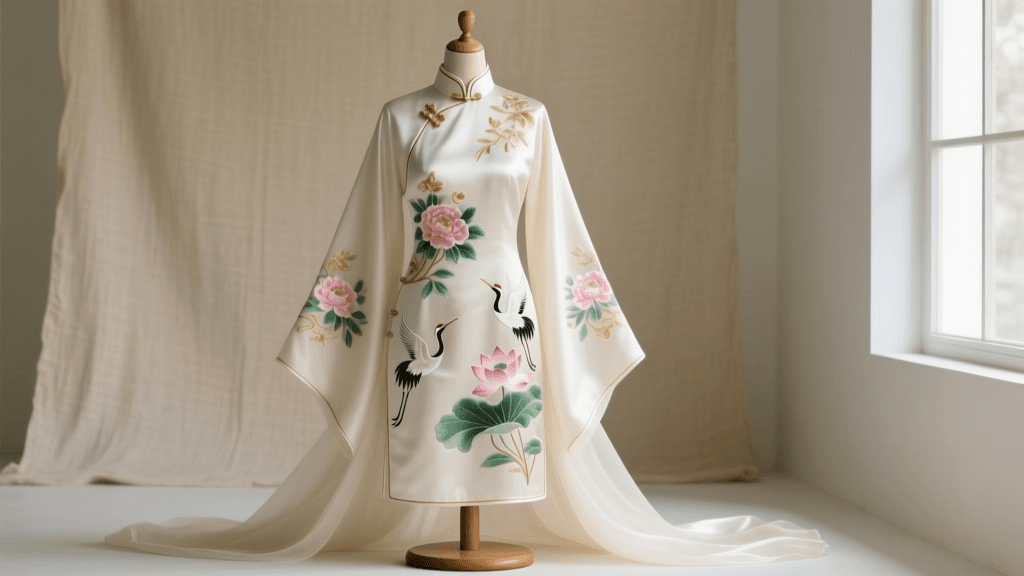
While Hanfu relies on volume and draping, the Qipao (Cheongsam) is an exercise in tailored precision. Su embroidery elevates the Qipao from a simple dress to a wearable masterpiece. The base fabric is crucial; master tailors prefer Xiangyunsha (Gambiered Canton Gauze) or high-grade Silk Crepe de Chine.
Custom Tailoring and Embroidery Placement
When commissioning a custom Su-embroidered Qipao, the placement of the art is just as important as the stitching itself. Unlike Western garments where patterns are cut and sewn haphazardly, a master tailor will map the embroidery onto the fabric before the garment is cut.
- The Collar: A standard high collar measures 3.5cm to 4.5cm. Embroidery here must be low-profile (using 1/32nd split silk) to prevent scratching the jawline and neck.
- The Diagonal Flap (Dajin): The most common canvas for Su embroidery. A sweeping branch of magnolia or a pair of swallows is often stitched to follow the curve of the frog closures (Pankou).
- Hand-Rolled Hems: A true luxury Qipao features hand-rolled hems. The embroidery must stop exactly 2cm before the hemline to allow the tailor to roll the silk edge seamlessly.
Practical Guide: Buying and Commissioning Garments
Investing in hand-embroidered traditional Chinese clothing requires an understanding of market costs, production timelines, and fabric weights. Below is a structured comparison to help buyers plan their commissions.
| Garment Type | Base Fabric Recommendation | Embroidery Coverage | Estimated Cost (USD) | Production Time |
|---|---|---|---|---|
| Mamianqun (Hanfu) | 100% Mulberry Silk (16-19 momme) | 15-20% (Borders/Lan) | $450 - $1,800 | 6 - 10 Weeks |
| Custom Qipao | Silk Crepe de Chine or Xiangyunsha | 10-30% (Motifs) | $1,200 - $4,500+ | 8 - 16 Weeks |
| Tangzhuang Jacket | Silk Brocade or Jacquard | 5-10% (Cuffs/Collar) | $300 - $800 | 4 - 6 Weeks |
| Hanfu Banbi (Jacket) | Silk Satin or Damask | 20-40% (Chest/Back) | $350 - $1,200 | 5 - 8 Weeks |
Note: Prices reflect authentic hand-embroidery by skilled artisans in Suzhou. Machine-embroidered alternatives are widely available for 20% of the cost but lack the luminous depth and split-silk finesse of genuine Suxiu.
Care and Conservation of Embroidered Silk
Silk is a protein fiber, making it highly sensitive to environmental factors, pH levels, and friction. Proper care is essential to preserve both the base fabric and the intricate embroidery. Conservation guidelines from institutions like the Victoria and Albert Museum emphasize the following actionable steps for collectors and wearers:
Cleaning Protocols
- Never Machine Wash: The agitation will snap the microscopic split-silk threads and cause the base silk to pucker.
- Dry Cleaning vs. Hand Washing: While dry cleaning is standard, ensure the cleaner uses a gentle, silk-safe solvent. If hand-washing a lined Hanfu skirt, use cold water and a strictly pH-neutral silk detergent (like Eucalan). Never wring the fabric; instead, roll it in a clean cotton towel to absorb moisture.
Storage and Preservation
- Avoid Camphor and Mothballs: Traditional mothballs contain chemicals that react with silk proteins, causing irreversible yellowing, particularly on white and pastel Su embroidery threads.
- Use Acid-Free Tissue: When storing a Mamianqun or Qipao, stuff the folds and sleeves with acid-free, unbuffered tissue paper to maintain the garment's shape and prevent hard creases that can snap the silk fibers over time.
- Cedar Blocks: Use natural cedar blocks for pest deterrence, but ensure they do not touch the silk directly, as cedar oils can stain the fabric.
- Light Exposure: Silk dyes, especially the vibrant natural dyes used in traditional Su embroidery, are highly photosensitive. Store garments in opaque, breathable cotton garment bags away from direct sunlight.
'A single stitch can hold a universe; a split thread can capture the soul of a koi.' — Suzhou Artisan Proverb
Conclusion
Su Embroidery is far more than a decorative afterthought; it is the beating heart of luxury Asian textile arts. Whether it is the sweeping, structured borders of a Hanfu Mamianqun or the intimate, tailored curves of a silk Qipao, Suzhou needlework transforms garments into heirlooms. By understanding the technical mastery of split silk, making informed choices about fabric weights and motif placement, and adhering to strict conservation practices, modern wearers can honor and preserve this magnificent 2,000-year-old tradition for generations to come.