Su Embroidery Guide: Hanfu and Qipao Textile Arts
The Legacy of Su Embroidery in Chinese Silk Textiles
Suzhou embroidery, universally known as Su Xiu, represents the pinnacle of Chinese textile arts and silk craftsmanship. Originating in the Jiangnan region over 2,000 years ago, this meticulous needlework has historically adorned the garments of royalty, scholars, and the elite. Today, as the global revival of traditional Chinese clothing gains momentum, Su embroidery has found a vibrant new life in the creation of bespoke Hanfu and the elegant, form-fitting Qipao (Cheongsam). Understanding the intricacies of this craft is essential for collectors, fashion historians, and enthusiasts looking to invest in authentic Asian traditions.
The essence of Su embroidery lies in its ability to mimic the fluid brushstrokes of traditional Chinese ink wash paintings. According to the The Metropolitan Museum of Art's Heilbrunn Timeline of Art History, Chinese silk weaving and embroidery have long been intertwined with the cultural and economic fabric of the empire, serving not only as domestic adornment but as vital diplomatic gifts along the Silk Road. When applied to traditional garments, Su embroidery elevates the silk canvas into a wearable masterpiece.
The Four Great Embroideries of China
To appreciate Su embroidery, one must understand its place among the 'Four Great Embroideries' of China. While each regional style boasts unique characteristics, Su Xiu is distinctly celebrated for its delicacy and elegance.
| Embroidery Style | Region | Key Characteristics | Common Garment Applications |
|---|---|---|---|
| Su (Suzhou) | Jiangsu | Delicate, elegant, flat surfaces, painting-like gradients, extremely fine silk splitting. | Bespoke Qipao, Hanfu Aoqun, Mamianqun hems. |
| Xiang (Hunan) | Hunan | Vibrant colors, realistic shading, famous for double-sided embroidery with different colors on each side. | Decorative screens, ceremonial jackets. |
| Shu (Sichuan) | Sichuan | Rich, saturated colors, thick satin stitches, folk motifs, often uses gold and silver threads. | Theatrical costumes, heavy winter Hanfu cloaks. |
| Yue (Guangdong) | Guangdong | Intricate, dense patterns, heavy use of metallic threads, three-dimensional relief effects. | Qungua (traditional wedding dresses), ceremonial robes. |
The Anatomy of a Silk Thread: Splitting and Stitches
The true magic of Su embroidery is not just in the design, but in the preparation of the silk thread. A single strand of raw silk is remarkably strong, but to achieve the photorealistic or painterly effects required for high-end Hanfu and Qipao, artisans must split the thread. A master embroiderer can split a single silk filament into 1/16, 1/32, or even 1/64 of its original thickness. This microscopic splitting allows for imperceptible color blending, enabling the creation of a koi fish scale or a peony petal that appears to possess genuine depth and shadow.
Artisans utilize over 40 distinct stitching techniques. The most prominent include:
- Pingzhen (Flat Stitch): Used for large, smooth areas like leaves and petals. The stitches lie perfectly flat, catching the light uniformly to give the silk a luminous sheen.
- Taozhen (Overlapping Stitch): Stitches overlap in alternating layers, creating a seamless gradient. This is crucial for rendering the subtle blush on a plum blossom or the scales of a dragon.
- Dazi (Seed Stitch): Tiny, knotted stitches used for the stamens of flowers or the eyes of birds, adding a tactile, three-dimensional element to the flat silk canvas.
Integrating Su Embroidery into Modern Hanfu
The modern Hanfu movement has sparked a renaissance in traditional textile arts. When commissioning or purchasing an embroidered Hanfu ensemble, the placement and density of the embroidery dictate both the aesthetic and the cost. The most popular garments for Su embroidery are the Mamianqun (horse-face skirt) and the Aoqun (a lined jacket paired with a skirt).
The Mamianqun (Horse-Face Skirt)
A traditional Mamianqun requires approximately 3.5 to 4 meters of heavy silk satin or jacquard brocade to achieve the proper pleating and swing. The embroidery is typically concentrated on the 'lan' (the decorative borders at the hem and waist). A fully hand-embroidered hem featuring motifs like the 'Hundred Birds Paying Homage to the Phoenix' or intricate lotus scrolls requires between 60 to 120 hours of painstaking labor. Because the hem takes the most physical stress, artisans often reinforce the back of the embroidered silk with a lightweight cotton or silk organza backing to prevent the delicate threads from snagging.
The Ao (Jacket)
The Ao, particularly the cross-collared or standing-collared styles popular in the Ming Dynasty revival, serves as a prime canvas for shoulder and cuff embroidery. Su embroidery on an Ao is usually asymmetrical or framed within the collar bands. The silk base is often a crepe or damask, which provides a subtle texture that contrasts beautifully with the high-sheen embroidery threads.
The Qipao: Silk Canvas and Asymmetrical Art
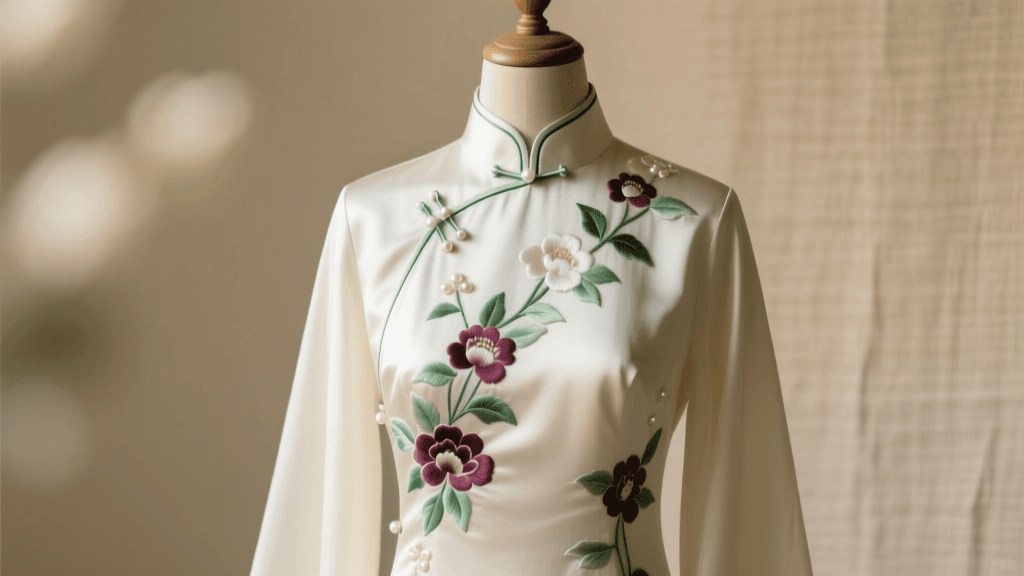
While Hanfu relies on voluminous layers and structural pleats, the Qipao (Cheongsam) is a masterclass in tailoring and negative space. Emerging in its modern form in 1920s Shanghai, the Qipao clings to the body, meaning any embroidery must follow the natural curves of the wearer. According to the Victoria and Albert Museum (V&A) Chinese Textiles Collection, the evolution of the Qipao reflects a fascinating blend of traditional Chinese motifs and Western sartorial tailoring.
For high-end bespoke Qipaos, Su embroidery is rarely used to cover the entire garment, as heavy embroidery can stiffen the silk and ruin the drape. Instead, artisans employ 'asymmetrical corner embroidery.' A cascade of hand-embroidered wisteria or orchids might begin at the left shoulder, trailing down across the bust and fading out near the right hip. This technique draws the eye vertically, elongating the silhouette. The preferred fabrics for embroidered Qipaos are heavy silk crepe de chine or silk velvet, as their matte or deeply textured backgrounds allow the glossy Su embroidery threads to pop dramatically.
Buyer’s Guide: Costs, Measurements, and Timing
Investing in authentic, hand-embroidered traditional garments requires an understanding of the market. Machine embroidery has flooded the market, making it vital to know what to expect when commissioning genuine Su Xiu.
| Garment Type | Silk Fabric Required | Embroidery Time (Hand) | Estimated Bespoke Cost (USD) |
|---|---|---|---|
| Mamianqun (Skirt) | 3.5 - 4.0 meters | 60 - 120 hours | $600 - $1,500+ |
| Hanfu Ao (Jacket) | 2.0 - 2.5 meters | 40 - 80 hours | $400 - $900 |
| Bespoke Qipao | 2.0 - 2.5 meters | 80 - 150 hours | $1,000 - $3,000+ |
| Embroidered Shawl/Cape | 1.5 - 2.0 meters | 50 - 90 hours | $500 - $1,200 |
Note: Costs vary wildly based on the complexity of the motif, the fineness of the silk splitting (e.g., 1/32 vs 1/16 thread), and the reputation of the artisan or atelier. Garments recognized by the UNESCO Intangible Cultural Heritage lists or crafted by provincial-level masters will command premium auction-level prices.
How to Authenticate Genuine Su Embroidery
As demand for Hanfu and Qipao grows, so does the prevalence of computerized machine embroidery. To ensure you are purchasing authentic handcrafted Su embroidery, examine the following details:
- The Reverse Side: Turn the fabric over. Machine embroidery often features a continuous, messy web of connecting threads (jump stitches) between disparate motifs, or a thick layer of white bobbin thread. Genuine hand embroidery will have a remarkably clean reverse side, with threads only appearing where the stitch is actively meant to be.
- Color Gradients: Look closely at a single flower petal. Machine embroidery achieves gradients by placing blocks of different colored threads next to each other. Hand-embroidered Su Xiu uses split threads to blend colors at the filament level, creating a seamless, photographic transition that machines cannot replicate.
- Thread Direction and Light: Hand embroidery follows the natural 'grain' or growth direction of the subject (e.g., stitches will curve along the spine of a leaf). When you tilt the garment in the light, the silk should shimmer dynamically. Machine stitches are often uniform in length and direction, resulting in a flat, static reflection.
Care and Preservation of Silk Embroidery
Silk is a protein fiber, making it highly susceptible to damage from alkaline detergents, direct sunlight, and moisture. Never wash a hand-embroidered Hanfu or Qipao at home. Water can cause the silk threads to bleed or shrink at different rates than the base fabric, causing the embroidery to pucker. Always seek a professional dry cleaner who specializes in vintage textiles or traditional Asian garments. When storing, avoid wire hangers which can distort the shoulder seams of a Qipao or the collar of an Ao. Instead, fold the garments carefully with acid-free tissue paper to cushion the embroidered panels, and store them in a breathable cotton garment bag in a cool, dark environment. By respecting the craftsmanship and providing proper care, these exquisite textile arts can be preserved as heirlooms for generations to come.