Styling Hanfu for Chinese Mythological Deities: A Guide
The Intersection of Myth and Hanfu
The resurgence of traditional Chinese clothing, widely known as the Hanfu movement, has transcended mere historical reenactment. Today, enthusiasts and cosplayers are increasingly drawing inspiration from the rich tapestry of Chinese mythology and folklore. Translating celestial beings, ancient creators, and elemental deities into wearable garments requires a deep understanding of historical silhouettes, textile symbolism, and color theory. As noted in Encyclopædia Britannica's overview of Chinese mythology, these deities are deeply tied to natural elements, cosmic balance, and the philosophical concepts of Yin and Yang. When styling Hanfu for mythological figures, the goal is to harmonize historical accuracy with the ethereal, larger-than-life qualities attributed to these legends.
Key Deities and Their Signature Garments
To accurately portray a mythological figure, one must select the appropriate Hanfu silhouette that aligns with the era in which the myth was popularized or the elemental nature of the deity. Below is a breakdown of three iconic figures and how to style them.
Chang'e (Goddess of the Moon)
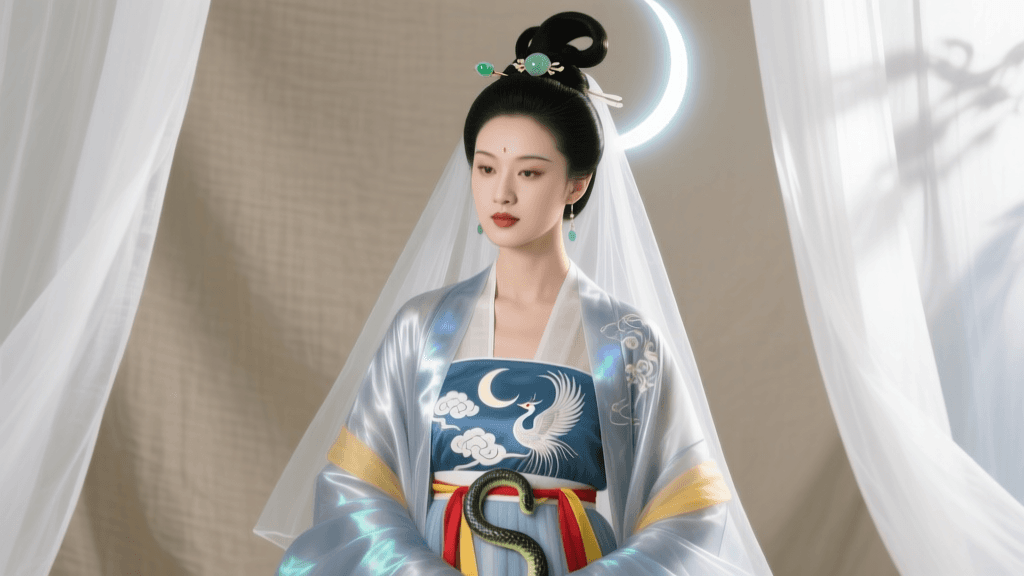
Chang'e, the immortal goddess who resides on the moon, is synonymous with grace, elegance, and the ethereal beauty of the Tang Dynasty. The ideal silhouette for Chang'e is the Qixiong Ruqun (chest-high skirt) paired with a flowing Pibo (silk ribbon or shawl). The chest-high skirt creates an elongated, statuesque silhouette that mimics the weightlessness of a celestial being. For the Pibo, choose a lightweight, translucent silk chiffon or organza that catches the wind, symbolizing her flight to the moon. Colors should reflect lunar imagery: moonlight silver, pale celadon, pearlescent white, and soft midnight blue. Embroidery motifs should feature osmanthus flowers, jade rabbits, and subtle lunar phases.
Nuwa (The Creator Goddess)
Nuwa, the mother goddess who created humanity and repaired the pillar of heaven, represents earth, creation, and primordial power. Unlike the delicate Tang aesthetics of Chang'e, Nuwa's styling should reflect the grounded, majestic silhouettes of the Han and Wei dynasties. The Shenyi (deep robe), which connects the upper and lower garments into one piece, is perfect for representing her unified, world-building nature. Alternatively, a heavily structured Mamianqun (horse-face skirt) from the Ming dynasty paired with an Ao (jacket) can convey her regal authority. Colors must be earthy and elemental: terracotta, deep jade green, ochre, and burnished gold. Motifs should include the five elements (Wu Xing), swirling clouds, and subtle serpent scales, honoring her mythological depiction with a serpent's tail.
The Dragon Kings (Longwang)
The Dragon Kings of the Four Seas command the waters and the weather. To portray Ao Guang or his brothers, the Yuanlingpao (round-collar robe) of the Ming Dynasty is the most authoritative choice. This robe, often worn with a leather or jade belt, projects imperial power and martial command. The fabric should be substantial, such as Song Brocade (Songjin) or heavy satin, to give the garment a commanding drape. The color palette is strictly aquatic and imperial: azure, deep sea blue, emerald, and metallic gold. The most critical design element is the Haishui Jiangya (water and wave motif) at the hem, featuring crashing waves and standing water, often interspersed with dragon scales and pearl motifs.
Fabric and Motif Selection Guide
Selecting the right textile is paramount in mythological styling. According to the Metropolitan Museum of Art, Chinese silk weaving has historically been imbued with deep symbolic meaning, where specific patterns and weaving techniques were reserved for divine or imperial representation. Below is a structured guide to matching fabrics and motifs with mythological archetypes.
| Deity Archetype | Recommended Garment | Primary Textiles | Key Motifs | Estimated Custom Cost (USD) |
|---|---|---|---|---|
| Celestial / Moon | Qixiong Ruqun + Pibo | Silk Chiffon, Organza, Crepe de Chine | Osmanthus, Jade Rabbit, Clouds | $120 - $250 |
| Creator / Earth | Shenyi or Aoqun | Raw Silk, Linen Blends, Cotton Sateen | Five Elements, Swirling Clouds | $180 - $350 |
| Aquatic / Dragon | Yuanlingpao | Song Brocade, Heavy Satin, Damask | Haishui Jiangya, Dragon Scales | $250 - $600 |
| Underworld / Judge | Feiyufu (Flying Fish) or Panlingpao | Dark Taffeta, Matte Silk, Velvet accents | Bats, Coins, Abstract Flames | $200 - $450 |
Practical Sourcing, Tailoring, and Budgeting
Bringing a mythological Hanfu vision to life requires careful planning, especially if you are aiming for convention-quality garments or professional photoshoots. Here is actionable advice for sourcing and commissioning your divine wardrobe.
Measurements and Fit
Mythological garments often rely on dramatic draping and precise layering. When ordering from Taobao artisans or independent Etsy tailors, you must provide exact measurements. Do not rely on standard S/M/L sizing. You will need:
- Upper Bust & Bust: Crucial for Qixiong Ruqun to ensure the chest-high skirt does not slip down during movement.
- Waist Circumference: Measured at the natural waist for Mamianqun and Aoqun skirts.
- Hollow-to-Hem: Measured from the hollow of your collarbone to the floor, while wearing the shoes you intend to use. Mythological skirts should ideally graze the top of your shoes to maintain an illusion of floating.
- Shoulder Width & Arm Length: Essential for the extended sleeves (Guangxiu) typical of deity robes, ensuring the fabric drapes elegantly past the fingertips.
Timing and Lead Times
Custom Hanfu, particularly those requiring intricate embroidery like the Dragon King's wave motifs, are made-to-order. If you are planning to debut your mythological Hanfu at a major event like the Xitang Hanfu Culture Week or a regional comic convention, you must place your order 90 to 120 days in advance. This accounts for the 30-45 days of tailoring, 15 days of quality control and revisions, and 30-45 days for international shipping and customs clearance.
Budgeting for the Complete Look
A common mistake is allocating the entire budget to the main garment and neglecting the underlayers and accessories. A complete mythological Hanfu budget should be divided as follows:
- Main Garment (Robe/Skirt/Jacket): 50% of total budget.
- Underlayers (Zhongyi/Zhongku): 15%. White or pale silk underlayers are mandatory for deities to provide contrast and volume.
- Footwear (Cloud Shoes/Boots): 10%. Traditional embroidered cloud shoes (Yunxie) or black leather court boots for male deities.
- Accessories (Hairpins, Belts, Jade): 25%. Divine styling requires elaborate headpieces.
Accessorizing the Divine
The evolution of these silhouettes and their accompanying adornments is well-documented in historical analyses of Chinese dress, where accessories denoted spiritual and social rank. For mythological styling, accessories are what elevate a historical garment to a divine costume.
Hair and Headpieces
For goddesses like Chang'e and Nuwa, the hair should be styled in elaborate updos such as the Feixian Ji (flying immortal bun). The centerpiece of the headpiece should be a Buyao (step-shake hairpin). For Chang'e, choose a Buyao featuring dangling pearls and silver moon rabbits that tremble with every step. For Nuwa, opt for gold and jade hairpins featuring abstract floral or serpent motifs. Male deities like the Dragon Kings require a Guan (crown or topknot cover), ideally crafted from dark wood, jade, or gold-toned metal, secured with a single, ornate hair stick.
Jade and Pendants
In Chinese mythology, jade is the stone of heaven, representing purity, moral integrity, and protection. No deity outfit is complete without a Jinbu (jade pendant assembly) hanging from the waist belt. For celestial deities, choose translucent, pale green or white nephrite jade carved into clouds or lotuses. For earth and water deities, deeper green or celadon jade carved into dragons, turtles, or mountains is appropriate. The rhythmic clinking of the jade beads as you walk is said to ward off evil spirits and announce the presence of a divine being.
Conclusion
Styling Hanfu for Chinese mythological deities is a profound exercise in cultural storytelling. By understanding the historical roots of the garments, selecting textiles that reflect the elemental nature of the deity, and investing in proper tailoring and accessories, you can bridge the gap between ancient folklore and modern wearable art. Whether you are stepping onto a convention floor or participating in a traditional festival, embodying these legends through authentic Hanfu ensures that the magic of Chinese mythology continues to flow through the fabric of contemporary culture.