Kimono Styling Guide for Every Body Type and Gender
The Evolution of Inclusive Kimono Fashion
The traditional Japanese kimono is often mistakenly viewed by outsiders as a rigid, one-size-fits-all garment bound by strict historical rules. However, as global interest in Japanese culture surges, the kimono industry is experiencing a renaissance of inclusivity. Today, wearers of all body types and gender identities are reclaiming this iconic garment, proving that its fundamental T-shaped structure is remarkably adaptable. According to the Metropolitan Museum of Art, the kimono's basic silhouette has remained largely unchanged since the Edo period, yet its styling, draping, and accessorizing have always been fluid enough to accommodate shifting societal norms and individual bodies.
Whether you are navigating a kimono rental shop in Kyoto's Higashiyama district or commissioning a custom piece from a Tokyo artisan, understanding how to manipulate the garment's flat planes to suit your unique dimensions is the key to achieving an elegant, comfortable fit. This guide breaks down the practical mechanics of kimono styling for diverse body types and explores the vibrant, gender-expansive movements reshaping modern Japanese fashion.
Decoding Kimono Measurements for the Perfect Fit
Unlike Western clothing, which is cut and sewn to mimic the curves of the human body, a kimono is constructed from straight bolts of fabric called tanmono. The fit is achieved entirely through the wrapping, folding, and tying process known as kitsuke. To find the right garment, you must understand three critical measurements:
- Mitake (Back Length): Measured from the base of the neck to the hem. For women, the ideal mitake is roughly equal to the wearer's height, allowing for the waist fold. Standard vintage women's kimono usually measure around 158cm to 162cm.
- Yuki (Sleeve Span): Measured from the center back of the neck, over the shoulder, and down to the wrist. A proper yuki ensures the sleeve falls gracefully without pulling at the shoulders or swallowing the hands.
- Haba (Width): The combined width of the front and back panels. Standard panels are about 36cm wide, meaning a standard kimono comfortably fits hips up to roughly 100cm before the front overlap (okumi) becomes too narrow.
Styling for Diverse Body Types
Petite Frames (Under 155cm)
For shorter individuals, a standard-length kimono will be far too long. The solution lies in the ohashori, the horizontal fold created at the waist when wrapping the garment. While standard dressing requires a 5cm to 7cm fold, petite wearers can take a much deeper ohashori, sometimes folding 15cm or more of fabric at the waist. This not only adjusts the hemline to sit perfectly at the ankle but also creates a visually elongating effect. To avoid being overwhelmed by fabric, petite wearers should opt for smaller, repeating patterns (komon) and narrower obi belts, such as the nagoya obi, tied in a compact bunko musubi (bow knot).
Tall Frames (Over 170cm)
Tall wearers face the opposite challenge: the dreaded "high-water" hemline. Because most vintage kimono were made for a population with a shorter average height, finding a sufficient mitake can be difficult. Tall individuals should seek out vintage Meiji or early Showa era garments, which were often cut longer. Alternatively, modern kimono brands now offer custom-length stretch polyester blends. If a tall wearer must use a standard-length kimono, the modern stylistic workaround is to intentionally wear the hem slightly higher, exposing the ankle and pairing the garment with modern footwear like leather boots or embellished sandals, a trend widely accepted in contemporary Tokyo street fashion.
Plus-Size and Curvy Bodies
The standard kimono's front overlap can be unforgiving on curvier figures, particularly around the hips and bust. If the hip measurement exceeds 110cm, the front panels may pull apart, exposing the undergarments. To solve this, professional dressers use a technique called machi-ire, where a matching panel of fabric is temporarily stitched or pinned into the side seams to add necessary width. For a more modern, accessible approach, many plus-size wearers opt for wari-fuku (two-piece kimono), which feature elasticized waistbands and wider cuts. When securing the obi, using a stretchy obi-jime (decorative cord) and a wider fukuro obi provides better support and distributes pressure more comfortably across the midsection.
Gender-Expansive and Non-Binary Kimono Styling
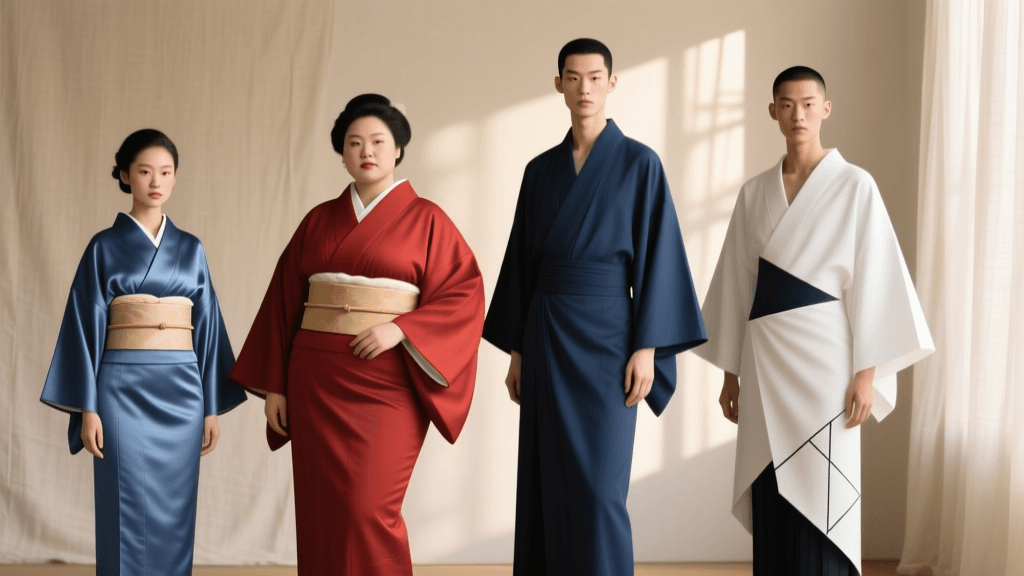
Historically, kimono were strictly divided into onna-mono (women's garments, characterized by deep back-neck drops, vibrant patterns, and long swinging sleeves) and otoko-mono (men's garments, featuring straight cuts, subdued colors, and snug necklines). Today, the rise of jendaresu (genderless) fashion in Japan has shattered these binaries. The Victoria and Albert Museum notes that while historical kimono denoted strict social and gender roles, contemporary wearers are increasingly treating the garment as a canvas for personal expression rather than a uniform of conformity.
Non-binary and gender-nonconforming wearers often find the straight, unstructured cut of the men's kimono to be highly flattering and comfortable, as it does not require the extensive padding traditionally used to create a cylindrical silhouette for women's kimono. A popular gender-expansive styling technique involves pairing a masculine, dark tsumugi (pongee silk) kimono with a brightly colored, feminine haori (jacket) and an unconventional obi tie, such as a draped scarf-style knot. This blending of sartorial codes allows wearers to curate an aesthetic that exists entirely outside the traditional gender binary.
Quick Reference: Styling Guide by Body and Gender
| Body/Gender Profile | Recommended Cut & Fabric | Ideal Obi Style | Avg. Rental Cost (USD) |
|---|---|---|---|
| Petite (Under 155cm) | Standard silk with deep ohashori fold | Bunko musubi (bow knot) | $35 - $50 |
| Tall (Over 170cm) | Vintage Meiji-era or modern custom stretch | Taiko musubi (drum knot) | $50 - $85 |
| Plus-Size / Curvy | Two-piece wari-fuku or added machi panel | Wide stretch obi with obi-jime cord | $45 - $75 |
| Masculine / Otoko-mono | Straight-cut tsumugi or wool, subdued tones | Kaku obi (stiff, narrow belt) | $30 - $60 |
| Non-Binary / Jendaresu | Mens cut with vibrant feminine haori jacket | Hybrid knot or draped scarf-style obi | $40 - $80 |
Navigating Rentals and Custom Purchases
For tourists and first-time wearers, renting is the most practical way to experience the kimono. The Japan National Tourism Organization (JNTO) highlights that rental shops in cultural hubs like Kyoto and Kanazawa are increasingly equipped to handle international visitors of diverse sizes. When booking a rental, it is crucial to communicate your height and hip measurements in advance. Most reputable shops carry a stock of "tall and plus-size" garments, but they require 48 hours' notice to prepare the correct tanmono and padding.
Rental packages typically cost between $35 and $85 USD and include the garment, obi, undergarments (juban), sandals (zori), and professional dressing services. For those looking to invest in a permanent piece, purchasing a vintage kimono from chains like Tansu-ya can cost as little as $30 to $150 USD, though these will likely require tailoring or creative styling to fit non-standard body types. Custom, newly woven silk kimono remain a luxury investment, starting around $800 USD and easily exceeding $3,000 USD for formal, hand-painted furisode or kurotomesode.
Ultimately, the kimono is a masterclass in the art of draping. By understanding the mechanics of the fold, the drape of the sleeve, and the tie of the obi, anyone—regardless of their height, weight, or gender identity—can wear this magnificent garment with confidence, comfort, and profound respect for its enduring legacy.