Kimono Fashion History: Heian Court to Edo Dynasty
Introduction to Japanese Dynasty Fashion
The evolution of Japanese traditional clothing is a profound reflection of the nation's shifting political landscapes, social hierarchies, and aesthetic philosophies. Unlike Western fashion, which often revolves around tailoring and the structural manipulation of fabric to fit the body's contours, Japanese dynasty fashion has historically prioritized the drape, the surface design, and the poetic layering of textiles. From the opulent, multi-layered court robes of the Heian period to the highly decorated, merchant-class silk garments of the Edo period, the kimono and its predecessors serve as a wearable archive of Japanese history. Understanding these historical periods is essential not only for cultural appreciation but also for modern collectors and practitioners seeking to acquire authentic reproductions or vintage pieces. This guide explores the sartorial milestones of Japanese history and provides actionable advice for sourcing historical garments today.
The Heian Period (794–1185): Layered Elegance and the Junihitoe
The Heian period marks the cessation of official diplomatic missions to Tang China, allowing Japan to cultivate a unique, indigenous culture known as kokufu bunka. This cultural isolation birthed one of the most complex and visually stunning garments in human history: the junihitoe, or 'twelve-layer robe.' Worn exclusively by high-ranking court ladies, the junihitoe was not merely a garment but a canvas for displaying seasonal awareness and poetic sensitivity through kasane no irome—the meticulous arrangement of colored silk layers. The colors at the collar, sleeves, and hem were carefully chosen to reflect the subtle transitions of nature, such as the 'under-snow plum' or 'autumn leaves' combinations.
The sheer volume of the junihitoe was staggering. A formal court ensemble could weigh up to 20 kilograms (44 pounds) and consist of multiple layers of unlined and lined silk robes, a short jacket (uchigi), and a train (mo). According to the Victoria and Albert Museum, the aesthetic focus was entirely on the edges and layers visible at the cuffs and neckline, as the body itself was completely obscured by the voluminous textiles. Movement was slow and deliberate, transforming the wearer into a living, breathing manifestation of the imperial court's refined elegance.
The Muromachi to Azuchi-Momoyama Periods: The Birth of the Kosode
As the imperial court's political power waned and the samurai class rose to dominance during the Kamakura and Muromachi periods, the practicalities of warrior life necessitated a shift in clothing. The cumbersome layers of the Heian court were abandoned in favor of the kosode—a garment with 'small sleeves' that had previously served as an undergarment or sleeping robe for nobility. By the Muromachi period (1336–1573), the kosode had become the primary outer garment for both men and women across all social classes.
The Azuchi-Momoyama period (1568–1600) further elevated the kosode, introducing dynamic surface decorations. Techniques like tsujigahana (a combination of tie-dyeing, embroidery, and gold leaf) flourished. The Metropolitan Museum of Art notes that this era laid the groundwork for the modern kimono, as the kosode's T-shaped, straight-seamed construction became the standardized template for Japanese dress, shifting the aesthetic focus from layered edges to the sweeping surface of the garment itself.
The Edo Period (1603–1867): Merchant Wealth and the Obi
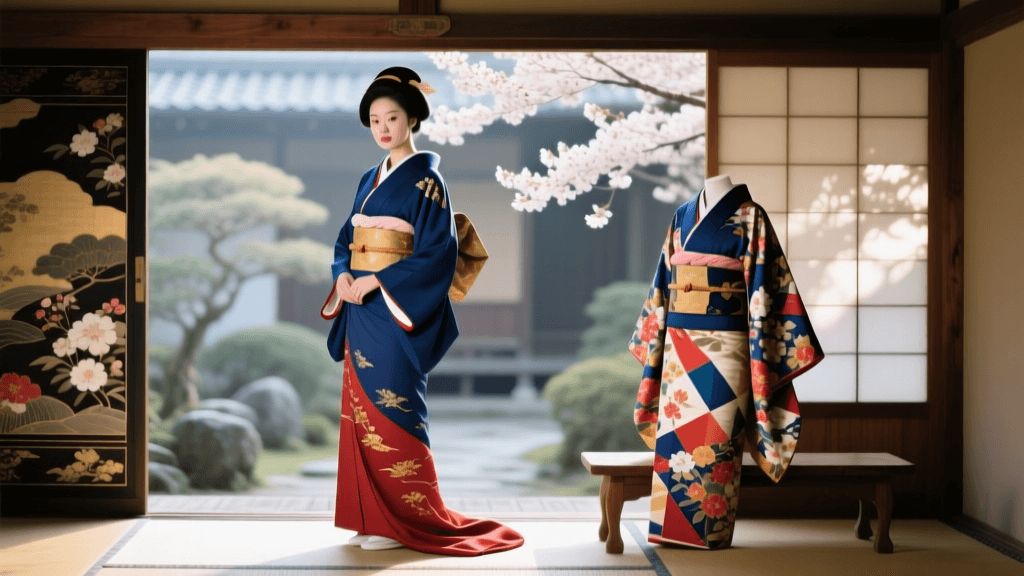
The Edo period, characterized by over two centuries of internal peace under the Tokugawa shogunate, witnessed an explosion of urban culture and merchant wealth. The kosode evolved into what we now recognize as the modern kimono. The most significant structural change during this era was the transformation of the obi. Originally a thin, utilitarian cord used simply to tie the robe closed, the obi widened dramatically, eventually becoming a rigid, heavily brocaded sash tied in elaborate knots at the back. This structural shift fundamentally altered the silhouette of the Japanese woman, restricting movement but creating a striking, columnar elegance.
Simultaneously, the invention of yuzen-zome (resist-dyeing using rice paste) by Miyazaki Yuzensai revolutionized textile design. Artisans could now paint intricate, pictorial designs directly onto silk, bypassing the strict sumptuary laws that restricted the lower classes from wearing ostentatious brocades and embroidery. Merchants expressed their wealth through hidden linings and subtle, highly technical dyeing methods like edo-komon (micro-patterns). For deeper insights into Edo-period textile preservation, the Kyoto National Museum maintains an extensive archive of these masterpieces, highlighting the technical zenith of Japanese dyeing and weaving.
Comparison Chart: Heian vs. Edo Kimono Styles
| Feature | Heian Period (Junihitoe) | Edo Period (Kosode/Kimono) |
|---|---|---|
| Primary Garment | Multi-layered unlined and lined robes | Single T-shaped kosode with wide obi |
| Aesthetic Focus | Color layering at collar and cuffs | Pictorial surface designs and obi knots |
| Weight & Mobility | Up to 20kg; highly restricted mobility | 3-5kg; restricted by tight obi binding |
| Primary Decoration | Woven silk patterns, color combinations | Yuzen resist-dyeing, embroidery, shibori |
| Social Class Focus | Imperial court aristocracy | Urban merchant class (Chonin) |
Practical Guide: Acquiring Historical Kimono Reproductions Today
For collectors, traditional arts practitioners, and fashion historians, acquiring garments that reflect these historical periods requires specific knowledge of measurements, sourcing, and artisan timelines. Whether you are seeking a vintage Edo-period piece or a modern reproduction of Heian court wear, precision is paramount.
Measurements and Sizing
Unlike Western clothing, historical Japanese garments are not sized by bust or waist, but by vertical and horizontal spans. When commissioning or purchasing, you must know your specific measurements:
- Yuki (Arm Span): Measured from the center of the back of the neck, across the shoulder, and down to the wrist bone. A standard modern yuki is 64-68cm, but historical Edo garments often feature shorter sleeves (60-62cm) due to the shorter average stature of the era.
- Miyatsukuchi (Underarm Opening): Crucial for women's kimono, this vertical slit below the sleeve allows the obi to be tied properly and provides ventilation. Ensure reproductions maintain the historical 23cm depth.
- Mitake (Back Length): Measured from the base of the neck to the ankle. Historical garments were often tailored to trail slightly on the tatami mats, requiring a custom hem allowance (hashori) when worn today.
Costs and Sourcing
The investment required for historical garments varies wildly based on authenticity and craftsmanship:
- Vintage Edo/Late-Meiji Kosode: Authentic, museum-quality antique silk kosode featuring hand-painted yuzen or gold-leaf tsujigahana can range from $1,500 to over $8,000. These should be sourced from specialized auction houses or antique textile dealers in Kyoto's Shoji-dori district.
- Modern Heian Junihitoe Reproductions: Commissioning a full, historically accurate 12-layer set from a traditional Kyoto atelier (such as those supplying the imperial household) is a major investment. Expect costs between $8,000 and $15,000, as each layer requires specific, custom-woven Heian-style silk.
- Edo-Komon Micro-Pattern Silk: For a wearable piece of Edo merchant history, a custom-bolt of Edo-komon paper-stencil dyed silk costs approximately $800 to $1,200 for the fabric alone, excluding tailoring.
Timing and Commissioning
Patience is a prerequisite for historical accuracy. If you are commissioning a traditional kyo-yuzen kimono or a Heian reproduction, the process involves multiple specialized artisans (the designer, the resist-paste applier, the dyer, and the embroiderer). Timing: Expect a lead time of 8 to 14 months. It is highly recommended to begin the commissioning process in early spring if you intend to wear the garment for a specific winter or New Year's event, as the dyeing and drying processes are heavily dependent on Kyoto's seasonal humidity and water quality.
Conclusion
The transition from the Heian court's layered junihitoe to the Edo period's boldly decorated kosode illustrates a profound shift in Japanese society—from an insular aristocracy focused on poetic subtlety to a vibrant, urban merchant class driven by technical innovation. Today, preserving and wearing these historical silhouettes is not merely an act of cosplay, but a vital continuation of Japan's textile heritage. By understanding the precise measurements, historical contexts, and artisan timelines required to acquire these garments, modern enthusiasts can ensure that the legacy of Japanese dynasty fashion continues to drape elegantly across the centuries.